Study probes potential link between cancer and a common chemical in consumer products
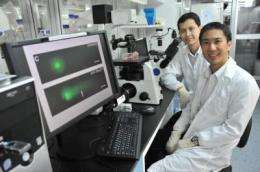
A study led by a group of Nanyang Technological University (NTU) researchers has found that a chemical commonly used in consumer products can potentially cause cancer.
The chemical, Zinc Oxide, is used to absorb harmful ultra violet light. But when it is turned into nano-sized particles, they are able to enter human cells and may damage the cells' DNA. This in turn activates a protein called p53, whose duty is to prevent damaged cells from multiplying and becoming cancerous. However, cells that lack p53 or do not produce enough functional p53 may instead develop into cancerous cells when they come into contact with Zinc Oxide nanoparticles.
The study is led by Assistant Professor Joachim Loo, 34, and Assistant Professor Ng Kee Woei, 37, from NTU's School of Materials Science and Engineering. They worked with Assistant Professor David Leong, 38, from the Department of Chemical and Biomolecular Engineering, National University of Singapore, a joint senior author of this research paper.
The findings suggest that companies may need to reassess the health impact of nano-sized Zinc Oxide particles used in everyday products. More studies are also needed on the use and concentration levels of nanomaterials in consumer products, how often a consumer uses them and in what quantities.
"Currently there is a lack of information about the risks of the nanomaterials used in consumer products and what they can pose to the human body. This study points to the need for further research in this area and we hope to work with the relevant authorities on this," said Asst Prof Loo.
The groundbreaking research findings were published in this month's edition of Biomaterials, one of the world's top journals in the field of biomaterials research. The breakthrough also validated efforts by Asst Prof Loo and Asst Prof Ng to pioneer a research group in the emerging field of nanotoxicology, which is still very much in its infancy throughout the world.
Nanotoxicology studies materials to see if they are toxic or harmful when they are turned into nano-sized particles. This is because nanomaterials usually have very different properties when compared to when the materials are of a larger size.
Asst Prof Ng said the team will carry out further research as the DNA damage brought about by nano-sized Zinc Oxide particles is currently a result of an unknown mechanism. But what is clear is that besides causing DNA damage, nanoparticles can also cause other harmful effects when used in high doses.
"From our studies, we found that nanoparticles can also increase stress levels in cells, cause inflammation or simply kill cells," said Asst Prof Ng who added that apart from finding out the cellular mechanism, more focused research is also expected to ascertain the physiological effects and damage that nano-sized Zinc Oxide particles can cause.
Asst Prof Loo pointed out that besides enhancing the understanding of the potential risks of using nanomaterials, advancements in nanotoxicology research will also help scientists put nanomaterials to good use in biomedical applications.
For example, although killing cells in our bodies is typically undesirable, this becomes a positive outcome if it can be effectively directed towards cancer cells in the body. At the same time, the team is also studying how nanomaterials can be "re-designed" to pose a lesser risk to humans, yet still possess the desired beneficial properties.
This research discovery is one of the latest in a series of biomedical breakthroughs by NTU in healthcare. Future healthcare is one of NTU's Five Peaks of Excellence with which the university aims to make its mark globally under the NTU 2015 five-year strategic plan. The other four peaks are sustainable earth, new media, the best of the East and West, and innovation.
Moving forward, the team hopes to work with existing and new collaborative partners, within and outside of Singapore, to orchestrate a more concerted effort towards the advancement of the fledgling field of nanotoxicology here, with the aim of helping regulatory bodies in Singapore formulate guidelines to protect consumer interests.
The research team would also like to work with the European Union to uncover the risks involving nanomaterials and how these materials should be regulated before they are made commercially available. Asst Prof Joachim Loo, who received his Bachelor and Doctorate degrees from NTU, was the only Singaporean representative in a recent nanotechnology workshop held in Europe. At the workshop, it was agreed that research collaborations in nanotoxicology between EU and South-east Asia should be increased.
Provided by Nanyang Technological University


