Potential new NASA mission would reveal the hearts of undead stars
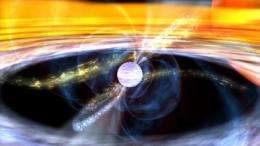
This is an artist's concept of a pulsar (blue-white disk in center) pulling in matter from a nearby star (red disk at upper right). The stellar material forms a disk around the pulsar (multicolored ring) before falling on to the surface at the magnetic poles. The pulsar's intense magnetic field is represented by faint blue outlines surrounding the pulsar. Credit: nasa
Neutron stars have been called the zombies of the cosmos, shining on even though they're technically dead, and occasionally feeding on a neighboring star if it gets too close.
They are born when a massive star runs out of fuel and collapses under its own gravity, crushing the matter in its core and blasting away its outer layers in a supernova explosion that can outshine a billion suns.
The core, compressed by gravity to inconceivable density one teaspoon would weigh about a billion tons on Earth lives on as a neutron star. Although the nuclear fusion fires that sustained its parent star are extinguished, it still shines with heat left over from its explosive formation, and from radiation generated by its magnetic field, which became intensely concentrated as the core collapsed, and can be over a trillion times stronger than Earth's.
Although its parent star could easily have been more than a million miles across, a neutron star is only about the size of a city. However, its intense gravity makes it the ultimate trash compactor, capable of packing in an astonishing amount of matter, more than 1.4 times the content of the Sun, or at least 460,000 Earths.
"A neutron star is right at the threshold of matter as it can exist if it gets any denser, it becomes a black hole," says Dr. Zaven Arzoumanian of NASA's Goddard Space Flight Center in Greenbelt, Md.
Arzoumanian is Deputy Principal Investigator on a proposed mission called the Neutron Star Interior Composition Explorer (NICER) that would unveil the dark heart of a neutron star. "We have no way of creating neutron star interiors on Earth, so what happens to matter under such incredible pressure is a mystery there are many theories about how it behaves. The closest we come to simulating these conditions is in particle accelerators that smash atoms together at almost the speed of light. However, these collisions are not an exact substitute they only last a split second, and they generate temperatures that are much higher than what's inside neutron stars."
If NASA approves it for construction, the mission will be launched by the summer of 2016 and attached robotically to the International Space Station. In September 2011, NASA selected NICER for study as a potential Explorer Mission of Opportunity. The mission will receive $250,000 to conduct an 11-month implementation concept study. Five Mission of Opportunity proposals were selected from 20 submissions. Following the detailed studies, NASA plans to select for development one or more of the five Mission of Opportunity proposals in February 2013.
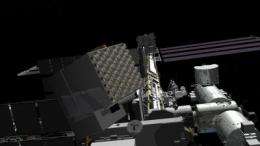
This is an artist's concept of the NICER instrument on board the International Space Station. NICER is the cube in the foreground on the left. The circular objects protruding from the cube are telescopes that focus X-rays from the pulsar on to the detector. Credit: NASA
NICER's array of 56 telescopes will collect X-rays generated both from hotspots on a neutron star's surface and from its powerful magnetic field. There are two hotspots on a neutron star at opposite sides, one at each magnetic pole, the place where the star's intense magnetic field emerges from the surface. Here, particles trapped in the magnetic field rain down and generate X-rays when they strike the surface. X-rays are an energetic form of light invisible to human eyes but detectable by special instruments. As the hotspots rotate into our line of sight, they produce a pulse of light, like a lighthouse beam, giving rise to the stars' alternate name, pulsars.Many pulsars flash several times per second, because of the rapid rotation they inherit as they are born. All stars rotate, and as the parent star's core shrinks, it spins faster, like a twirling ice skater pulling in her arms. A neutron star's powerful gravity can also pull in gas from a neighboring star if it orbits too closely. This infalling gas can spin up a neutron star to even higher speeds; some rotate hundreds of times per second.
The key to understanding how matter behaves inside a neutron star is pinning down the correct Equation Of State (EOS) that most accurately describes how matter responds to increasing pressure. Currently, there are many suggested EOSs, each proposing that matter can be compressed by different amounts inside neutron stars. Suppose you held two balls of the same size, but one was made of foam and the other was made of wood. You could squeeze the foam ball down to a smaller size than the wooden one. In the same way, an EOS that says matter is highly compressible will predict a smaller neutron star for a given mass than an EOS that says matter is less compressible.
So if researchers know a neutron star's mass, all they need to do is find out how big it is to get the correct EOS and unlock the secret of what matter does under extreme gravity. "The problem is that neutron stars are small, and much too far away to allow their sizes to be measured directly," says NICER Principal Investigator Dr. Keith Gendreau of NASA Goddard. "However, NICER will be the first mission that has enough sensitivity and time-resolution to figure out a neutron star's size indirectly. The key is to precisely measure how much the brightness of the X-rays changes as the neutron star rotates."
This change in brightness with time is called a star's light curve, and it appears as a wavy line on a graph.
Because neutron stars pack so much mass into such a tiny volume, they generate strong gravity that actually bends space (and distorts time) in accordance with Einstein's theory of General Relativity. This warping of space enables researchers to determine a neutron star's mass if it has a nearby companion, either another neutron star or a white dwarf, a lower-density object that is the core remnant of a less-massive star. Neutron stars with these companions are actually fairly common.
The warping of space produces effects like an orbital shift called precession, which makes the orbit move like a hula-hoop around a dancer. Also, as the neutron star and its companion move around each other, they create ripples in space called gravitational waves. These waves carry away orbital energy, so the neutron star and its companion gradually move closer together and their orbit shrinks. NICER will measure these effects over time, and the greater these effects, the more mass the neutron star has.
Warped space also will let the NICER team figure out a neutron star's size. Suppose we have a neutron star lined up so that you can only see one hotspot, the one on the near side that faces us. As it rotates into view, the brightness increases until the hotspot is pointed directly at us, then the brightness decreases as it rotates away.
This alignment makes the star's brightness highly variable it's quite bright when the hotspot is pointed at us, and very dim when the hotspot is on the far side out of our view. The drastic change in brightness produces a light curve with large waves, with deep troughs when the star is dim.
However, since light must follow the contours of space, warped space bends light. The distorted space around the neutron star bends its light so much that you can see parts of the far side, including the other hotspot. With the second hotspot visible, at least part of the time, you have bright light more often, so the brightness doesn't change as much. This makes a light curve that appears smoother, with smaller waves.
If a woman wearing stiletto heels walks on a trampoline, she will warp the surface more than if she wears snowshoes. In the same way, the more compact a neutron star is, the more it will bend space and light. This will allow us to see the far-side hotspot more often, which will make its X-ray brightness less variable, and the star will produce a smoother light curve.
The team has models that produce unique light curves for the various sizes predicted by different EOSs. By choosing the light curve that best matches the observed one, they will get the correct EOS and solve the riddle of matter on the edge of oblivion.
Provided by
NASA's Goddard Space Flight Center
-
From lemons to lemonade: Reaction uses carbon dioxide to make carbon-based semiconductor,
32 comments
-
Thioridazine kills cancer stem cells in human while avoiding toxic side-effects of conventional cancer treatments,
3 comments
-
SpaceX private rocket blasts off for space station (Update),
42 comments
-
Climate scientists say they have solved riddle of rising sea,
31 comments
-
SpaceX capsule has 'new car' smell, astronauts say (Update),
4 comments
-
Distance of planets from stars and revolution
7 hours ago
-
revamping general concept and cosmological principle
May 25, 2012
-
Transiting Exoplanet Light Curve
May 25, 2012
-
Math behind Theoretical Physics
May 24, 2012
-
Do we know whats at the center of galaxies yet?
May 23, 2012
-
Structure of the Milky Way?
May 20, 2012
- More from Physics Forums - General Astronomy
More news stories
Land and sea species differ in climate change response: study
(Phys.org) -- Marine and terrestrial species will likely differ in their responses to climate warming, new research by Simon Fraser University and Australia’s University of Tasmania has found.
5 hours ago |
3.7 / 5 (3) |
5
|
Yale study concludes public apathy over climate change unrelated to science literacy
Are members of the public divided about climate change because they don't understand the science behind it? If Americans knew more basic science and were more proficient in technical reasoning, would public consensus match ...
7 hours ago |
4.8 / 5 (5) |
15
|
10 million years needed to recover from mass extinction
It took some 10 million years for Earth to recover from the greatest mass extinction of all time, latest research has revealed.
Space & Earth / Earth Sciences
7 hours ago |
4 / 5 (4) |
1
|
Sophisticated simulations predict future warming
The chances of our planet being hit by a global warming of 3 degrees Celsius by 2050 is as likely as it being hit by an increase of 1.4 degrees, new research shows. Presented in the journal Nature Geoscience, the British study ...
Space & Earth / Earth Sciences
May 22, 2012 |
4.4 / 5 (9) |
51
Aliens don't want to eat us, says former SETI director
Alien life probably isnt interested in having us for dinner, enslaving us or laying eggs in our bellies, according to a recent statement by former SETI director Jill Tarter.
Space & Earth / Space Exploration
May 25, 2012 |
4.4 / 5 (15) |
41
Stunning image of smallest possible five-ringed structure
Scientists have created and imaged the smallest possible five-ringed structure about 100,000 times thinner than a human hair and you'll probably recognise its shape.
'Unzipped' carbon nanotubes could help energize fuel cells, batteries
Multi-walled carbon nanotubes riddled with defects and impurities on the outside could replace some of the expensive platinum catalysts used in fuel cells and metal-air batteries, according to scientists at ...
Change in developmental timing was crucial in the evolutionary shift from dinosaurs to birds: study
At first glance, it's hard to see how a common house sparrow and a Tyrannosaurus Rex might have anything in common. After all, one is a bird that weighs less than an ounce, and the other is a dinosaur that ...
Computer model used to pinpoint prime materials for efficient carbon capture
When power plants begin capturing their carbon emissions to reduce greenhouse gases and to most in the electric power industry, it's a question of when, not if it will be an expensive undertaking.
T cells 'hunt' parasites like animal predators seek prey, study shows
By pairing an intimate knowledge of immune-system function with a deep understanding of statistical physics, a cross-disciplinary team at the University of Pennsylvania has arrived at a surprising finding: T cells use a movement ...
Scientists develop ultra-sensitive test that detects diseases in their earliest stages
Scientists have developed an ultra-sensitive test that should enable them to detect signs of a disease in its earliest stages, in research published today in the journal Nature Materials.

Nov 09, 2011
Rank: 4.4 / 5 (10)
Nov 09, 2011
Rank: 2 / 5 (1)
I understand that the mathematics we currently employ predict it, but how can we be sure there isn't more physics beyond what we've learned? Are we really sure there are no forms of degenerate matter with pressures to sustain some kind of structure with a diameter less than the schwarzschild radius?
For example, have physicists in fact calculated whether it's possible for particles to become so tightly packed that they can not even emit EM radiation, forming a perfect black body below the event horizon? A neutron star is obviously still emitting light, which should prove undoubtedly that matter is still not compacted to it's full potential, right? Emitting EM radiation implies vibration, doesn't it?
I suspect the fact that a neutron star shines in itself is evidence of more physics, that there is more structure beneath an event horizon. Any thoughts?
Nov 09, 2011
Rank: 5 / 5 (3)
**insert joke about zombie movies here**
Nov 09, 2011
Rank: not rated yet
"One measure of such immense gravity is the fact that neutron stars have an escape velocity of around 100,000 km/s, about a third the speed of light. Matter falling onto the surface of a neutron star would be accelerated to tremendous speed by the star's gravity. The force of impact would likely destroy the object's component atoms, rendering all its matter identical, in most respects, to the rest of the star."
That's honestly amazing. :D
Nov 09, 2011
Rank: not rated yet
If a neutron star collapses to the point of becoming a sphere of pure quark gluon plasma, would that objects radius be below the schwarzschild radius?
If not then how well do we understand quark gluon plasma? Are we sure that such a substance cannot be further compressed without collapsing into a singularity?
I'm making my mind feel broken trying to imagine something beyond neutron degeneracy pressure and trying to understand quark gluon plasma.
... maybe I'm just retarded, I probably asked stupid questions.
Nov 09, 2011
Rank: 5 / 5 (5)
Well, any body with a temperature above absolute zero is going to emit electromagnetic radiation, unless there are zero electrical charges. Even neutrons have charges inside of them. Temperature implies vibration/movement, which means that any charges present will move randomly. This random motion includes times where the particles are accelerating, and an accelerating charge emits light.
And currently, we know of no force that can withstand the pull of gravity after a certain point. We see that from the Tolman-Oppenheimer-Volkoff equation (see the wiki entry) that there exists a certain radius for a given mass where the pressure needed to counter-balance the gravity goes to infinity. This occurs for any matter we've yet dreamed of. See wiki: TOV limit.
There are proposals for a quark star, but no observational evidence.
Nov 09, 2011
Rank: not rated yet
Nov 09, 2011
Rank: 1 / 5 (12)
"The hearts of stars" are not dead, but ALIVE!
Neutron stars are called "zombies" by those who think reality depends on their consensus models of reality.
"Technically dead"?
What arrogant nonsense! Study nuclear rest mass data and see for yourself that neutron stars are energized by repulsive interactions between neutrons:
www.omatumr.com/D...Data.htm
Or study any of these peer-reviewed papers:
www.omatumr.com/a...tnuc.pdf
www.springerlink....6685079/
www.springerlink....ak3lyrc/
http://arxiv.org/.../0404064
http://arxiv.org/.../0501441
http://arxiv.org/...2.1499v1
Reality does not depend on models promoted by Al Gore, NAS, UN, RS or world leaders.
Reality is "What Is."
With kind regards,
Oliver K. Manuel
http://myprofile....m/manuel
Nov 09, 2011
Rank: 5 / 5 (4)
I guess my ramblings are coming to the following: pressure provides extra gravity in relativity.
We can calculate how much the gravity increases as we change the radius a little bit. And so we know the extra pressure needed to keep the star from collapsing. But the addition of more pressure adds some more force to the gravity, so we really need to add more pressure than we expect initially. There is a mass/radius ratio after which the addition of more pressure increases the gravity more than can be compensated, leading to a runaway collapse.
This seems to be a general feature to any equation of state (pressure vs. density & temperature). I hope I answered some of your concerns. I seem to have been all over the place in my response...
Nov 09, 2011
Rank: not rated yet
Also as the hot spot spins around, there will be a blue and red shift showing up in each rotation. This should give a very strong indication of the size. Normally you could expect that a shift in a broad spectrum would not be observable, but since some of these spin at a good fraction the speed of light the whole spectrum should be observable.
Nov 10, 2011
Rank: 5 / 5 (2)
You insist there is such a thing as neutron repulsion. You insist it is strong enough to stop the formation of black holes, not just stellar black holes but ALL black holes no matter what the size. Also it you claim it is long ranged enough to sunder galaxies. Though you refuse to answer any question about its actual strength or range those claims make it clear that it MUST be more powerful than gravity per unit of mass even if the mass is mostly hydrogen atoms as we can see makes up most the mass in the in the Universe, based on your denial of Dark Matter that is.
It really doesn't require a great deal of effort to notice that there is a severe problem with that set of claims. They make galaxies, stars, even neutron stars, planets and pretty much everything held together by gravity impossible.>>
Please explain this contradiction of reality that is an inevitable conclusion based on your own claims for Neutron Repulsion.
Ethelred
Nov 10, 2011
Rank: 5 / 5 (2)
Well to your first question, I was going to suggest wikipedia, but now that you've done that, I'll extrapolate.
For this question, the answer is actually hinted at in the article. The energy level is much less in a neutron star than a particle accelerator. However, the density and gravity are much higher.
It is not a quark gluon matter, it is a 'degenerate' matter state.
Continued
Nov 10, 2011
Rank: 5 / 5 (2)
The current theory that only gives neutron stars (including pulsars/masars) and black holes is based on best guesses on degeneracy pressure of neutrons and EOS.
If they found that they were significantly off on their estimates, it would have significant implications to our view of these types of 'stars' - just like you noted - and they would have to rewrite the science/cosmology/physics books.
So in conclusion, with the current estimates on quantum mechanics and astrophysics, this is the current 'correct' view of star architecture. However, since this view is based on estimates - This may not necessarily be the way things are - and those scenarios have been explored.
Nov 10, 2011
Rank: 5 / 5 (2)
Nov 10, 2011
Rank: 4 / 5 (4)
http://www.homefa...uel.html
http://mominer.ms...hildren/