Does the Pluto system pose a threat to New Horizons?
November 10, 2011 by Tammy Plotner, Universe Today
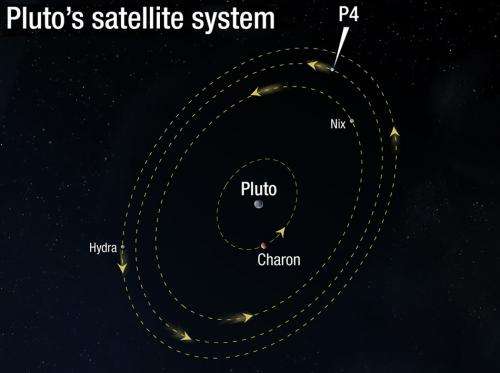
Pluto's newest found moon, P4, orbits between Nix and Hydra, both of which orbit beyond Charon. Could there be still more moons of Pluto? Perhaps, and the New Horizons team plans to look harder to ensure that we don't run into something that could damage or destroy New Horizons.
With nearly two-thirds of its journey complete, the New Horizons spacecraft is still alive and well. It recently experienced a hibernation wakeup which started on November 5th and will last until November 15th and it will sleep again until a month-long call in January. However, the real wakeup call may be when it reaches the complicated Pluto system. Watch out for that rock!
As more and more moons are discovered around Pluto, the higher the probability becomes of one of them or debris surrounding them could impact the delicate probe. With P4 discovered just a few short months ago, scientists are beginning to wonder just how many more are there which are too small and faint to be seen.
Says New Horizons Principal Investigator Alan Stern: Even more worrisome than the possibility of many small moons themselves is the concern that these moons will generate debris rings, or even 3-D debris clouds around Pluto that could pose an impact hazard to New Horizons as it flies through the system at high speed. After all, at our 14-kilometer-per-second flyby speed, even particles less than a milligram can penetrate our micrometeoroid blankets and do a lot of damage to electronics, fuel lines and sensors.
To enable research into what might be a prospective problem, the New Horizons team brought together about 20 of the worlds experts in ring systems, orbital dynamics and state-of-the-art astronomical observing techniques to search for small satellites and rings at distant Pluto. During a two day workshop, the group hashed and rehashed every possible scenario including all the hazards that a small moon and debris-strewn system might cause.
We found a plausible chance that New Horizons might face real danger of a killer impact; and that to mitigate that hazard, we need to undertake two broad classes of work. said Stern. First, we need to look harder at the Pluto system for still undiscovered satellites and rings. The best tools for this are going to be the Hubble Space Telescope, some very large ground-based telescopes, telescopes that can make stellar occultation observations of the space between Pluto and Charon where New Horizons is currently targeted, and thermal observations of the system by the ALMA radio telescope array just now being commissioned.
The next step is planning planning on a possible safer route through the Pluto system in the event that observations confirm navigational hazards. Studies presented at the Encounter Hazards Workshop show a good safe haven bailout trajectory (or SHBOT) could be designed to target a closest-approach aim point about 10,000 kilometers farther than the nominal mission trajectory. In this case, it would be a matter of aiming more towards Charons orbit, where the moon itself has cleared a path. However, even 180 degrees away on closest approach may not be enough. Theres always a chance of a debris field one that doesnt follow a plane, but has created a torus. In this event, material could be sailing along at speeds of up to 1-2 kilometers per second. Enough to annihilate delicate instruments.
The question of whether the Pluto system could be hazardous to New Horizons remains open but one well be studying hard over the next year, with everything from computer models to big ground-based telescopes to the Hubble. concludes Stern. Ill report on results as we obtain them, but it is not lost on us that there is a certain irony that the very object of our long-held scientific interest and affection may, after so many years of work to reach her, turn out to be less hospitable than other planets have been. Well see.
Source: Universe Today
-
From lemons to lemonade: Reaction uses carbon dioxide to make carbon-based semiconductor,
32 comments
-
Thioridazine kills cancer stem cells in human while avoiding toxic side-effects of conventional cancer treatments,
3 comments
-
SpaceX private rocket blasts off for space station (Update),
42 comments
-
Climate scientists say they have solved riddle of rising sea,
31 comments
-
SpaceX capsule has 'new car' smell, astronauts say (Update),
4 comments
-
Distance of planets from stars and revolution
7 hours ago
-
revamping general concept and cosmological principle
May 25, 2012
-
Transiting Exoplanet Light Curve
May 25, 2012
-
Math behind Theoretical Physics
May 24, 2012
-
Do we know whats at the center of galaxies yet?
May 23, 2012
-
Structure of the Milky Way?
May 20, 2012
- More from Physics Forums - General Astronomy
More news stories
Land and sea species differ in climate change response: study
(Phys.org) -- Marine and terrestrial species will likely differ in their responses to climate warming, new research by Simon Fraser University and Australia’s University of Tasmania has found.
5 hours ago |
3.7 / 5 (3) |
5
|
Yale study concludes public apathy over climate change unrelated to science literacy
Are members of the public divided about climate change because they don't understand the science behind it? If Americans knew more basic science and were more proficient in technical reasoning, would public consensus match ...
7 hours ago |
4.8 / 5 (5) |
15
|
10 million years needed to recover from mass extinction
It took some 10 million years for Earth to recover from the greatest mass extinction of all time, latest research has revealed.
Space & Earth / Earth Sciences
7 hours ago |
4 / 5 (4) |
1
|
Sophisticated simulations predict future warming
The chances of our planet being hit by a global warming of 3 degrees Celsius by 2050 is as likely as it being hit by an increase of 1.4 degrees, new research shows. Presented in the journal Nature Geoscience, the British study ...
Space & Earth / Earth Sciences
May 22, 2012 |
4.4 / 5 (9) |
51
Aliens don't want to eat us, says former SETI director
Alien life probably isnt interested in having us for dinner, enslaving us or laying eggs in our bellies, according to a recent statement by former SETI director Jill Tarter.
Space & Earth / Space Exploration
May 25, 2012 |
4.4 / 5 (15) |
41
Stunning image of smallest possible five-ringed structure
Scientists have created and imaged the smallest possible five-ringed structure about 100,000 times thinner than a human hair and you'll probably recognise its shape.
'Unzipped' carbon nanotubes could help energize fuel cells, batteries
Multi-walled carbon nanotubes riddled with defects and impurities on the outside could replace some of the expensive platinum catalysts used in fuel cells and metal-air batteries, according to scientists at ...
Change in developmental timing was crucial in the evolutionary shift from dinosaurs to birds: study
At first glance, it's hard to see how a common house sparrow and a Tyrannosaurus Rex might have anything in common. After all, one is a bird that weighs less than an ounce, and the other is a dinosaur that ...
Computer model used to pinpoint prime materials for efficient carbon capture
When power plants begin capturing their carbon emissions to reduce greenhouse gases and to most in the electric power industry, it's a question of when, not if it will be an expensive undertaking.
T cells 'hunt' parasites like animal predators seek prey, study shows
By pairing an intimate knowledge of immune-system function with a deep understanding of statistical physics, a cross-disciplinary team at the University of Pennsylvania has arrived at a surprising finding: T cells use a movement ...
Scientists develop ultra-sensitive test that detects diseases in their earliest stages
Scientists have developed an ultra-sensitive test that should enable them to detect signs of a disease in its earliest stages, in research published today in the journal Nature Materials.
Nov 10, 2011
Rank: 5 / 5 (1)
Nov 10, 2011
Rank: 4.2 / 5 (5)
Nov 10, 2011
Rank: 5 / 5 (3)
From Wikipedia:
"Pioneer 11 imaged and nearly collided with one of Saturn's small moons, passing at a distance of no more than 4,000 kilometers (2,500 mi). The object was tentatively identified as Epimetheus, a moon discovered the previous day from Pioneer's imaging, and suspected from earlier observations by Earth-based telescopes. After the Voyager flybys, it became known that there are two similarly-sized moons (Epimetheus and Janus) in the same orbit, so there is some uncertainty about which one was the object of Pioneer's near-miss. Pioneer 11 encountered Janus on September 1, 1979 at 14:52 UTC at a distance of 2500 km and Mimas at 16:20 UTC the same day at 103000 km."
Hopefully no disastrous close calls befall New Horizons at Pluto!
Nov 10, 2011
Rank: 5 / 5 (3)
Nov 10, 2011
Rank: 4 / 5 (4)
It's a dwarf planet. All the bigger planets made fun of it and made it wrestle with all the other dwarf planets.
And it's 'cold', not 'cool'.
Nov 11, 2011
Rank: 5 / 5 (5)
What are the odds that a moon (even if there are 10 undiscovered ones) hits the probe. Should be pretty slim (but weird stuff sometimes does - almost - happen, as yyz's post demonstrates).
But even so - the probe probably could do not much about it if it discovered such an object onits path. Let's just hope. Otherwise we'll just get some very good closeups of the new moon.
Nov 11, 2011
Rank: 5 / 5 (1)
Maybe something like this: http://www.youtub...ifHgZyrg
Nov 13, 2011
Rank: 5 / 5 (1)
Nov 14, 2011
Rank: 5 / 5 (1)
I'd like to point out that it isn't exactly a fine line between 'debris' and 'moon'. it is possible that there are many very small objects orbiting pluto that have more than sufficient mass to destroy the probe. I think that is the crux of the issue.
That said, they do have one thing going for them. An undiscovered 'moon' or 'moonlet' is much less likely to have serious gravitational affects on the probe, whereas undiscovered moons on the voyager trips could influence a probe and pull it into harm's way as well.
Nov 14, 2011
Rank: 5 / 5 (1)
I think you're on the right track there, tg. Think of the probe being peppered with microparticles like those found in the dark diaphanous rings of, say, Neptune or Saturn:
http://en.wikiped..._Neptune
http://en.wikiped...er_rings
That could possibly be a mission-ending event, and more likely than an impact with a more massive Plutonian "moonlet".