Study finds pigeons use bodies to turn rather than wing force
November 29, 2011 by Bob Yirka report

Pigeon

Pigeon

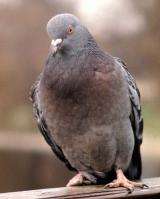
(PhysOrg.com) -- In a rather surprising turn of events, it appears pigeons use their body to make sharp turns, rather than stronger wing strokes when flying. This bit of news comes from Ivo Ros of Harvard University and his colleagues who have been studying the bird’s flight skills with high speed cameras. They have published their results in the Proceedings of the National Academy of Sciences.

Intuitively, it might seem, at least to humans who have no natural of course, that to turn, especially when sharp angles are involved, that flailing the wing harder or faster that is opposite the turn would be the most natural way to proceed. After all, that’s the approach us humans would use in water for instance, in trying to turn quickly. But that’s not how birds operate, at least not pigeons. Ros and his team set up nine high-speed synchronized cameras in a hall that had a ninety degree turn in the middle of it. They then marked a pigeon in sixteen places to track just exactly how each body part moved as it flew. They then set the bird to flying the hallway, capturing every detail and noting precisely what goes on with its body, wings, and tail as it turns. Surprisingly, it turned out that the pigeon neither flapped faster or harder, opting instead to simply turn or roll its body to adjust for the turn and allowing its wings to flap as they would were the bird heading straight. Once through the turn, the bird then readjusted its body to enable straight ahead flight.

While all this may not seem all that remarkable, after all, the have likely been turning in flight for more years than we have held interest in how they do so, the observations may provide important information for people wishing to improve on clunky old human flight, or more specifically, when trying to build drones that can fly better than what is available today.

It’s not hard to imagine the difference. Sending a drone down a narrow hall where it must negotiate a ninety degree turn is quite frankly, impossible at this point, though a helicopter, which perhaps not coincidently turns in ways very similar to the pigeon, could do it with ease. This is because it can slow down without losing lift. But if the drone could be made to maneuver its as it turns, perhaps then it could perform maneuvers that the common pigeon takes for granted.

More information: Pigeons steer like helicopters and generate down- and upstroke lift during low speed turns, PNAS, Published online before print November 28, 2011, doi: 10.1073/pnas.1107519108

Abstract
Turning is crucial for animals, particularly during predator–prey interactions and to avoid obstacles. For flying animals, turning consists of changes in (i) flight trajectory, or path of travel, and (ii) body orientation, or 3D angular position. Changes in flight trajectory can only be achieved by modulating aerodynamic forces relative to gravity. How birds coordinate aerodynamic force production relative to changes in body orientation during turns is key to understanding the control strategies used in avian maneuvering flight. We hypothesized that pigeons produce aerodynamic forces in a uniform direction relative to their bodies, requiring changes in body orientation to redirect those forces to turn. Using detailed 3D kinematics and body mass distributions, we examined net aerodynamic forces and body orientations in slowly flying pigeons (Columba livia) executing level 90° turns. The net aerodynamic force averaged over the downstroke was maintained in a fixed direction relative to the body throughout the turn, even though the body orientation of the birds varied substantially. Early in the turn, changes in body orientation primarily redirected the downstroke aerodynamic force, affecting the bird’s flight trajectory. Subsequently, the pigeon mainly reacquired the body orientation used in forward flight without affecting its flight trajectory. Surprisingly, the pigeon’s upstroke generated aerodynamic forces that were approximately 50% of those generated during the downstroke, nearly matching the relative upstroke forces produced by hummingbirds. Thus, pigeons achieve low speed turns much like helicopters, by using whole-body rotations to alter the direction of aerodynamic force production to change their flight trajectory.

Journal reference: Proceedings of the National Academy of Sciences search and more info website

© 2011 PhysOrg.com

4.3 /5 (7 votes)  

Filter


Move the slider to adjust rank threshold, so that you can hide some of the comments.


Display comments: newest first

axemaster
Nov 29, 2011

Rank: not rated yet
Sending a drone down a narrow hall where it must negotiate a ninety degree turn is quite frankly, impossible at this point, though a helicopter, which perhaps not coincidently turns in ways very similar to the pigeon, could do it with ease.

Why do these articles always wind up talking about weapons? Why is there such an obsession with finding new and more effective ways to kill people?
DavidMcC
Nov 29, 2011

Rank: 5 / 5 (2)
This is kid's stuff surely! Anyone who's watched a bird fly (or sat in an airliner, for that matter) knows that tilting the body/fuselage is the efficient way to make a turn for a bird or an aeroplane.
Ity's known as "banking" (non-financial kind!).
jakack
Nov 29, 2011

Rank: 1 / 5 (1)
Sending a drone down a narrow hall doesn't really imply it's use as a weapon. However, I do think you are right that a lot of tech is readily applied towards weaponry in a lot of peoples minds. It could be due to the drive towards protecting innocent life during the process of the necessary killing of an enemy. And then of course weaponry is where the money is. I would compare it to toilet plungers...It's use is ugly, but often times necessary.

Could the use of heavy wheeled gyroscopes mounted in aircraft or vehicles allow for the same type of "body movement"? I'm sure high g-forces and falling out of the sky might be an obstacle to this idea. Don't rockets have this type of technology already?
DavidMcC
Nov 29, 2011

Rank: not rated yet
... I've also watched vanessid butterflies (eg, commas) use exactly the same method to stear a course in a "fuel efficient" manner (which butterflies are famous for - the reason that the military have studied them using wind-tunnels).
jakack
Nov 29, 2011

Rank: 1 / 5 (1)
This is kid's stuff surely! Anyone who's watched a bird fly (or sat in an airliner, for that matter) knows that tilting the body/fuselage is the efficient way to make a turn for a bird or an aeroplane.


I think the article is saying that the birds don't just tilt like an airplane. From what I imagine it probably looks like a swimmer making laps in a pool...the most effective way to turn to the opposite direction is not to make a gradual turn, but to orient your entire body in the opposite direction.
theknifeman
Nov 29, 2011

Rank: 1 / 5 (1)
Thank GOD they have finally found this to be the case! I have been contemplating this for decades... wings or a shift of the body to alter the center of gravity by way of a muscular structure instead of a rigid frame. Thankfully it will be in the Proceedings of the National Academy of Sciences for me to reference. That or I think it is an idiotic waste of time to research what is clearly obvious, and did not require research time or money. I forget which. On the plus side the researchers are now published experts.
Isaacsname
Nov 29, 2011

Rank: not rated yet
Yep, birdies have flexible frames that allow them to shift their centers of gravity, ...on the fly....sort of reminds me of zero-propellent maneuvering.
theknifeman
Nov 29, 2011

Rank: 3.3 / 5 (3)
Yep, birdies have flexible frames that allow them to shift their centers of gravity, ...on the fly....sort of reminds me of zero-propellent maneuvering.


These researchers could have just contacted the mechanical engineers who designed hang gliders. If they haven't all died from old age yet... My point being they are repeating the known and obvious and publishing it in a scientific journal. There should be a study on how much research time is wasted on foolery.

Signed,
Captain obvious.
Husky
Nov 29, 2011

Rank: not rated yet
dred and double dredd, get that fast turning pigeon!
rah
Nov 29, 2011

Rank: 5 / 5 (1)
So I'm thinking that adding a rotatable weight inside an aircraft would improve it's turning performance. Whether that performance improvement is greater than the penalty of carrying the extra weight is beyond me at this moment. I'm sitting at home in my drawers with a bottle of San Pellegrino.
Isaacsname
Nov 29, 2011

Rank: 3 / 5 (2)
Yep, birdies have flexible frames that allow them to shift their centers of gravity, ...on the fly....sort of reminds me of zero-propellent maneuvering.


These researchers could have just contacted the mechanical engineers who designed hang gliders. If they haven't all died from old age yet... My point being they are repeating the known and obvious and publishing it in a scientific journal. There should be a study on how much research time is wasted on foolery.

Signed,
Captain obvious.


Too true, there are things that are lost and rediscovered years later, all the time. There's nothing like expending time and energy into a project only to find somebody already did it.

Eventually we'll be linked into them, like the Beastmaster.

Remember that movie ?

SCREEEEEEEEEEEEEEEEEEEEEEE
LKD
Nov 29, 2011

Rank: 5 / 5 (1)
No matter what, at least their work could be sold to Pixar to aid in better movie graphics.
DavidMcC
Nov 30, 2011

Rank: not rated yet

I think the article is saying that the birds don't just tilt like an airplane. From what I imagine it probably looks like a swimmer making laps in a pool...the most effective way to turn to the opposite direction is not to make a gradual turn, but to orient your entire body in the opposite direction.

No, it's mainly attacking a straw man version of how birds change direction, as if they had to beat one wing faster than the other as their "normal" way of changing course!
packrat
Dec 03, 2011

Rank: not rated yet
I watched a Bluejay last summer for about 1/2 hour. He seemed to be practicing power slide turns around the corner of our house. He would fly almost to the corner, stop flapping and flip his whole body sideways and then start flapping again. He was doing almost 90% turns within a foot of the side of the house. It was interesting to watch being done. He was pretty good at it by the time he quit and finally flew off.
Rank 4.3 /5 (7 votes)
Relevant PhysicsForums posts

More news stories

Manufacturing genes to attack flu virus

An international research team has manufactured a new protein that can combat deadly flu epidemics.

Biology / Biotechnology

created 7 hours ago | popularity not rated yet | comments 0 | with audio podcast

Scientist: Evolution debate will soon be history

(AP) -- Richard Leakey predicts skepticism over evolution will soon be history. Not that the avowed atheist has any doubts himself.

Biology / Evolution

created May 26, 2012 | popularity 3.5 / 5 (20) | comments 93

More plant species responding to global warming than previously thought

(Phys.org) -- Far more wild plant species may be responding to global warming than previous large-scale estimates have suggested.

Biology / Ecology

created May 22, 2012 | popularity 4.6 / 5 (14) | comments 18 | with audio podcast

For monogamous sparrows, it doesn't pay to stray (but they do it anyway)

It's quite common for a female song sparrow to stray from her breeding partner and mate with the male next door, but a new study shows that sleeping around can be costly.

Biology / Plants & Animals

created May 22, 2012 | popularity 5 / 5 (2) | comments 8 | with audio podcast

Thousands of shellfish found dead in Peru

Thousands of crustaceans were found dead off the coast of Lima following the mystery mass death of dolphins and pelicans, the Peruvian Navy said Friday.

Biology / Ecology

created May 26, 2012 | popularity 4.7 / 5 (7) | comments 7


Stunning image of smallest possible five-ringed structure

Scientists have created and imaged the smallest possible five-ringed structure – about 100,000 times thinner than a human hair – and you'll probably recognise its shape.

'Unzipped' carbon nanotubes could help energize fuel cells, batteries

Multi-walled carbon nanotubes riddled with defects and impurities on the outside could replace some of the expensive platinum catalysts used in fuel cells and metal-air batteries, according to scientists at ...

Change in developmental timing was crucial in the evolutionary shift from dinosaurs to birds: study

At first glance, it's hard to see how a common house sparrow and a Tyrannosaurus Rex might have anything in common. After all, one is a bird that weighs less than an ounce, and the other is a dinosaur that ...

Computer model used to pinpoint prime materials for efficient carbon capture

When power plants begin capturing their carbon emissions to reduce greenhouse gases – and to most in the electric power industry, it's a question of when, not if – it will be an expensive undertaking.

T cells 'hunt' parasites like animal predators seek prey, study shows

By pairing an intimate knowledge of immune-system function with a deep understanding of statistical physics, a cross-disciplinary team at the University of Pennsylvania has arrived at a surprising finding: T cells use a movement ...

Land and sea species differ in climate change response: study

(Phys.org) -- Marine and terrestrial species will likely differ in their responses to climate warming, new research by Simon Fraser University and Australia’s University of Tasmania has found.