Closing the phosphorus-efficiency gap
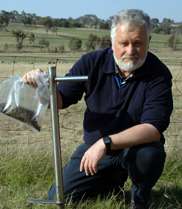
Dr. Richard Simpson has been part of a team of CSIRO and other scientists researching the phosphorus efficiency of Australian agricultural soils.
(PhysOrg.com) -- Ways to reduce the costs of phosphorus fertiliser use on farms critical for sustaining high agricultural production in many Australian farming systems have been identified in a new suite of journal papers.
The price for phosphorus is increasing steadily and has doubled over the last 10 years.
Providing a national review of phosphorus use in grazing and cropping systems, Australian and international scientists found that Australias pasture systems, on average, have low phosphorus-use efficiency (15-30 per cent) while most broadacre grain operations average around 50-60 per cent efficiency.
They say that the major avenue for addressing inefficiencies and increases in phosphorus fertiliser cost could be addressed through improving fertilizer technologies; breeding plants that can more efficiently take up phosphorus from the soil or grow better in lower-phosphorus soils; and applying the right amounts of phosphorus fertilizers at the right times.
According to Dr. Richard Simpson from CSIROs Sustainable Agriculture Flagship, with a few exceptions, improvements in using phosphorus efficiently have been stalled for years.
Ideally we would like to be applying only one kilogram of phosphorus as fertilizer to produce one kilogram of phosphorus in food and fibre products, Dr. Simpson said.
But for every kilogram of phosphorus that ends up in farm products, usually two to four kilograms of phosphorus has been added to the soil in fertiliser. This is because most Australian soils tend to hold on to phosphorus when they are fertilized and plants cant access it.
We really cant afford to continue doing that. From a dollar point of view, improved efficiency will mean we can reduce costs for our farmers, but also, high-quality phosphorus reserves are a finite global resource the more effectively we use phosphorus the better global citizens we will be, Dr. Simpson said.
This latest work is showing us how we may be able to achieve improved efficiency through improved practices and technologies.
Globally, phosphorus fertilizers are an important input for producing food. For most Australian farms, using phosphorus fertilizer (along with other inputs like nitrogen and water) ensures high production per hectare therefore helping to minimise overhead costs and support more efficient use of land and other resources. This helps Australian enterprises to maximize their returns on investment and maintain their global competitiveness.
Unfortunately, the price of fertilizer has doubled over the last decade and some meat and wool producers are deciding to forego productivity gains as they need to reduce stocking rates, Dr. Simpson said.
In addition, the cost of energy needed to source and produce fertilisers is rising, so further steady increases in fertilizer costs are expected.
The key thing for farmers to think about is whether they are optimising fertiliser application for their production goals. Applying phosphorus amounts that exceed the targets for optimal management simply cost more in fertilizer for no gain.
If the inefficiency gap can be closed there are big opportunities to maintain high farm productivity with reduced food production costs and reduced phosphorus losses to the environment such as into waterways.
While its not going to be easy, there are immediate steps we can take and there are many improvements possible. Pasture systems particularly provide the biggest opportunity, he said.
CSIROs Sustainable Agriculture Flagship is working with industry and farmers to more efficiently use resources such as nutrients, water, soil and labour to benefit both productivity and the environment.
This research was supported by Meat and Livestock Australia.
For online papers published in preparation for a special edition of the journal Plant and Soil see Volume 1 / 1948 - Volume 348 / 2011
Provided by
CSIRO
-
From lemons to lemonade: Reaction uses carbon dioxide to make carbon-based semiconductor,
32 comments
-
Thioridazine kills cancer stem cells in human while avoiding toxic side-effects of conventional cancer treatments,
3 comments
-
SpaceX private rocket blasts off for space station (Update),
42 comments
-
Climate scientists say they have solved riddle of rising sea,
31 comments
-
SpaceX capsule has 'new car' smell, astronauts say (Update),
4 comments
-
Hypothetical desert earth
20 hours ago
-
More human population = greater mass?
May 25, 2012
-
Conversion from aircraft bearing to normal degrees
May 23, 2012
-
Interpretation/Analysis of the Lab results(HEPA filter)
May 22, 2012
-
Has anyone here attended the The Urbino Summer School in Paleoclimatology?
May 22, 2012
-
Earthquakes: Mag 6 N. Italy and Mag 5.6 W. Bulgaria
May 21, 2012
- More from Physics Forums - Earth
More news stories
Land and sea species differ in climate change response: study
(Phys.org) -- Marine and terrestrial species will likely differ in their responses to climate warming, new research by Simon Fraser University and Australia’s University of Tasmania has found.
3 hours ago |
3.7 / 5 (3) |
2
|
Yale study concludes public apathy over climate change unrelated to science literacy
Are members of the public divided about climate change because they don't understand the science behind it? If Americans knew more basic science and were more proficient in technical reasoning, would public consensus match ...
5 hours ago |
4.8 / 5 (4) |
11
|
10 million years needed to recover from mass extinction
It took some 10 million years for Earth to recover from the greatest mass extinction of all time, latest research has revealed.
Space & Earth / Earth Sciences
5 hours ago |
5 / 5 (3) |
1
|
Sophisticated simulations predict future warming
The chances of our planet being hit by a global warming of 3 degrees Celsius by 2050 is as likely as it being hit by an increase of 1.4 degrees, new research shows. Presented in the journal Nature Geoscience, the British study ...
Space & Earth / Earth Sciences
May 22, 2012 |
4.4 / 5 (9) |
51
Aliens don't want to eat us, says former SETI director
Alien life probably isnt interested in having us for dinner, enslaving us or laying eggs in our bellies, according to a recent statement by former SETI director Jill Tarter.
Space & Earth / Space Exploration
May 25, 2012 |
4.4 / 5 (14) |
40
Nvidia trumpets Tegra 3 phone design wins for 2012
(Phys.org) -- Nvidias competitive war paint has a name, Tegra 3. On the heels of Nvidia announcements about lowering costs of its Tegra 3 processors and Nvidia-enabled tablets running Android Ice Cream ...
'Unzipped' carbon nanotubes could help energize fuel cells, batteries
Multi-walled carbon nanotubes riddled with defects and impurities on the outside could replace some of the expensive platinum catalysts used in fuel cells and metal-air batteries, according to scientists at ...
T cells 'hunt' parasites like animal predators seek prey, study shows
By pairing an intimate knowledge of immune-system function with a deep understanding of statistical physics, a cross-disciplinary team at the University of Pennsylvania has arrived at a surprising finding: T cells use a movement ...
Computer model used to pinpoint prime materials for efficient carbon capture
When power plants begin capturing their carbon emissions to reduce greenhouse gases and to most in the electric power industry, it's a question of when, not if it will be an expensive undertaking.
Change in developmental timing was crucial in the evolutionary shift from dinosaurs to birds: study
At first glance, it's hard to see how a common house sparrow and a Tyrannosaurus Rex might have anything in common. After all, one is a bird that weighs less than an ounce, and the other is a dinosaur that ...
Scientist: Evolution debate will soon be history
(AP) -- Richard Leakey predicts skepticism over evolution will soon be history. Not that the avowed atheist has any doubts himself.