Paleontologist describes large nest of juvenile dinosaurs, first of their genus ever found
November 21, 2011

Paleontologist describes large nest of juvenile dinosaurs, first of their genus ever found

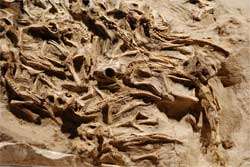
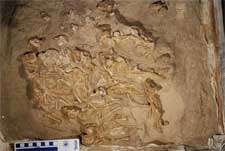
A nest containing the fossilized remains of 15 juvenile Protoceratops andrewsi dinosaurs from Mongolia has been described by a University of Rhode Island paleontologist, revealing new information about postnatal development and parental care. It is the first nest of this genus ever found and the first indication that Protoceratops juveniles remained in the nest for an extended period.

The findings were reported in the most recent issue of the Journal of Paleontology.

David Fastovsky, URI professor of , said the bowl-shaped measuring 2.3 feet in diameter was found in the Djadochta Formation at Tugrikinshire, .

"Finding juveniles at a nest is a relatively uncommon occurrence, and I cannot think of another dinosaur specimen that preserves 15 at its nest in this way," he said.

The analysis of the 70-million-year-old nest by Fastovsky and his colleagues found that all 15 – at least 10 of which are complete specimens – were about the same size and had achieved the same state of growth and development, suggesting they represent a single clutch from a single mother. The discovery also indicates that the young dinosaurs remained in the nest through the early stages of postnatal development and were cared for by their parents.
Paleontologist describes large nest of juvenile dinosaurs, first of their genus ever found
Protoceratops grew to about 6 feet long and may have taken as long as 10 years to reach full size. Those Fastovsky found in the nest were likely less than one year old when they died.

"I suspect that the preserved animals were rapidly buried by the shifting, accumulating sands that must have constituted the bulk of sedimentation in this setting," he said. "Death likely occurred during a desert sandstorm. My guess is that the initial and present-day dryness contributed significantly to the superb preservation, not just of Protoceratops, but of all the fossils from this unit."

Fastovsky calls Protoceratops "a fascinating and unexpected mass of contradictions." It is an herbivore that lived in a sand sea much like the Sahara Desert and likely bestowed significant parental care on a relatively large number of offspring, perhaps because it lived where mortality was quite high.

A wide variety of theropod dinosaurs lived in Mongolia at the time, some of which, including the notorious Velociraptor, probably ate young Protoceratops'.

"Juvenile Protoceratops mortality may have been rather high, not only from predation but from a potentially stressful environment, and large clutches may have been a way of ensuring survival of the animals in that setting," he said. "Nonetheless, if preservation is any indicator of abundance in life, then during the time represented by the Djadochta Formation, Protoceratops were a very common feature of Mongolian Late Cretaceous desert landscapes."

Journal reference: Journal of Paleontology search and more info website

Provided by University of Rhode Island search and more info website

3.5 /5 (2 votes)  

Filter


Move the slider to adjust rank threshold, so that you can hide some of the comments.


Display comments: newest first

jsa09
Nov 22, 2011

Rank: not rated yet
Interesting and strange. How can the parents care for a dozen offspring at the same time when they are plant eaters in a desert environment.

Perhaps they regurgitated their food for the young. Would sure be hard to bring home supper for the babies otherwise.
Rank 3.5 /5 (2 votes)
Relevant PhysicsForums posts

More news stories

Change in developmental timing was crucial in the evolutionary shift from dinosaurs to birds: study

At first glance, it's hard to see how a common house sparrow and a Tyrannosaurus Rex might have anything in common. After all, one is a bird that weighs less than an ounce, and the other is a dinosaur that ...

Other Sciences / Archaeology & Fossils

created 5 hours ago | popularity 5 / 5 (3) | comments 0 | with audio podcast

Social welfare cuts ultimately come with heavy price, researchers say

(Phys.org) -- Slashing government funding for Medicaid, food stamps and other programs that serve the poor – while politically popular with some lawmakers and many conservatives – may do more harm ...

Other Sciences / Social Sciences

created May 24, 2012 | popularity 4.3 / 5 (17) | comments 154

Ancient Bethlehem seal unearthed in Jerusalem

Israeli archaeologists have discovered a 2,700-year-old seal that bears the inscription "Bethlehem," the Israel Antiquities Authority announced Wednesday, in what experts believe to be the oldest artifact ...

Other Sciences / Archaeology & Fossils

created May 23, 2012 | popularity 3.3 / 5 (15) | comments 24

Dollars and sense: Why are some people morally against tax?

As the U.S. presidential election campaigns heat up, the economic debate is dominated by bailouts, austerity and, inevitably, taxation. Now a new study published in Symbolic Interaction asks why tax is such an important issue ...

Other Sciences / Social Sciences

created May 23, 2012 | popularity 3 / 5 (2) | comments 15

Oldest Jewish archaeological evidence on the Iberian Peninsula

German archaeologists of the Friedrich Schiller University Jena found one of the oldest archaeological evidence so far of Jewish Culture on the Iberian Peninsula at an excavation site in the south of Portugal, ...

Other Sciences / Archaeology & Fossils

created May 25, 2012 | popularity 4.2 / 5 (6) | comments 12


Nvidia trumpets Tegra 3 phone design wins for 2012

(Phys.org) -- Nvidia’s competitive war paint has a name, Tegra 3. On the heels of Nvidia announcements about lowering costs of its Tegra 3 processors and Nvidia-enabled tablets running Android Ice Cream ...

'Unzipped' carbon nanotubes could help energize fuel cells, batteries

Multi-walled carbon nanotubes riddled with defects and impurities on the outside could replace some of the expensive platinum catalysts used in fuel cells and metal-air batteries, according to scientists at ...

T cells 'hunt' parasites like animal predators seek prey, study shows

By pairing an intimate knowledge of immune-system function with a deep understanding of statistical physics, a cross-disciplinary team at the University of Pennsylvania has arrived at a surprising finding: T cells use a movement ...

Computer model used to pinpoint prime materials for efficient carbon capture

When power plants begin capturing their carbon emissions to reduce greenhouse gases – and to most in the electric power industry, it's a question of when, not if – it will be an expensive undertaking.

Land and sea species differ in climate change response: study

(Phys.org) -- Marine and terrestrial species will likely differ in their responses to climate warming, new research by Simon Fraser University and Australia’s University of Tasmania has found.

Scientist: Evolution debate will soon be history

(AP) -- Richard Leakey predicts skepticism over evolution will soon be history. Not that the avowed atheist has any doubts himself.