Pairing up: How chromosomes find each other
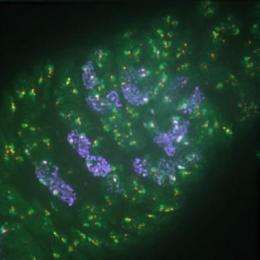
After more than a century of study, mysteries still remain about the process of meiosis -- a special type of cell division that helps insure genetic diversity in sexually-reproducing organisms. Now, researchers at Stowers Institute for Medical Research shed light on an early and critical step in meiosis.
The research, to be published in the Nov. 8, 2011 issue of Current Biology, clarifies the role of key chromosomal regions called centromeres in the formation of a structure known as the synaptonemal complex (SC). "Understanding this and other mechanisms involved in meiosis is important because of the crucial role meiosis plays in normal reproduction—and the dire consequences of meiosis gone awry," says R. Scott Hawley, Ph.D., who led the research at Stowers.
"Failure of the meiotic division is probably the most common cause of spontaneous abortion and causes a number of birth defects such Down syndrome," Hawley says.
Meiosis reduces the number of chromosomes carried by an individual's regular cells by half, allocating precisely one copy of each chromosome to each egg or sperm cell and thus ensuring that the proper number of chromosomes is passed from parent to offspring. And because chromosomes come in pairs—23 sets in humans—the chromosomes must be properly matched up before they can be divvied up.
"Chromosome 1 from your dad has to be paired with chromosome 1 from your mom, chromosome 2 from your dad with chromosome 2 from your mom, and so on," Hawley explains, "and that's a real trick. There's no room for error; the first step of pairing is the most critical part of the meiotic process. You get that part wrong, and everything else is going to fail."
The task is something like trying to find your mate in a big box store. It helps if you remember what they are wearing and what parts of the store they usually frequent (for example, movies or big-screen TVs). Similarly, chromosomes can pair up more easily if they're able to recognize their partners and find them at a specific place.
"Once they've identified each other at some place, they'll begin the process we call synapsis, which involves building this beautiful structure—the synaptonemal complex—and using it to form an intimate association that runs the entire length of each pair of chromosomes," Hawley explains.
Some model organisms employed in the study of meiosis, such as yeast and the roundworm Caenorhabditis elegans, use the ends of their chromosomes to facilitate the process. "These organisms gather all the chromosome ends against the nuclear envelope into one big cluster called a bouquet or into a bunch of smaller clusters called aggregates, and this brings the chromosome ends into proximity with each other," Hawley says. "This changes the problem of finding your homologue in this great big nucleus into one of finding your mate on just the surface of the inside of the nucleus."
But the fruit fly Drosophila melanogaster—the model organism in which meiosis has been thoroughly studied for more than a century, and which Hawley has studied for almost 40 years – has unusual chromosome ends that don't lend themselves to the same kind of clustering.
"So even though the study of meiosis began in Drosophila, we really haven't had any idea how chromosomes initiate synapsis in Drosophila," Hawley says. "Now, we show that instead of clustering their chromosome ends, flies cluster their centromeres—highly organized structures that chromosomes use to move during cell division. From there, the biology works pretty much as you would expect: synapsis is initiated at the centromeres, and it appears to spread out along the arms of the chromosomes."
The ramifications of the findings extend beyond fruit flies, as there's some evidence that synapsis starts at centromeres in other organisms. In addition, Hawley and coauthors found that centromere clustering may play a role later in meiosis, when chromosomes separate from their partners.
"There's reason to believe that some parts of that process will be at least explorable and potentially applicable to humans," Hawley said.
The work also is notable as an example of discovery-based science, Hawley said. "We didn't actually set out to study the initiation of meiosis; we were simply interested in characterizing the basic biology of early meiosis."
But postdoctoral researcher and first author Satomi Takeo, Ph.D., noticed that centromere clustering and synaptonemal complex initiation occurred in concert, and her continued observations revealed the role of centromeres in initiating synapsis.
"I was staring with tired eyes at the cells that I was analyzing," Takeo recalls. "Somehow I started looking at the spots I had previously ignored—probably because I thought they were just background noise—until I saw the connection between centromere clustering and synapsis initiation. After going through many images, I wrote an email to Scott, saying, 'This is really important, isn't it??' With that finding, everything else started to make sense."
Provided by Stowers Institute for Medical Research


