Overfishing on the menu of Istanbul conference
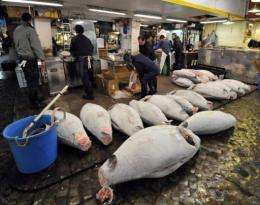
Fishmongers cut frozen bluefin tuna in Tokyo in March 2011. Hundreds of representatives of countries involved in bluefin tuna fishing, international organisations and NGOs met here Friday on how to improve catch controls and protect endangered species.
Hundreds of representatives of countries involved in bluefin tuna fishing, international organisations and NGOs met here Friday on how to improve catch controls and protect endangered species.
A report released last month warned that more than twice as many tonnes of Atlantic bluefin tuna were sold last year compared with official catch records for this threatened species.
This "bluefin gap" occurred despite enhanced reporting and enforcement measures introduced in 2008 by the 48-member International Commission for the Conservation of Atlantic Tunas (ICCAT), which sets annual quotas by country, it said.
Trade figures showed that real catches of bluefin in 2009 and 2010 totalled more than 70,500 tonnes, twice ICCAT's tally for those two years, according to the report compiled by the Washington-based Pew Environment Group.
In 2010, the target quota -- 12,900 tonnes for fish caught in the Mediterranean and Northeastern Atlantic -- fell for the first time within the panel's recommended range.
But the new report, released ahead of the nine-day ICCAT meeting in Istanbul which is attended by delegates from member countries, implies the industry has circumvented the catch limits and tougher compliance measures.
"The follow-up of catches is a key issue," ICCAT executive secretary Driss Meski told AFP on Friday.
"We are thinking about how to set up an electronic document that will follow the product from catch to consumer. We are doing a feasibility study and we will submit it."
ICCAT will also propose how to better protect other species, said a delegate who would not be named.
"We're talking about catch quotas or technical measures like a cap on the number of boats. And generalluy speaking we're following scientific recommendations," he added.
Meski confirmed that the parties involved in the Istanbul talks will discuss quotas.
The delegate said he also expected proposals on how to protect sharks which ICCAT sees as collateral victims of tuna fishing.
(c) 2011 AFP
-
From lemons to lemonade: Reaction uses carbon dioxide to make carbon-based semiconductor,
32 comments
-
Thioridazine kills cancer stem cells in human while avoiding toxic side-effects of conventional cancer treatments,
3 comments
-
SpaceX private rocket blasts off for space station (Update),
42 comments
-
Climate scientists say they have solved riddle of rising sea,
31 comments
-
SpaceX capsule has 'new car' smell, astronauts say (Update),
4 comments
-
What would stain as translucent on light-coloured fabric?
May 26, 2012
-
How do I identify different bacteria on culture plates?
May 26, 2012
-
Why Do Dogs do Strange things...
May 25, 2012
-
What does exophillic and endophillic mean in terms of mosquito and their control?
May 24, 2012
-
Semen stains glows under black lights (uv light)?
May 23, 2012
-
Question on Human Chromosome 2
May 23, 2012
- More from Physics Forums - Biology
More news stories
Scientist: Evolution debate will soon be history
(AP) -- Richard Leakey predicts skepticism over evolution will soon be history. Not that the avowed atheist has any doubts himself.
23 hours ago |
3.5 / 5 (20) |
87
Manufacturing genes to attack flu virus
An international research team has manufactured a new protein that can combat deadly flu epidemics.
5 hours ago |
not rated yet |
0
|
More plant species responding to global warming than previously thought
(Phys.org) -- Far more wild plant species may be responding to global warming than previous large-scale estimates have suggested.
May 22, 2012 |
4.6 / 5 (14) |
18
|
For monogamous sparrows, it doesn't pay to stray (but they do it anyway)
It's quite common for a female song sparrow to stray from her breeding partner and mate with the male next door, but a new study shows that sleeping around can be costly.
May 22, 2012 |
5 / 5 (2) |
8
|
Thousands of shellfish found dead in Peru
Thousands of crustaceans were found dead off the coast of Lima following the mystery mass death of dolphins and pelicans, the Peruvian Navy said Friday.
May 26, 2012 |
4.7 / 5 (7) |
7
Nvidia trumpets Tegra 3 phone design wins for 2012
(Phys.org) -- Nvidias competitive war paint has a name, Tegra 3. On the heels of Nvidia announcements about lowering costs of its Tegra 3 processors and Nvidia-enabled tablets running Android Ice Cream ...
'Unzipped' carbon nanotubes could help energize fuel cells, batteries
Multi-walled carbon nanotubes riddled with defects and impurities on the outside could replace some of the expensive platinum catalysts used in fuel cells and metal-air batteries, according to scientists at ...
T cells 'hunt' parasites like animal predators seek prey, study shows
By pairing an intimate knowledge of immune-system function with a deep understanding of statistical physics, a cross-disciplinary team at the University of Pennsylvania has arrived at a surprising finding: T cells use a movement ...
Computer model used to pinpoint prime materials for efficient carbon capture
When power plants begin capturing their carbon emissions to reduce greenhouse gases and to most in the electric power industry, it's a question of when, not if it will be an expensive undertaking.
Change in developmental timing was crucial in the evolutionary shift from dinosaurs to birds: study
At first glance, it's hard to see how a common house sparrow and a Tyrannosaurus Rex might have anything in common. After all, one is a bird that weighs less than an ounce, and the other is a dinosaur that ...
Land and sea species differ in climate change response: study
(Phys.org) -- Marine and terrestrial species will likely differ in their responses to climate warming, new research by Simon Fraser University and Australia’s University of Tasmania has found.