Oil palms and conservation -- do they mix?
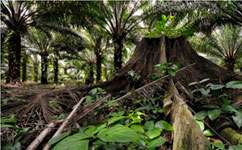
Conservation science can help protect the variety of living things in tropical landscapes even if they are being turned into oil palm plantations, new research argues.
Throughout the tropics, rainforest is being cut down at an alarming rate to make room for palm oil plantations. This has a devastating effect on the plants and animals that lived there, driving many species into extinction.
But we need much more research into the benefits and costs of different tactics, as at the moment many efforts to conserve forest biodiversity are working in the dark.
'Some conservationists just focus on protecting the biggest possible number of forest species, particularly charismatic animals,' says Dr William Foster, a zoologist at the University of Cambridge and the lead author of the paper, which was published in a recent special edition of Philosophical Transactions of the Royal Society B.
'But we wanted to look, not just at how many forest species are being lost, but also at how you can arrive at a sustainable oil palm landscape that delivers reasonable ecosystem services and doesn't constantly need vast amounts of pesticides and fertiliser to keep producing.'
His team suggests that simple measures, like leaving strips of forest alongside rivers and preserving undergrowth when trees are cleared for oil palms, could make a big difference to the diversity of certain kinds of plants and animals.
This could in turn improve the lives of local people and help put plantations on a sounder environmental footing. For example, encouraging certain habitats that provide a refuge for predators can help control the numbers of pest species that would otherwise cause damage, as well as letting farmers use fewer chemicals.
Sparing or sharing?
The research points to a fundamental debate in conservation - 'land sparing' versus 'land sharing'. Is it better to farm very intensively to maximise yields, so that less land needs to be turned into plantations? Or is it better to farm more land, but do so less intensively, adopting wildlife-friendly farming methods and setting aside patches of habitat within it that are left mostly undisturbed?
It's a difficult question, and we still don't have a definitive answer. Foster argues that while land sparing may save more species from extinction, land sharing may be the more helpful approach to conservation across large areas, in part because it's likely to do more to preserve the ecosystem services on which local communities and the plantations themselves depend.
'If you're only trying to conserve species, land sparing is probably the better option - you will probably preserve the most species by having very productive palm plantations with very little biodiversity, but with large areas of untouched forest,' Foster says.
'But many ecologists don't see it that way. For one thing you may end up with areas of protected forest surrounded by armed guards. Also, the ecosystem services of the intensively-farmed plantation will be absolutely horrible, and the whole landscape probably won't be sustainable in the long term. Clearly, what we need is some mix of the two approaches' By ecosystem services he means benefits like flood control and crop pollination, many of which depend on a diverse community of living things.
But the situation doesn't have to be catastrophic. Compared to many other crops, a palm plantation is a fairly complex landscape, with the potential for several layers of vegetation growing underneath the palms. If it's managed properly, this diversity can increase as the plantation matures.
It's still probably less diverse and interesting even than badly-logged areas of the original forest, Foster points out. But that doesn't mean nothing can be done to lessen the damage of deforestation. Indeed, preserving some biodiversity is in farmers' best interests, if only to provide ecosystem services. Scientists should be working to find out the best ways to make palm ecosystems as diverse as possible.
There are relatively simple measures that can help, and many of them are already being put into practice as recommended by the Roundtable on Sustainable Palm Oil, an industry group that encourages growers to adopt less environmentally-damaging methods.
Obviously some plants and animals stand to benefit more than others. Leaving small chunks of slightly-degraded forest in the middle of plantations, or allowing understorey plants to remain beneath the oil palms, may be good for insects and birds, but it's unlikely to help apes or jaguars much. Foster argues that it's better than nothing, though.
He adds that we urgently need more research to get a better idea of exactly how various changes in plantation management affects the range of plants and animals living in the area, and how in turn this biodiversity affects ecosystem services. At present many methods are based largely on conservationists' gut feelings; we need a better base of evidence on what works and what doesn't.
This story is republished courtesy of Planet Earth online, a free, companion website to the award-winning magazine Planet Earth published and funded by the Natural Environment Research Council (NERC).
More information: Establishing the evidence base for maintaining biodiversity and ecosystem function in the oil palm landscapes of South East Asia. William Foster, Jake Snaddon, Edgar Turner, Tom Fayle, Timothy Cockerill, M. D. Farnon Ellwood, Gavin Broad, Arthur Chung, Paul Eggleton, Chey Vun Khen and Kalsum Yusah. Phil. Trans. R. Soc. B 27 November 2011 vol. 366 no. 1582 3277-3291. doi: 10.1098/rstb.2011.0041
Provided by PlanetEarth Online


