NXP develops automotive ethernet transceivers for in-vehicle networks
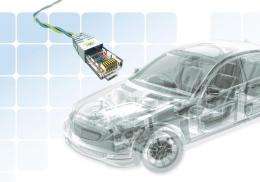
NXP Semiconductors N.V. today announced its engagement in automotive Ethernet as the first automotive semiconductor supplier to license Broadcom’s BroadR-Reach Ethernet technology for in-vehicle networking. As NXP is the No. 1 supplier of In-Vehicle Networking electronics, this is a significant step forward in establishing BroadR-Reach as an open, de facto standard for in-vehicle Ethernet. At the same time, Broadcom, NXP, Freescale, and Harman today announced the foundation of the OPEN Alliance Special Interest Group. The objective of the newly founded group is to drive the wide adoption of Ethernet in the automotive industry.
NXP plans to create an automotive-grade product portfolio for the Ethernet physical layer based upon BroadR-Reach®, leveraging NXP’s expertise in automotive electronics, in the industry’s quality requirements, as well as its strong application know-how. Major car manufacturers are designing with Ethernet as a high-bandwidth, low-cost networking technology complementary to existing in-vehicle network technologies such as CAN, LIN, LVDS and FlexRay. BMW cars supporting Ethernet are already on the market since 2008.
As cars evolve into ever more sophisticated and connected electronic environments, there is increasing demand among OEMs and design engineers for an in-vehicle networking technology that can handle high-bandwidth applications without being excessively expensive. Broadcom BroadR-Reach Ethernet technology has significant cost advantages over other high-bandwidth automotive networking technologies such as LVDS, based on its ability to operate over single unshielded twisted pair (UTP) cabling. Not only is single UTP less expensive and lower in weight than shielded cabling, the technology is already in use by CAN- and LIN-based control systems, enabling BroadR-Reach to run over existing in-vehicle networks.
One of the key applications driving high-bandwidths in vehicles is camera-based security, a safety feature that may become mandatory for new vehicles in countries such as the US in the future. Currently, there are many instances when the driver doesn’t have a complete view in maneuvering the car - for example, when backing out of a tight space or reversing down a drive. This may lead to damage to the car or injury to pedestrians. By networking a series of cameras mounted on the outside of the vehicle, the driver can get a 360-degree view of what’s happening around the car displayed via the dashboard. Other high-bandwidth applications that Ethernet could support include networked infotainment.
Another advantage of using Ethernet as an in-vehicle technology is that it is a globally recognized standard that supports IP-based networking. This makes it much easier to adapt existing IP software and applications from the consumer and business markets for automotive use, speeding the development of the connected vehicles of the future.
“We’re very excited that NXP, as a key supplier of innovative in-vehicle electronics, has chosen to license BroadR-Reach,” said Dr. Ali Abaye, senior director of PHY product marketing, Broadcom Corporation. “Licensing BroadR-Reach to other semiconductor suppliers will encourage wide-scale adoption of 100 Mbps Ethernet connectivity as the standard in automotive networking applications.”
“We see Ethernet as the best choice for high-bandwidth in-vehicle networks and believe that BroadR-Reach is the superior technology in this field,” said Rob Hoeben, director of marketing and business development for Ethernet, NXP Semiconductors. “As such, we have chosen to partner with Broadcom rather than undertake a parallel R&D program. This enables us to reduce development costs, and also to bring new technologies to the automotive market more quickly. We believe that licensing BroadR-Reach will give a major boost to its adoption as a de facto standard for automotive Ethernet. Based upon the BroadR-Reach IP from Broadcom, we will develop our own automotive-grade PHY products.”
The first NXP product samples will be available in 2013.
Provided by NXP


