Why NHL goalies prefer wooden sticks?
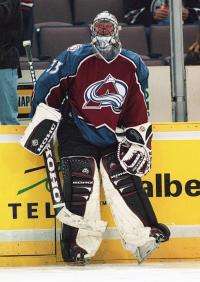
Goalies in the National Hockey League overwhelmingly continue to use wooden sticks largely indistinguishable from those used decades ago by their mask-less predecessors.
Compared with state-of the-art composite materials favored by the other players on the ice, the age-old wooden material dampens the sting of vibrations more effectively, making it simply more comfortable for goalies to wield a wooden stick.
In Flint, Mich., Kettering University undergraduate student Linda Hunt studied the way goalie sticks respond to impacts along with her adviser, Daniel Russell. Presented earlier this month at the meeting of the Acoustical Society of America in San Diego, the project quantified a feeling often expressed by many goalies playing at higher levels.
Throughout college, Hunt has worked for hockey equipment manufacturer Warrior, where she learned that the wooden sticks preferred by goaltenders were the opposite of what athletes playing other positions on the ice used. Offensive and defensive players -- those skating across open ice -- almost all prefer stronger and lighter sticks made primarily from composite materials.
Most NHL goalies use wooden sticks, officials from the Carolina Hurricanes and Columbus Blue Jackets said. Hurricanes equipment manager Bob Gorman explained that one of their goalies does use a composite stick, primarily because it weighs less than a wooden one.
The energy of a frozen puck traveling 100 mph is quickly absorbed by the thick padding of a goalie's leg pads. But the sticks -- wooden or composite -- are not as forgiving. The puck transfers its energy to the stick, which vibrates violently.
"If you get hit the wrong way you're going to want to drop [the stick] because it stings your hand, the same with baseball bats," said Hunt. "A lot of goalies in general are just willing to sacrifice the weight for their hand being able to take more impacts."
In the experiment, Hunt and Russell attached an accelerometer to a stick and used a hammer to strike each stick at over 300 points. Recording the stick's movement allowed them to develop a profile of how it vibrated in response to different forces and frequencies.
Nerves in the human hand are particularly sensitive to vibrations of 200-400 times per second. The wooden material tends to vibrate at lower rates, away from this sensitive range. Any vibrations in the 200-400 times per second range die down more quickly than they do in composite sticks, the researchers found.
-
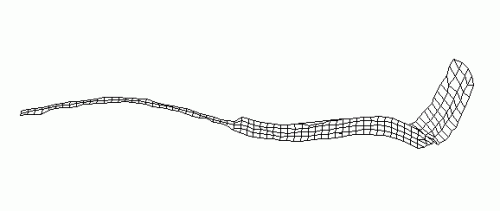
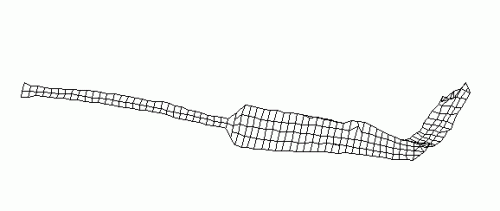
The researchers used a hammer to strike over 300 points on each goalie stick and measured the response. The above animations show how the sticks responded at specific frequencies. The different animations separate out the different types of vibrations, both the bending component and the twisting component. The stick on the left at 261 hertz, the stick on the right at 213 hertz. Credit: Linda Hunt & Daniel Russell -
"I have felt sting before and I can relate and understand why the goalies would prefer the wooden sticks in high level," said Alain Hache, a professor of physics at the University of Moncton, in New Brunswick, Canada, and the author of the 2002 book "The Physics of Hockey".
Hache is himself a goalie. He uses a composite stick, but hard shots are prohibited in his recreational league.
Hache said the reason why goalies might prefer wooden sticks is directly related to the reason why other players prefer sticks made from composite materials. New sticks make slap shots as much as 10 percent faster, because of their mechanical properties.
When players hit a slap shot, they strike the ice before hitting the puck. This flexes the stick, which stores energy. When the stick hits the puck it transfers the energy of a player's swing and the additional kick of stored energy from the flex.
"When you bend the [composite] stick it tends to restore its energy back," said Hache. "The wooden stick would vibrate and then dampen."
In addition to developing insights as to why wooden sticks are preferred by goalies, Hunt and Russell also noticed that the intensity of the vibrations varies over the length of the stick. At small regions called nodes a portion of the stick remains essentially stationary while the rest vibrates. The areas of largest vibrations are called antinodes.
"If you happen to hold the stick at the node you won't feel much," said Hache.
Goalies wrap tape on the end of their sticks, which can actually change the response to vibrations. The researchers taped the sticks as part of their experiment.
"If you put on more tape it dampens some of the vibrations, it moves those node locations a little bit," said Hunt. "But every goalie tapes their stick very differently."
"There could some interesting tip there for maybe goalies to try to put the tape at the right place or maybe the right amount with the right location to minimize the sting," said Hache.
Provided by Inside Science News Service


