NASA captures new images of large asteroid passing Earth
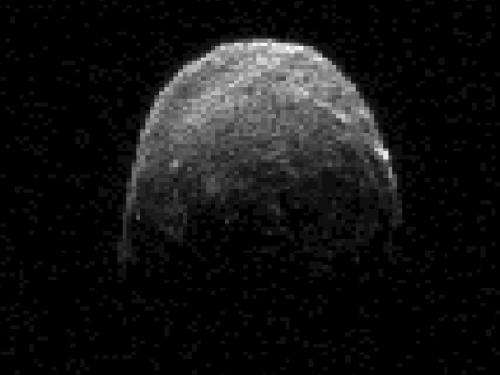
This radar image of asteroid 2005 YU55 was obtained on Nov. 7, 2011, at 11:45 a.m. PST (2:45 p.m. EST/1945 UTC), when the space rock was at 3.6 lunar distances, which is about 860,000 miles, or 1.38 million kilometers, from Earth. Image credit: NASA/JPL-Caltech
(PhysOrg.com) -- NASA's Deep Space Network antenna in Goldstone, Calif. has captured new radar images of Asteroid 2005 YU55 passing close to Earth.
The asteroid safely will fly past our planet slightly closer than the moon's orbit on Nov. 8. The last time a space rock this large came as close to Earth was in 1976, although astronomers did not know about the flyby at the time. The next known approach of an asteroid this size will be in 2028.
The image was taken on Nov. 7 at 11:45 a.m. PST, when the asteroid was approximately 860,000 miles (1.38 million kilometers) away from Earth. Tracking of the aircraft carrier-sized asteroid began at Goldstone at 9:30 a.m. PDT on Nov. 4 with the 230-foot-wide (70-meter) antenna and lasted about two hours, with an additional four hours of tracking planned each day from Nov. 6 - 10.
Radar observations from the Arecibo Planetary Radar Facility in Puerto Rico will begin Nov. 8, the same day the asteroid will make its closest approach to Earth at 3:28 p.m. PST.
The trajectory of asteroid 2005 YU55 is well understood. At the point of closest approach, it will be no closer than 201,700 miles (324,600 kilometers) as measured from the center of Earth, or about 0.85 times the distance from the moon to Earth. The gravitational influence of the asteroid will have no detectable effect on Earth, including tides and tectonic plates. Although the asteroid is in an orbit that regularly brings it to the vicinity of Earth, Venus and Mars, the 2011 encounter with Earth is the closest it has come for at least the last 200 years.
NASA detects, tracks and characterizes asteroids and comets passing close to Earth using both ground- and space-based telescopes. The Near-Earth Object Observations Program at the Jet Propulsion Laboratory (JPL) in Pasadena, Calif., commonly called "Spaceguard," discovers these objects, characterizes some of them, and plots their orbits to determine if any could be potentially hazardous to our planet. JPL manages the Near-Earth Object Program Office for NASA's Science Mission Directorate in Washington.
Provided by
JPL/NASA
-
From lemons to lemonade: Reaction uses carbon dioxide to make carbon-based semiconductor,
32 comments
-
Thioridazine kills cancer stem cells in human while avoiding toxic side-effects of conventional cancer treatments,
3 comments
-
SpaceX private rocket blasts off for space station (Update),
42 comments
-
Climate scientists say they have solved riddle of rising sea,
31 comments
-
SpaceX capsule has 'new car' smell, astronauts say (Update),
4 comments
-
Distance of planets from stars and revolution
5 hours ago
-
revamping general concept and cosmological principle
May 25, 2012
-
Transiting Exoplanet Light Curve
May 25, 2012
-
Math behind Theoretical Physics
May 24, 2012
-
Do we know whats at the center of galaxies yet?
May 23, 2012
-
Structure of the Milky Way?
May 20, 2012
- More from Physics Forums - General Astronomy
More news stories
Land and sea species differ in climate change response: study
(Phys.org) -- Marine and terrestrial species will likely differ in their responses to climate warming, new research by Simon Fraser University and Australia’s University of Tasmania has found.
2 hours ago |
5 / 5 (2) |
2
|
Yale study concludes public apathy over climate change unrelated to science literacy
Are members of the public divided about climate change because they don't understand the science behind it? If Americans knew more basic science and were more proficient in technical reasoning, would public consensus match ...
4 hours ago |
4 / 5 (1) |
11
|
10 million years needed to recover from mass extinction
It took some 10 million years for Earth to recover from the greatest mass extinction of all time, latest research has revealed.
Space & Earth / Earth Sciences
4 hours ago |
not rated yet |
1
|
Sophisticated simulations predict future warming
The chances of our planet being hit by a global warming of 3 degrees Celsius by 2050 is as likely as it being hit by an increase of 1.4 degrees, new research shows. Presented in the journal Nature Geoscience, the British study ...
Space & Earth / Earth Sciences
May 22, 2012 |
4.4 / 5 (9) |
51
Aliens don't want to eat us, says former SETI director
Alien life probably isnt interested in having us for dinner, enslaving us or laying eggs in our bellies, according to a recent statement by former SETI director Jill Tarter.
Space & Earth / Space Exploration
May 25, 2012 |
4.4 / 5 (14) |
40
Nvidia trumpets Tegra 3 phone design wins for 2012
(Phys.org) -- Nvidias competitive war paint has a name, Tegra 3. On the heels of Nvidia announcements about lowering costs of its Tegra 3 processors and Nvidia-enabled tablets running Android Ice Cream ...
'Unzipped' carbon nanotubes could help energize fuel cells, batteries
Multi-walled carbon nanotubes riddled with defects and impurities on the outside could replace some of the expensive platinum catalysts used in fuel cells and metal-air batteries, according to scientists at ...
T cells 'hunt' parasites like animal predators seek prey, study shows
By pairing an intimate knowledge of immune-system function with a deep understanding of statistical physics, a cross-disciplinary team at the University of Pennsylvania has arrived at a surprising finding: T cells use a movement ...
Computer model used to pinpoint prime materials for efficient carbon capture
When power plants begin capturing their carbon emissions to reduce greenhouse gases and to most in the electric power industry, it's a question of when, not if it will be an expensive undertaking.
Change in developmental timing was crucial in the evolutionary shift from dinosaurs to birds: study
At first glance, it's hard to see how a common house sparrow and a Tyrannosaurus Rex might have anything in common. After all, one is a bird that weighs less than an ounce, and the other is a dinosaur that ...
Scientist: Evolution debate will soon be history
(AP) -- Richard Leakey predicts skepticism over evolution will soon be history. Not that the avowed atheist has any doubts himself.
Nov 08, 2011
Rank: 5 / 5 (4)
Nov 08, 2011
Rank: not rated yet
Nov 08, 2011
Rank: 5 / 5 (3)
Nov 08, 2011
Rank: not rated yet
I wish I'd thought of that ;-)
Nov 08, 2011
Rank: not rated yet
What's really odd is there are much better pictures from several days ago.
Nov 08, 2011
Rank: not rated yet
Nov 08, 2011
Rank: 5 / 5 (1)
Nov 08, 2011
Rank: 1.6 / 5 (5)
Thanks for the words of assurance.
Where is NASA's calender of future close encounters?
With kind regards,
Oliver K. Manuel
Nov 08, 2011
Rank: not rated yet
Nov 08, 2011
Rank: not rated yet
Nov 08, 2011
Rank: not rated yet
Nov 08, 2011
Rank: 1.8 / 5 (5)
www.youtube.com/w...embedded
Nov 08, 2011
Rank: 3.3 / 5 (3)
Nov 08, 2011
Rank: not rated yet
BUT what has been done to develop a system to get rid of those that are large enough to present a grave danger if they impacted this planet?