Nanowrinkles, nanofolds yield strange hidden channels
November 23, 2011

Nanowrinkles, nanofolds yield strange hidden channels

Enlarge

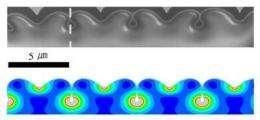
Researchers at Brown University and in Korea used focused ion beams to extract a cross-section of compressed gold nanofilm. When tips of regular, neighboring folds touched, nanopipes were created beneath the surface. Credit: Kyung-Suk Kim lab, Brown University

Wrinkles and folds are ubiquitous. They occur in furrowed brows, planetary topology, the surface of the human brain, even the bottom of a gecko's foot. In many cases, they are nature's ingenious way of packing more surface area into a limited space. Scientists, mimicking nature, have long sought to manipulate surfaces to create wrinkles and folds to make smaller, more flexible electronic devices, fluid-carrying nanochannels or even printable cell phones and computers.

But to attain those technology-bending feats, scientists must fully understand the profile and performance of wrinkles and folds at the , dimensions 1/50,000th the thickness of a . In a series of observations and experiments, engineers at Brown University and in Korea have discovered unusual properties in wrinkles and folds at the nanoscale. The researchers report that wrinkles created on super-thin films have hidden long waves that lengthen even when the film is compressed. The team also discovered that when folds are formed in such films, closed nanochannels appear below the , like thousands of super-tiny pipes.

"Wrinkles are everywhere in science," said Kyung-Suk Kim, professor of engineering at Brown and corresponding author of the paper published in the journal A. "But they hold certain secrets. With this study, we have found mathematically how the wrinkle spacings of a are determined on a largely deformed soft substrate and how the wrinkles evolve into regular folds."

Wrinkles are made when a thin stiff sheet is buckled on a soft foundation or in a soft surrounding. They are precursors of regular folds: When the sheet is compressed enough, the wrinkles are so closely spaced that they form folds. The folds are interesting to manufacturers, because they can fit a large surface area of a sheet in a finite space.

Kim and his team laid gold nanogranular film sheets ranging from 20 to 80 thick on a rubbery substrate commonly used in the microelectronics industry. The researchers compressed the film, creating wrinkles and examined their properties. As in previous studies, they saw primary wrinkles with short periodicities, the distance between individual wrinkles' peaks or valleys. But Kim and his colleagues discovered a second type of wrinkle, with a much longer periodicity than the primary wrinkles — like a hidden long wave. As the researchers compressed the gold nanogranular film, the primary wrinkles' periodicity decreased, as expected. But the periodicity between the hidden long waves, which the group labeled secondary wrinkles, lengthened.

"We thought that was strange," Kim said.

It got even stranger when the group formed folds in the gold nanogranular sheets. On the surface, everything appeared normal. The folds were created as the peaks of neighboring got so close that they touched. But the research team calculated that those folds, if elongated, did not match the length of the film before it had been compressed. A piece of the original film surface was not accounted for, "as if it had been buried," Kim said.

Indeed, it had been, as nano-size closed channels. Previous researchers, using atomic force microscopy that scans the film's surface, had been unable to see the buried channels. Kim's group turned to focused ion beams to extract a cross-section of the film. There, below the surface, were rows of closed channels, about 50 to a few 100 nanometers in diameter. "They were hidden," Kim said. "We were the first ones to cut (the film) and see that there are channels underneath."

The enclosed nano channels are important because they could be used to funnel liquids, from drugs on patches to treat diseases or infections, to clean water and energy harvesting, like a microscopic hydraulic pump.

Provided by Brown University search and more info website

3.4 /5 (5 votes)  

Rank 3.4 /5 (5 votes)
Relevant PhysicsForums posts
  • How to determine the flexural rigidity of a composite
    created59 minutes ago
  • microstructure of titanium
    createdMay 26, 2012
  • Steam in My Espresso Machine
    createdMay 26, 2012
  • Density question
    createdMay 24, 2012
  • Mass transport originating from a point source at a solid gas interface
    createdMay 22, 2012
  • Ammonia dispersion in Air
    createdMay 22, 2012
  • More from Physics Forums - Materials & Chemical Engineering

More news stories

'Unzipped' carbon nanotubes could help energize fuel cells, batteries

Multi-walled carbon nanotubes riddled with defects and impurities on the outside could replace some of the expensive platinum catalysts used in fuel cells and metal-air batteries, according to scientists at ...

Nanotechnology / Nanomaterials

created 4 hours ago | popularity not rated yet | comments 0 | with audio podcast

Dopant gives graphene solar cells highest efficiency yet

(Phys.org) -- By taking advantage of graphene’s favorable electrical and optical properties, and then adding an organic dopant, researchers have achieved the highest power conversion efficiency yet for ...

Nanotechnology / Nanophysics

created May 21, 2012 | popularity 5 / 5 (10) | comments 14 | with audio podcast feature

In nanorod crystal growth, nanoparticles seen as artificial atoms

In the growth of crystals, do nanoparticles act as "artificial atoms" forming molecular-type building blocks that can assemble into complex structures? This is the contention of a major but controversial theory ...

Nanotechnology / Nanophysics

created May 24, 2012 | popularity 4.8 / 5 (6) | comments 0 | with audio podcast

First direct observation of oriented attachment in nanocrystal growth

Berkeley Lab researchers have reported the first direct observation of nanoparticles undergoing oriented attachment, the critical step in biomineralization and the growth of nanocrystals. A better understanding ...

Nanotechnology / Nanophysics

created May 24, 2012 | popularity 4.7 / 5 (3) | comments 0 | with audio podcast

Synthetic nano-waste does not disappear

(Phys.org) -- Tiny particles of cerium oxide do not burn or change in the heat of a waste incineration plant. They remain intact on combustion residues or in the incineration system, as a new study by Swiss ...

Nanotechnology / Bio & Medicine

created May 25, 2012 | popularity 5 / 5 (2) | comments 1 | with audio podcast


Nvidia trumpets Tegra 3 phone design wins for 2012

(Phys.org) -- Nvidia’s competitive war paint has a name, Tegra 3. On the heels of Nvidia announcements about lowering costs of its Tegra 3 processors and Nvidia-enabled tablets running Android Ice Cream ...

T cells 'hunt' parasites like animal predators seek prey, study shows

By pairing an intimate knowledge of immune-system function with a deep understanding of statistical physics, a cross-disciplinary team at the University of Pennsylvania has arrived at a surprising finding: T cells use a movement ...

Computer model used to pinpoint prime materials for efficient carbon capture

When power plants begin capturing their carbon emissions to reduce greenhouse gases – and to most in the electric power industry, it's a question of when, not if – it will be an expensive undertaking.

Change in developmental timing was crucial in the evolutionary shift from dinosaurs to birds: study

At first glance, it's hard to see how a common house sparrow and a Tyrannosaurus Rex might have anything in common. After all, one is a bird that weighs less than an ounce, and the other is a dinosaur that ...

Land and sea species differ in climate change response: study

(Phys.org) -- Marine and terrestrial species will likely differ in their responses to climate warming, new research by Simon Fraser University and Australia’s University of Tasmania has found.

Scientist: Evolution debate will soon be history

(AP) -- Richard Leakey predicts skepticism over evolution will soon be history. Not that the avowed atheist has any doubts himself.