Nanoparticles offer insights into interactions between single-stranded DNA and their binding proteins
November 29, 2011 By Lee Swee Heng

Nanotechnology: Probing for interactions

Enlarge

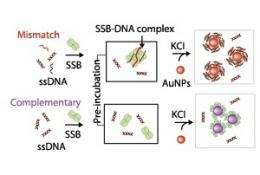
Schematic illustration showing the mechanism used to probe interactions between single-stranded DNA (ssDNA) and single stranded DNA-binding protein (SSB). Credit: 2011 ACS

Double-stranded DNA must disentangle itself into single strands during replication or repair to allow functional molecules to bind and perform their various operations. Cellular proteins specifically bind to single-stranded DNA to prevent their premature recombination. Unfortunately, detailed studies of these DNA–protein interactions have been hindered by the need for expensive instrumentation and time-consuming labelling techniques. Yen Nee Tan at the A*STAR Institute of Materials Research and Engineering and co-workers1 have now developed a convenient method to characterize the interactions between single-stranded DNA and their binding proteins.

The researchers used the optical properties of gold nanoparticles to probe the mechanism of protein– binding. When the nanoparticles were well dispersed in solution, they yielded a bright red color, but when aggregated, the solution changed to blue. Tan and co-workers discovered that when single-stranded DNA and its were both present in the solution, coupled with a salt that stimulates nanoparticle aggregation, the DNA remained red in color, indicating that the DNA–protein complexes had bound with the nanoparticles through electrosteric stabilization forces. In contrast, when the protein or single-stranded DNA was introduced alone in the salt solution, there was a greater shift to the blue-grey color, indicating nanoparticle aggregation (see image).

“The greatest challenge in this work was to determine the optimum conditions for single-stranded DNA to bind with its binding protein to form complexes that confer the highest stability to gold nanoparticles from salt-induced aggregation,” says Tan.

The researchers attribute binding of the nanoparticles and the DNA–protein complexes to the presence of sulphur-containing groups in the protein, which are known to create strong bonds with gold. The protein molecules alone are smaller in molecular size than the protein–DNA complexes, leading to a less effective steric stabilization of the nanoparticles.

Tan and co-workers showed that there was a minimum length of DNA sequence under which the binding protein–DNA adhesion mechanism could operate. They found that the binding protein had a preference for binding to specific chemical units (bases) which make up DNA, and were able to spot DNA sequence variations, called single nucleotide polymorphisms (SNPs), even at the extreme ends of the molecule which are difficult to identify. Double-stranded DNA with SNPs cannot bind together so closely. The binding protein can thus attach to the dissociated single-stranded DNA to form protein–DNA complexes, offering sites to which gold nanoparticles can adhere.

“We plan to further develop this assay into a hassle-free genotyping assay to detect SNPs in real biological samples containing long genomic DNA,” says Tan.

More information: Research article in Analytical Chemistry

Provided by Agency for Science, Technology and Research (A*STAR)


Rank not rated yet
Relevant PhysicsForums posts

More news stories

'Unzipped' carbon nanotubes could help energize fuel cells, batteries

Multi-walled carbon nanotubes riddled with defects and impurities on the outside could replace some of the expensive platinum catalysts used in fuel cells and metal-air batteries, according to scientists at ...

Nanotechnology / Nanomaterials

created 4 hours ago | popularity not rated yet | comments 0 | with audio podcast

Dopant gives graphene solar cells highest efficiency yet

(Phys.org) -- By taking advantage of graphene’s favorable electrical and optical properties, and then adding an organic dopant, researchers have achieved the highest power conversion efficiency yet for ...

Nanotechnology / Nanophysics

created May 21, 2012 | popularity 5 / 5 (10) | comments 14 | with audio podcast feature

In nanorod crystal growth, nanoparticles seen as artificial atoms

In the growth of crystals, do nanoparticles act as "artificial atoms" forming molecular-type building blocks that can assemble into complex structures? This is the contention of a major but controversial theory ...

Nanotechnology / Nanophysics

created May 24, 2012 | popularity 4.8 / 5 (6) | comments 0 | with audio podcast

First direct observation of oriented attachment in nanocrystal growth

Berkeley Lab researchers have reported the first direct observation of nanoparticles undergoing oriented attachment, the critical step in biomineralization and the growth of nanocrystals. A better understanding ...

Nanotechnology / Nanophysics

created May 24, 2012 | popularity 4.7 / 5 (3) | comments 0 | with audio podcast

Synthetic nano-waste does not disappear

(Phys.org) -- Tiny particles of cerium oxide do not burn or change in the heat of a waste incineration plant. They remain intact on combustion residues or in the incineration system, as a new study by Swiss ...

Nanotechnology / Bio & Medicine

created May 25, 2012 | popularity 5 / 5 (2) | comments 1 | with audio podcast


Nvidia trumpets Tegra 3 phone design wins for 2012

(Phys.org) -- Nvidia’s competitive war paint has a name, Tegra 3. On the heels of Nvidia announcements about lowering costs of its Tegra 3 processors and Nvidia-enabled tablets running Android Ice Cream ...

T cells 'hunt' parasites like animal predators seek prey, study shows

By pairing an intimate knowledge of immune-system function with a deep understanding of statistical physics, a cross-disciplinary team at the University of Pennsylvania has arrived at a surprising finding: T cells use a movement ...

Computer model used to pinpoint prime materials for efficient carbon capture

When power plants begin capturing their carbon emissions to reduce greenhouse gases – and to most in the electric power industry, it's a question of when, not if – it will be an expensive undertaking.

Change in developmental timing was crucial in the evolutionary shift from dinosaurs to birds: study

At first glance, it's hard to see how a common house sparrow and a Tyrannosaurus Rex might have anything in common. After all, one is a bird that weighs less than an ounce, and the other is a dinosaur that ...

Land and sea species differ in climate change response: study

(Phys.org) -- Marine and terrestrial species will likely differ in their responses to climate warming, new research by Simon Fraser University and Australia’s University of Tasmania has found.

Scientist: Evolution debate will soon be history

(AP) -- Richard Leakey predicts skepticism over evolution will soon be history. Not that the avowed atheist has any doubts himself.