Microfabrication breakthrough could set piezoelectric material applications in motion
November 17, 2011 by Renee Meiller

Microfabrication breakthrough could set piezoelectric material applications in motion

Enlarge

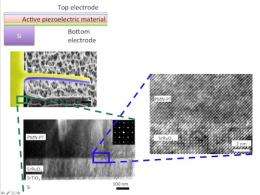
Micro-machined hyper-active cantilever structure incorporating the giant piezoresponse material PMN-PT. Low voltage giant piezoelectric response induces mechanical motion of (PMN-PT) the micromachined cantilever. Counterclockwise from upper left: 1) Schematic layer structure showing the silicon base, metallic top and bottom electrodes, and active PMN-PT. 2) False color scanning electron microscope image of completed cantilever. 3) Transmission electron microscope image showing layer structure. 4) High-resolution transmission electron microscope image showing perfect atomic arrangement of the giant piezoresponse PMN-PT layer and bottom metallic electrode SrRuO3.

(PhysOrg.com) -- Integrating a complex, single-crystal material with "giant" piezoelectric properties onto silicon, University of Wisconsin-Madison engineers and physicists can fabricate low-voltage, near-nanoscale electromechanical devices that could lead to improvements in high-resolution 3-D imaging, signal processing, communications, energy harvesting, sensing, and actuators for nanopositioning devices, among others.

Led by Chang-Beom Eom, a UW-Madison professor of and physics, the multi-institutional team published its results in the Nov. 18, issue of the journal Science. (Eom and his students also are co-authors on another paper, "Domain dynamics during ferroelectric switching," published in the same issue.)

Piezoelectric use mechanical motion to generate an , such as the light that flashes in some children's shoe heels when they stomp their feet. Conversely, piezoelectrics also can use an electrical signal to generate mechanical motion—for example, piezoelectric materials are used to generate high-frequency acoustic waves for ultrasound imaging.

Eom studies the advanced piezoelectric material lead magnesium niobate-lead titanate, or PMN-PT. Such materials exhibit a "giant" piezoelectric response that can deliver much greater mechanical displacement with the same amount of electric field as traditional . They also can act as both actuators and sensors. For example, they use electricity to deliver an ultrasound wave that penetrates deeply into the body and returns data capable of displaying a high-quality 3-D image.

This video is not supported by your browser at this time.

Currently, a major limitation of these advanced materials is that to incorporate them into very small-scale devices, researchers start with a bulk material and grind, cut and polish it to the size they desire. It's an imprecise, error-prone process that's intrinsically ill-suited for nanoelectromechanical systems (NEMS) or microelectromechanical systems (MEMS).

Until now, the complexity of PMN-PT has thwarted researchers' efforts to develop simple, reproducable microscale fabrication techniques.

Applying microscale fabrication techniques such as those used in computer electronics, Eom's team has overcome that barrier. He and his colleagues worked from the ground up to integrate PMN-PT seamlessly onto silicon. Because of potential chemical reactions among the components, they layered materials and carefully planned the locations of individual atoms. "You have to lay down the right element first," says Eom.

Onto a silicon "platform," his team adds a very thin layer of strontium titanate, which acts as a template and mimics the structure of silicon. Next comes a layer of strontium ruthenate, an electrode Eom developed some years ago, and finally, the single-crystal piezoelectric material PMN-PT.

The researchers have characterized the material's piezoelectric response, which correlates with theoretical predictions. "The properties of the single crystal we integrated on silicon are as good as the bulk single crystal," says Eom.

His team calls devices fabricated from this giant piezoelectric material "hyper-active MEMS" for their potential to offer researchers a high level of active control. Using the material, his team also developed a process for fabricating piezoelectric MEMS. Applied in , communications, medical imaging and nanopositioning actuators, hyper-active MEMS devices could reduce power consumption and increase actuator speed and sensor sensitivity. Additionally, through a process called energy harvesting, hyper-active MEMS devices could convert energy from sources such as mechanical vibrations into electricity that powers other small devices—for example, for wireless communication.

The National Science Foundation is funding the research via a four-year, $1.35 million NIRT grant. At UW-Madison, team members include Lynn H. Matthias Professor in Electrical and Computer Engineering Professor Robert Blick and Physics Professor Mark Rzchowski. Other collaborators include people at the National Institute of Standards and Technology, Pennsylvania State University, the University of Michigan, Argonne National Laboratory, the University of California at Berkeley, and Cornell University.

More information: Giant Piezoelectricity on Si for Hyperactive MEMS, Science 18 November 2011: Vol. 334 no. 6058 pp. 958-961 DOI: 10.1126/science.120718 http://www.science … 958.abstract

Provided by University of Wisconsin-Madison search and more info website


Rank 5 /5 (5 votes)
Relevant PhysicsForums posts
  • How to determine the flexural rigidity of a composite
    created59 minutes ago
  • microstructure of titanium
    createdMay 26, 2012
  • Steam in My Espresso Machine
    createdMay 26, 2012
  • Density question
    createdMay 24, 2012
  • Mass transport originating from a point source at a solid gas interface
    createdMay 22, 2012
  • Ammonia dispersion in Air
    createdMay 22, 2012
  • More from Physics Forums - Materials & Chemical Engineering

More news stories

'Unzipped' carbon nanotubes could help energize fuel cells, batteries

Multi-walled carbon nanotubes riddled with defects and impurities on the outside could replace some of the expensive platinum catalysts used in fuel cells and metal-air batteries, according to scientists at ...

Nanotechnology / Nanomaterials

created 4 hours ago | popularity not rated yet | comments 0 | with audio podcast

Dopant gives graphene solar cells highest efficiency yet

(Phys.org) -- By taking advantage of graphene’s favorable electrical and optical properties, and then adding an organic dopant, researchers have achieved the highest power conversion efficiency yet for ...

Nanotechnology / Nanophysics

created May 21, 2012 | popularity 5 / 5 (10) | comments 14 | with audio podcast feature

In nanorod crystal growth, nanoparticles seen as artificial atoms

In the growth of crystals, do nanoparticles act as "artificial atoms" forming molecular-type building blocks that can assemble into complex structures? This is the contention of a major but controversial theory ...

Nanotechnology / Nanophysics

created May 24, 2012 | popularity 4.8 / 5 (6) | comments 0 | with audio podcast

First direct observation of oriented attachment in nanocrystal growth

Berkeley Lab researchers have reported the first direct observation of nanoparticles undergoing oriented attachment, the critical step in biomineralization and the growth of nanocrystals. A better understanding ...

Nanotechnology / Nanophysics

created May 24, 2012 | popularity 4.7 / 5 (3) | comments 0 | with audio podcast

Synthetic nano-waste does not disappear

(Phys.org) -- Tiny particles of cerium oxide do not burn or change in the heat of a waste incineration plant. They remain intact on combustion residues or in the incineration system, as a new study by Swiss ...

Nanotechnology / Bio & Medicine

created May 25, 2012 | popularity 5 / 5 (2) | comments 1 | with audio podcast


Nvidia trumpets Tegra 3 phone design wins for 2012

(Phys.org) -- Nvidia’s competitive war paint has a name, Tegra 3. On the heels of Nvidia announcements about lowering costs of its Tegra 3 processors and Nvidia-enabled tablets running Android Ice Cream ...

T cells 'hunt' parasites like animal predators seek prey, study shows

By pairing an intimate knowledge of immune-system function with a deep understanding of statistical physics, a cross-disciplinary team at the University of Pennsylvania has arrived at a surprising finding: T cells use a movement ...

Computer model used to pinpoint prime materials for efficient carbon capture

When power plants begin capturing their carbon emissions to reduce greenhouse gases – and to most in the electric power industry, it's a question of when, not if – it will be an expensive undertaking.

Change in developmental timing was crucial in the evolutionary shift from dinosaurs to birds: study

At first glance, it's hard to see how a common house sparrow and a Tyrannosaurus Rex might have anything in common. After all, one is a bird that weighs less than an ounce, and the other is a dinosaur that ...

Land and sea species differ in climate change response: study

(Phys.org) -- Marine and terrestrial species will likely differ in their responses to climate warming, new research by Simon Fraser University and Australia’s University of Tasmania has found.

Scientist: Evolution debate will soon be history

(AP) -- Richard Leakey predicts skepticism over evolution will soon be history. Not that the avowed atheist has any doubts himself.