Landsat's TIRS instrument comes out of first round of thermal vacuum testing
November 1, 2011

Landsat's TIRS instrument comes out of first round of thermal vacuum testing

Enlarge

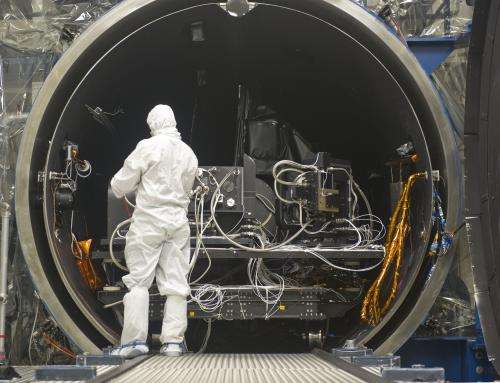
A technician surveys the TIRS instrument and the calibration equipment, preparing to move to the clean room after testing. Credit:NASA/Goddard/Bill Hrybyk

The Thermal Infrared Sensor (TIRS) that will fly on the next Landsat satellite came out of its first round of thermal vacuum testing Tuesday, Oct. 4 at NASA's Goddard Space Flight Center, Greenbelt, Md.

The two-month test marked the first time engineers evaluated the fully-assembled instrument at its normal operating temperature, a frigid 43 Kelvin (-382° F). The verdict is that TIRS is living up to its design and even exceeding expectations in some areas. The thermal imager is one of two instruments that will fly on the Landsat Data Continuity Mission (LDCM) scheduled to launch in December 2012. A late addition to the mission, TIRS is designed and built in-house at Goddard. It uses a new detector technology called Quantum Well Infrared Photodetectors, or QWIPs, that will continue and improve upon the thermal infrared data collected by the Thematic Mapper on Landsat 5 and by the Enhanced Thermal Mapper-Plus on Landsat 7, both currently collecting data in orbit.

One of the important applications of TIRS will be to help scientists and resource managers monitor water evaporation and transpiration over Earth's land surface by measuring radiation emitted in two thermal bands of the electromagnetic spectrum. TIRS's resolution is 100 meters, which allows monitoring on a field-by-field basis for agriculture. This type of detail is vital for water managers in the semi-arid western U.S. states.
Landsat's TIRS instrument comes out of first round of thermal vacuum testing
Enlarge

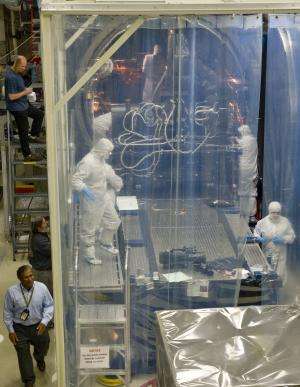
The TIRS instrument sits half out of the thermal vacuum chamber while still protected in a clean tent, as team members disconnect the electrical wires and cooling lines after testing. Credit:NASA/Goddard/Bill Hrybyk

Three shifts of engineers manned the testing facility at Goddard 24-7 while TIRS was in the thermal-vacuum test chamber. Inside the blue cylindrical chamber, TIRS viewed targets that provided calibrated thermal illumination for TIRS to sense and sent data to a computer that simulated the spacecraft. The air was pumped out and the temperature in the chamber lowered with liquid nitrogen. Then the instrument's cryocooler was turned on. The cryocooler's job is to maintain a steady 43 K for the three detector arrays even when the chamber temperature goes up and down -- mimicking the temperature changes on the light and dark sides of Earth in space as the satellite orbits our planet.

"In many areas TIRS is even exceeding its requirements," says Deputy Instrument Manager Betsy Forsbacka at Goddard.

A few surprises occurred as well, including the cryocooler working more efficiently than expected and cooling the detectors an extra 5 degrees Kelvin -- good news for the heat-sensitive detector arrays. But these kinds of surprises are normal at this stage of testing, and finding them now means the team has time to understand and adjust procedures for operating the instrument, says Forsbacka.

As TIRS heads into environmental testing, including another round in the thermal vacuum chamber, the engineering team is working hard to iron out the kinks to meet their tight delivery deadline. The schedule is "the elephant in the room," says Forsbacka, but she is confident they'll make it. "The big things are going right," she says. And for an instrument that usually takes four years to make space-ready, she adds that the team has gone above and beyond. "We're this close to building an instrument in three years that nobody thought we could do."

TIRS is scheduled to be on the dock and ready for integration with the LDCM spacecraft at Orbital Science Corp. in Gilbert, Ariz. in late January, 2012.

Provided by NASA's Goddard Space Flight Center search and more info website


Rank not rated yet
Relevant PhysicsForums posts
  • Distance of planets from stars and revolution
    created6 hours ago
  • revamping general concept and cosmological principle
    createdMay 25, 2012
  • Transiting Exoplanet Light Curve
    createdMay 25, 2012
  • Math behind Theoretical Physics
    createdMay 24, 2012
  • Do we know whats at the center of galaxies yet?
    createdMay 23, 2012
  • Structure of the Milky Way?
    createdMay 20, 2012
  • More from Physics Forums - General Astronomy

More news stories

Land and sea species differ in climate change response: study

(Phys.org) -- Marine and terrestrial species will likely differ in their responses to climate warming, new research by Simon Fraser University and Australia’s University of Tasmania has found.

Space & Earth / Environment

created 4 hours ago | popularity 3.7 / 5 (3) | comments 5 | with audio podcast

Yale study concludes public apathy over climate change unrelated to science literacy

Are members of the public divided about climate change because they don't understand the science behind it? If Americans knew more basic science and were more proficient in technical reasoning, would public consensus match ...

Space & Earth / Environment

created 6 hours ago | popularity 4.8 / 5 (5) | comments 12 | with audio podcast

10 million years needed to recover from mass extinction

It took some 10 million years for Earth to recover from the greatest mass extinction of all time, latest research has revealed.

Space & Earth / Earth Sciences

created 6 hours ago | popularity 5 / 5 (3) | comments 1 | with audio podcast

Sophisticated simulations predict future warming

The chances of our planet being hit by a global warming of 3 degrees Celsius by 2050 is as likely as it being hit by an increase of 1.4 degrees, new research shows. Presented in the journal Nature Geoscience, the British study ...

Space & Earth / Earth Sciences

created May 22, 2012 | popularity 4.4 / 5 (9) | comments 51

Aliens don't want to eat us, says former SETI director

Alien life probably isn’t interested in having us for dinner, enslaving us or laying eggs in our bellies, according to a recent statement by former SETI director Jill Tarter.

Space & Earth / Space Exploration

created May 25, 2012 | popularity 4.4 / 5 (15) | comments 41


Stunning image of smallest possible five-ringed structure

Scientists have created and imaged the smallest possible five-ringed structure – about 100,000 times thinner than a human hair – and you'll probably recognise its shape.

'Unzipped' carbon nanotubes could help energize fuel cells, batteries

Multi-walled carbon nanotubes riddled with defects and impurities on the outside could replace some of the expensive platinum catalysts used in fuel cells and metal-air batteries, according to scientists at ...

Change in developmental timing was crucial in the evolutionary shift from dinosaurs to birds: study

At first glance, it's hard to see how a common house sparrow and a Tyrannosaurus Rex might have anything in common. After all, one is a bird that weighs less than an ounce, and the other is a dinosaur that ...

Computer model used to pinpoint prime materials for efficient carbon capture

When power plants begin capturing their carbon emissions to reduce greenhouse gases – and to most in the electric power industry, it's a question of when, not if – it will be an expensive undertaking.

T cells 'hunt' parasites like animal predators seek prey, study shows

By pairing an intimate knowledge of immune-system function with a deep understanding of statistical physics, a cross-disciplinary team at the University of Pennsylvania has arrived at a surprising finding: T cells use a movement ...

Scientists develop ultra-sensitive test that detects diseases in their earliest stages

Scientists have developed an ultra-sensitive test that should enable them to detect signs of a disease in its earliest stages, in research published today in the journal Nature Materials.