Invoked computing: Pizza box is too loud! I can't hear the banana
November 22, 2011 by Nancy Owano report

Invoked computing: Pizza box is too loud! I can't hear the banana

Enlarge

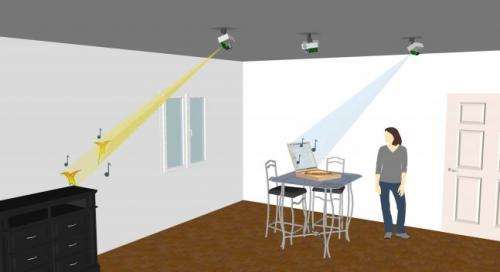
'Invoked Computing' at home

(PhysOrg.com) -- Mention the buzz word ubiquitous to any technology futurists and they will know what that implies. Hardware as we know it will recede. More people will communicate with words and images embedded in walls, on boxes, as part of room furniture and kitchen appliances. Pretty much the entire physical environment, not a screen, will be the canvas for carrying and sharing information. Some futurists call it computing’s third wave, following the mainframe and then the PC and mobile gadgets.

But here is an interesting recent twist. Researchers at the Ishikawa-Oku lab at the University of Tokyo are eagerly sharing their Invoked Computing . It’s about “spatial audio and video” augmented reality that is invoked through miming. At least that is one way to describe the concept. Another way is this.

This video is not supported by your browser at this time.

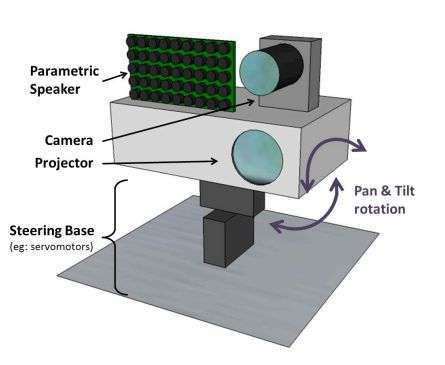
Researchers taking part in the “invoked computing” project are working up a multimodal augmented reality system that can transform everyday objects into communication devices on the spot. To “invoke” an application, the user just needs to mimic a specific scenario.

DigInfo recently released a video of the demos. The presentation shows how the team puts their concept into action. There is a banana scenario where the person takes a banana out of a fruit bowl and brings it closer to his ear. A high speed camera tracks the banana; a parametric speaker array directs the sound in a narrow beam. The person talks into the banana as if it were a conventional phone.
Invoked computing: Pizza box is too loud! I can't hear the banana
“With an iPhone, for example, you have everything in a small device and you have to learn how to use it,” said project spokesperson, Alexis Zerroug, whose university work in Tokyo is focused on virtual reality and machine human interfaces. “Here we want to do the opposite; the computer will have to learn what you want to do.”

Another concept example that the team presents is “a laptop in a pizza box.” Video and sound are projected onto the lid of the pizza box. The user interacts with what he sees on the pizza box, moving a playhead and changing the volume.

Zerroug, Alvaro Cassinelli, and Masatoshi Ishikawa recently won grand prize at the Laval Virtual 2011 in France for their concept demo. They also had the concept on display at the Digital Contents Expo in Tokyo. At the expo, their entry had the following descriptive notes:”Our multimodal AR system will detect objects and augment them with images and sounds. For example, you can take a banana and use it as a phone handset, or a pizza box as a laptop computer.”

More information: Researchers' website

© 2011 PhysOrg.com

Filter


Move the slider to adjust rank threshold, so that you can hide some of the comments.


Display comments: newest first

Isaacsname
Nov 22, 2011

Rank: 5 / 5 (2)
I see I'm not the only person with an affinity for bananaphones :)

I like where this is going. Have they tried any sort of integration with domestic animals ?
Nerdyguy
Nov 22, 2011

Rank: 5 / 5 (1)
I always get a chuckle reading these kind of futuristic "predictions". They could be right, but lots of things I've been reading for decades in scifi just don't pan out. Sometimes, because people just really don't care all that much. I mean, I'd personally be interested in a nano-level communication system between me and everything I own, to the point of integrated sensors allowing me to "see" the hawk soaring over my house or "feel" the electricity coursing through the grid. But, that kind of thing may just not happen because, as is so often the case in a consumer economy, there's just not enough profit in it. But I can dream.
Ricochet
Nov 23, 2011

Rank: not rated yet
If something like this goes into place, then that scene in Dreamcatcher where the guy's talking to his friend "through the gun" wouldn't seem odd at all to the generation that grows up with the technology. And kids would think that we had this technology all the way back to Maxwell Smart's generation.
Rank 5 /5 (4 votes)
Relevant PhysicsForums posts

More news stories

Browser wars flare in mobile space

The browser wars are heating up again, but this time the fight is for dominance of the mobile Internet.

Technology / Software

created 14 hours ago | popularity 5 / 5 (2) | comments 3

Probability of contamination from severe nuclear reactor accidents is higher than expected: study

Catastrophic nuclear accidents such as the core meltdowns in Chernobyl and Fukushima are more likely to happen than previously assumed. Based on the operating hours of all civil nuclear reactors and the number ...

Technology / Energy & Green Tech

created May 22, 2012 | popularity 3.6 / 5 (25) | comments 56 | with audio podcast

HyperSolar shows dirty water no barrier to power world

(Phys.org) -- The Santa Barbara, California, company, HyperSolar, is set to transparently share the ups and downs of its research experiences toward the company’s ultimate vision, successfully producing ...

Technology / Energy & Green Tech

created May 24, 2012 | popularity 4.8 / 5 (16) | comments 17 | with audio podcast report

SpotterRF debuts Radar Backpack Kit (w/ Video)

(Phys.org) -- SpotterRF has announced a special radar backpack kit designed to enhance situational awareness for soldiers on the ground. The company says its special radar is designed for warfighters as part ...

Technology / Hi Tech & Innovation

created May 26, 2012 | popularity 5 / 5 (5) | comments 13 | with audio podcast report

Tesla to launch electric sedan in US on June 22

Tesla Motors said Tuesday it would begin deliveries of "the world's first premium electric sedan" on June 22, slightly ahead of schedule.

Technology / Energy & Green Tech

created May 22, 2012 | popularity 4.5 / 5 (12) | comments 18


Stunning image of smallest possible five-ringed structure

Scientists have created and imaged the smallest possible five-ringed structure – about 100,000 times thinner than a human hair – and you'll probably recognise its shape.

'Unzipped' carbon nanotubes could help energize fuel cells, batteries

Multi-walled carbon nanotubes riddled with defects and impurities on the outside could replace some of the expensive platinum catalysts used in fuel cells and metal-air batteries, according to scientists at ...

Change in developmental timing was crucial in the evolutionary shift from dinosaurs to birds: study

At first glance, it's hard to see how a common house sparrow and a Tyrannosaurus Rex might have anything in common. After all, one is a bird that weighs less than an ounce, and the other is a dinosaur that ...

Computer model used to pinpoint prime materials for efficient carbon capture

When power plants begin capturing their carbon emissions to reduce greenhouse gases – and to most in the electric power industry, it's a question of when, not if – it will be an expensive undertaking.

T cells 'hunt' parasites like animal predators seek prey, study shows

By pairing an intimate knowledge of immune-system function with a deep understanding of statistical physics, a cross-disciplinary team at the University of Pennsylvania has arrived at a surprising finding: T cells use a movement ...

Land and sea species differ in climate change response: study

(Phys.org) -- Marine and terrestrial species will likely differ in their responses to climate warming, new research by Simon Fraser University and Australia’s University of Tasmania has found.