Researchers ink nanostructures with tiny 'soldering iron'

Thermal dip-pen nanolithography turns the tip of scanning probe microscope into a tiny soldering iron that can be used to draw chemical patterns as small as 20 nanometers on surfaces. Credit: Image courtesy of DeYoreo, et. al
Researchers with the Lawrence Berkeley National Laboratory (Berkeley Lab) have shed light on the role of temperature in controlling a fabrication technique for drawing chemical patterns as small as 20 nanometers. This technique could provide an inexpensive, fast route to growing and patterning a wide variety of materials on surfaces to build electrical circuits and chemical sensors, or study how pharmaceuticals bind to proteins and viruses.
One way of directly writing nanoscale structures onto a substrate is to use an atomic force microscope (AFM) tip as a pen to deposit ink molecules through molecular diffusion onto the surface. Unlike conventional nanofabrication techniques that are expensive, require specialized environments and usually work with only a few materials, this technique, called dip-pen nanolithography, can be used in almost any environment to write many different chemical compounds. A cousin of this technique called thermal dip-pen nanolithography extends this technique to solid materials by turning an AFM tip into a tiny soldering iron.
Dip-pen nanolithography can be used to pattern features as small as 20 nanometers, more than forty thousand times smaller than the width of a human hair. What's more, the writing tip also performs as a surface profiler, allowing a freshly-writ surface to be imaged with nanoscale precision immediately after patterning.
"Tip-based manufacturing holds real promise for precise fabrication of nanoscale devices," says Jim DeYoreo, interim director of Berkeley Lab's Molecular Foundry, a DOE nanoscience research center. "However, a robust technology requires a scientific foundation built on an understanding of material transfer during this process. Our study is the first to provide this fundamental understanding of thermal dip-pen nanolithography."
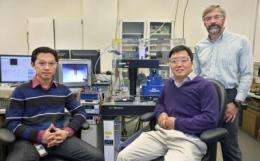
Debin Wang, Sungwook Chung and James DeYoreo at Berkeley Lab’s Molecular Foundry have shed light on a tip-based fabrication technique for patterning a wide variety of materials on surfaces to build electrical circuits and chemical sensors, or study how pharmaceuticals bind to proteins and viruses. Credit: Photo by Roy Kaltschmidt, Berkeley Lab
In this study, DeYoreo and coworkers systematically investigated the effect of temperature on feature size. Using their results, the team developed a new model to deconstruct how ink molecules travel from the writing tip to the substrate, assemble into an ordered layer and grow into a nanoscale feature."By carefully considering the role of temperature in thermal dip-pen nanolithography, we may be able to design and fabricate nanoscale patterns of materials ranging from small molecules to polymers with better control over feature sizes and shapes on a variety of substrates," says Sungwook Chung, a staff scientist in Berkeley Lab's Physical Biosciences Division, and Foundry user working with DeYoreo.
"This technique helps overcome fundamental length scale limitations without the need for complex growth methods."
DeYoreo and Chung collaborated with a research team from the University of Illinois at Urbana-Champaign that specializes in fabricating specialized tips for AFMs. Here, these collaborators developed a silicon-based AFM tip with a gradient of charge-carrying atoms sprinkled into the silicon such that a higher number reside at the base while fewer sit at the tip. This makes the tip heat up when electricity flows through it, much like the burner on an electric stove.
This 'nanoheater' can then be used to heat up inks applied to the tip, causing them to flow to the surface for fabricating microscale and nanoscale features. The group demonstrated this by drawing dots and lines of the organic molecule mercaptohexadecanoic acid on gold surfaces. The hotter the tip, the larger the feature size the team could draw.
"We are excited about this collaboration with Berkeley Lab, which combines their remarkable nanoscience capabilities with our technology to control temperature and heat flow on the nanometer scale," says co-author William P. King, a University of Illinois professor of mechanical sciences and engineering. "Our ability to control the temperature within a nanometer-scale spot enabled this study of molecular-scale transport. By tuning the hotspot temperature, we can probe how molecules flow to a surface."
"This thermal control over tip-to-surface transfer developed by Professor King's group adds versatility by enabling on-the-fly variations in feature size and patterning of both liquid and solid materials," DeYoreo adds.
More information: "Temperature-dependence of ink transport during thermal dip-pen nanolithography."
Provided by
Lawrence Berkeley National Laboratory
-
From lemons to lemonade: Reaction uses carbon dioxide to make carbon-based semiconductor,
32 comments
-
Thioridazine kills cancer stem cells in human while avoiding toxic side-effects of conventional cancer treatments,
3 comments
-
SpaceX private rocket blasts off for space station (Update),
42 comments
-
Climate scientists say they have solved riddle of rising sea,
31 comments
-
SpaceX capsule has 'new car' smell, astronauts say (Update),
4 comments
-
Why does a boiled egg rotates while a raw egg doesn't?
2 hours ago
-
Lightning strike in mindair
2 hours ago
-
Why does light move?
4 hours ago
-
How to calculate the repulsion force between a permanent and an electromagnet?
5 hours ago
-
Why does light allow us to see things?
5 hours ago
-
Room temperature superconductivity
5 hours ago
- More from Physics Forums - General Physics
More news stories
Stunning image of smallest possible five-ringed structure
Scientists have created and imaged the smallest possible five-ringed structure about 100,000 times thinner than a human hair and you'll probably recognise its shape.
42 minutes ago |
4.5 / 5 (2) |
0
|
'Unzipped' carbon nanotubes could help energize fuel cells, batteries
Multi-walled carbon nanotubes riddled with defects and impurities on the outside could replace some of the expensive platinum catalysts used in fuel cells and metal-air batteries, according to scientists at ...
Nanotechnology / Nanomaterials
6 hours ago |
1 / 5 (1) |
0
|
Dopant gives graphene solar cells highest efficiency yet
(Phys.org) -- By taking advantage of graphenes favorable electrical and optical properties, and then adding an organic dopant, researchers have achieved the highest power conversion efficiency yet for ...
In nanorod crystal growth, nanoparticles seen as artificial atoms
In the growth of crystals, do nanoparticles act as "artificial atoms" forming molecular-type building blocks that can assemble into complex structures? This is the contention of a major but controversial theory ...
May 24, 2012 |
4.8 / 5 (6) |
0
|
First direct observation of oriented attachment in nanocrystal growth
Berkeley Lab researchers have reported the first direct observation of nanoparticles undergoing oriented attachment, the critical step in biomineralization and the growth of nanocrystals. A better understanding ...
May 24, 2012 |
4.7 / 5 (3) |
0
|
Change in developmental timing was crucial in the evolutionary shift from dinosaurs to birds: study
At first glance, it's hard to see how a common house sparrow and a Tyrannosaurus Rex might have anything in common. After all, one is a bird that weighs less than an ounce, and the other is a dinosaur that ...
Computer model used to pinpoint prime materials for efficient carbon capture
When power plants begin capturing their carbon emissions to reduce greenhouse gases and to most in the electric power industry, it's a question of when, not if it will be an expensive undertaking.
T cells 'hunt' parasites like animal predators seek prey, study shows
By pairing an intimate knowledge of immune-system function with a deep understanding of statistical physics, a cross-disciplinary team at the University of Pennsylvania has arrived at a surprising finding: T cells use a movement ...
Land and sea species differ in climate change response: study
(Phys.org) -- Marine and terrestrial species will likely differ in their responses to climate warming, new research by Simon Fraser University and Australia’s University of Tasmania has found.
Yale study concludes public apathy over climate change unrelated to science literacy
Are members of the public divided about climate change because they don't understand the science behind it? If Americans knew more basic science and were more proficient in technical reasoning, would public consensus match ...
10 million years needed to recover from mass extinction
It took some 10 million years for Earth to recover from the greatest mass extinction of all time, latest research has revealed.
