Inconstant supernovae?
November 7, 2011 By Steve Nerlich, Universe Today

Inconstant supernovae?

Enlarge

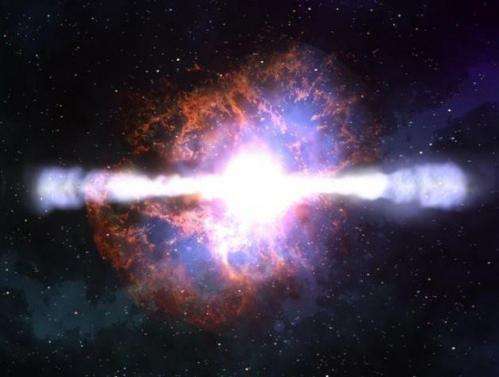
Any discrepancies in Type 1a supernovae light curves need to be accounted for when we use them as 'standard candles' to estimate the nature of the universe. Credit: NASA.

Given the importance of Type 1a supernovae as the standard candles which demonstrate that the universe’s expansion is actually accelerating – we require a high degree of confidence that those candles really are standard.

A paper released on Arxiv, with a list of authors reading like a Who’s Who in cosmology and including all three winners of this year’s Nobel Prize in Physics, details an ultraviolet (UV) analysis of four Type 1a , three of which represent significant outliers from the standard light curve expected of Type 1a supernovae.

Some diversity in UV output has already been established from observing distant high red-shift Type 1a supernovae, since their UV output is shifted into and can hence be observed through the atmosphere. However, to gain detailed observations in UV, you need to look at closer, less red-shifted Type 1a supernovae and hence you need space telescopes. These researchers used data collected by the ACS (Advanced Camera for Surveys) on the Hubble Space Telescope.

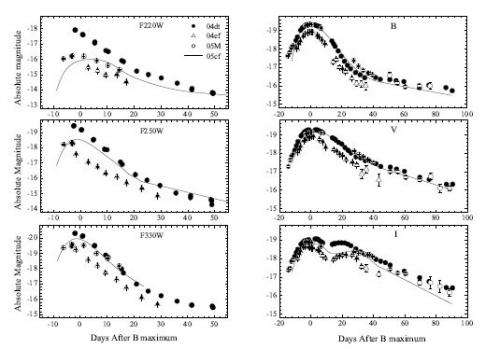
The supernovae studied were SN 2004dt, SN 2004ef, SN 2005M and SN 2005cf. SN 2005cf is considered a ‘gold standard’ Type 1a supernovae – while the other three show considerable diversion from the standard UV light curve, even though their optical light output looks standard.

The researchers also looked at a slightly larger dataset of UV supernovae observations made by the Swift spacecraft – which also showed a similar diversity in UV light, that was not apparent in optical light.

This is a bit of a worry, since the supernovae dataset from which we conclude that the universe is expanding is largely based on observations in optical light which, unlike UV, can make it through the atmosphere and be collected by ground-based telescopes.
Inconstant supernovae?
Enlarge

The left side diagrams show the three anomalous Type 1a supernovae light curves in UV light through three filters. The three outlier supernovae are mapped against the light curve of SN 2005cf (solid line), considered a 'gold standard' light curve. The diversity of the other three supernovae is apparent in UV, but not in optical - as shown in the frames on the right side. Credit: Wang et al.

Nonetheless, if you are thinking that three outliers isn’t a lot – you’d be right. The paper’s aim is to indicate that there are minor discrepancies in the current data set upon which we have built our current model of the universe. The academic muscle that is focused on this seemingly minor issue is some indication of the importance of isolating and characterising the nature any such discrepancies, so that we can continue to have confidence in the Type 1a supernovae standard candle dataset – or not.

The researchers acknowledge that the UV excess – not seen at all in SN 2005cf, but seen in varying degrees in the other three Type 1a supernovae – with the most pronounced difference seen in SN 2004dt – is a problem, even if it is not a huge problem.

As standard candles, Type 1a supernovae (or SNe1a) are key to determining the distance of their host galaxies. A higher than expected UV flux in some SNe1a could enhance their brightness in visible light (in cases where the unexpectedly bright UV is red-shifted into unexpectedly bright blue light). Such SNe1a would then be picked up in ground-based SNe1a sky surveys as misleadingly bright SNe1a – and their host galaxies would be determined as being closer to us than they really are.

The researchers call this another possible systematic error within the current SNe1a-based calculations of the nature of the universe – those other possible systematic errors including the metallicity of the supernovae themselves, as well as the size, density and chemistry of their host galaxy.

The key question to take forward now is what proportion of the total population of SNe1a in the might have this high UV flux. To answer that we will need to get more space telescope data.

More information: Wang et al. Evidence for Type Ia Supernova Diversity from Ultraviolet Observations with the Hubble Space Telescope.

Source: Universe Today

Filter


Move the slider to adjust rank threshold, so that you can hide some of the comments.


Display comments: newest first

omatumr
Nov 07, 2011

Rank: 1 / 5 (5)
Thanks for the story.

If supernova remains consist of

A.) Debris that emits UV, and
B.) Debris that emits Visible

Could the observations be explained by differences in the A/B ratio?

With kind regards,
Oliver K. Manuel
http://myprofile....anuelo09
Rank 5 /5 (1 vote)
Relevant PhysicsForums posts
  • Distance of planets from stars and revolution
    created7 hours ago
  • revamping general concept and cosmological principle
    createdMay 25, 2012
  • Transiting Exoplanet Light Curve
    createdMay 25, 2012
  • Math behind Theoretical Physics
    createdMay 24, 2012
  • Do we know whats at the center of galaxies yet?
    createdMay 23, 2012
  • Structure of the Milky Way?
    createdMay 20, 2012
  • More from Physics Forums - General Astronomy

More news stories

Land and sea species differ in climate change response: study

(Phys.org) -- Marine and terrestrial species will likely differ in their responses to climate warming, new research by Simon Fraser University and Australia’s University of Tasmania has found.

Space & Earth / Environment

created 4 hours ago | popularity 3.7 / 5 (3) | comments 5 | with audio podcast

Yale study concludes public apathy over climate change unrelated to science literacy

Are members of the public divided about climate change because they don't understand the science behind it? If Americans knew more basic science and were more proficient in technical reasoning, would public consensus match ...

Space & Earth / Environment

created 6 hours ago | popularity 4.8 / 5 (5) | comments 12 | with audio podcast

10 million years needed to recover from mass extinction

It took some 10 million years for Earth to recover from the greatest mass extinction of all time, latest research has revealed.

Space & Earth / Earth Sciences

created 6 hours ago | popularity 5 / 5 (3) | comments 1 | with audio podcast

Sophisticated simulations predict future warming

The chances of our planet being hit by a global warming of 3 degrees Celsius by 2050 is as likely as it being hit by an increase of 1.4 degrees, new research shows. Presented in the journal Nature Geoscience, the British study ...

Space & Earth / Earth Sciences

created May 22, 2012 | popularity 4.4 / 5 (9) | comments 51

Aliens don't want to eat us, says former SETI director

Alien life probably isn’t interested in having us for dinner, enslaving us or laying eggs in our bellies, according to a recent statement by former SETI director Jill Tarter.

Space & Earth / Space Exploration

created May 25, 2012 | popularity 4.4 / 5 (15) | comments 41


Stunning image of smallest possible five-ringed structure

Scientists have created and imaged the smallest possible five-ringed structure – about 100,000 times thinner than a human hair – and you'll probably recognise its shape.

'Unzipped' carbon nanotubes could help energize fuel cells, batteries

Multi-walled carbon nanotubes riddled with defects and impurities on the outside could replace some of the expensive platinum catalysts used in fuel cells and metal-air batteries, according to scientists at ...

Change in developmental timing was crucial in the evolutionary shift from dinosaurs to birds: study

At first glance, it's hard to see how a common house sparrow and a Tyrannosaurus Rex might have anything in common. After all, one is a bird that weighs less than an ounce, and the other is a dinosaur that ...

Computer model used to pinpoint prime materials for efficient carbon capture

When power plants begin capturing their carbon emissions to reduce greenhouse gases – and to most in the electric power industry, it's a question of when, not if – it will be an expensive undertaking.

T cells 'hunt' parasites like animal predators seek prey, study shows

By pairing an intimate knowledge of immune-system function with a deep understanding of statistical physics, a cross-disciplinary team at the University of Pennsylvania has arrived at a surprising finding: T cells use a movement ...

Scientists develop ultra-sensitive test that detects diseases in their earliest stages

Scientists have developed an ultra-sensitive test that should enable them to detect signs of a disease in its earliest stages, in research published today in the journal Nature Materials.