Image: Saturn's Northern storm
Nov 21, 2011
Image Credit:NASA/JPL-Caltech/Space Science Institute

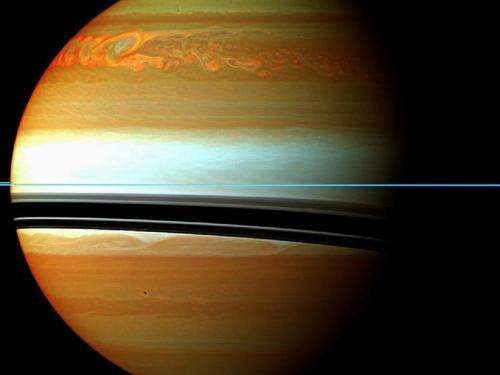
(PhysOrg.com) -- This false-color mosaic from NASA's Cassini spacecraft shows the tail of Saturn's huge northern storm. In mid-September 2004, the Cassini spacecraft chronicled a similar, but smaller, storm in the southern hemisphere called the "Dragon Storm."

The head of this storm is beyond the horizon in this view. Saturn's atmosphere and its rings are shown here in a false color composite made from 12 images taken in near-infrared light through filters that are sensitive to varying degrees of methane absorption. Red and orange colors in this view indicate clouds that are deep in the atmosphere. Yellow and green colors, most noticeable near the top of the view, indicate intermediate clouds. White and blue indicate and haze. The rings appear as a thin horizontal line of bright blue because they are outside of the atmosphere and not affected by methane absorption.

The oval in the upper left of this image that appears slightly blue is the same hole in the deep clouds of the planet's atmosphere that can be seen near the tail in a larger false-color mosaic, PIA14903. The blue color comes from the high haze overlying the hole.

This view looks toward the northern, sunlit side of the rings from just above the ring plane. The shadow of the is visible on the planet in the lower left of the image.

The images were taken with the wide-angle camera using a combination of spectral filters sensitive to wavelengths of near-infrared light. The images filtered at 890 nanometers are projected as blue. The images filtered at 728 nanometers are projected as green, and images filtered at 752 nanometers are projected as red.

The images were taken on Jan. 12, 2011, over about one hour at a distance of approximately 684,000 miles (1.1 million kilometers) from Saturn and at a sun-Saturn-spacecraft, or phase, angle of 52 degrees. The images were re-projected to the same viewing geometry, so that scale in this final mosaic is 76 miles (122 kilometers) per pixel.

Explore further: Communications satellite launched into space

add to favorites email to friend print save as pdf

Related Stories

Image: Rings around a crescent

Nov 23, 2010

A crescent Saturn appears nestled within encircling rings in this Cassini spacecraft image. Clouds swirl through the atmosphere of the planet and a barely visible Prometheus orbits between the planet's main ...

Rings on the horizon

Jan 26, 2011

The Cassini spacecraft has taken a some recent images of two of Saturn’s most notorious moons, where in both images the planet’s rings serve as a backdrop. Above, Enceladus stands out with its cratered ...

Strings of Shadowy Rings Drape Saturn

Sep 17, 2004

Saturn's ring shadows appear wrapped in a harmonious symphony with the planet in this color view from the Cassini spacecraft. Saturn and its rings would nearly fill the space between Earth and the Moon. Ye ...

'Chinese Lantern' Technique Helps Track Clouds at Saturn

Oct 05, 2006

A new image of Saturn demonstrates a technique that creates a 'Chinese lantern' effect, showing Saturn's deep clouds silhouetted against the planet’s warm, glowing interior. Seen this way, Saturn's interior ...

Recommended for you

Dark, massive asteroid to fly by Earth on May 31

May 24, 2013

It's 1.7 miles long. Its surface is covered in a sticky black substance similar to the gunk at the bottom of a barbecue. If it impacted Earth it would probably result in global extinction. Good thing it is ...

Research team explains 'Lazarus' comets

May 24, 2013

Astronomers from the University of Antioquia have discovered a graveyard of comets. These once-dormant comets, dubbed by astronomers as "The Lazarus comets," are now rejuvenated.

NASA ships sensors for seafaring satellite to France

May 24, 2013

(Phys.org) —Three NASA-built instruments that are integral components of the next in a series of U.S./European ocean altimetry satellites have arrived in France for integration with their spacecraft in ...

Trip into space with DiCaprio costs $1.55m

May 24, 2013

Leonardo DiCaprio is going to get closer to stars of a different kind as he heads into space aboard the Virgin Galactic, and a well-heeled bidder at the Cannes Film Festival has paid 1.2 million euros (1.5 million) to be ...

User comments : 0

More news stories

Galaxies fed by funnels of fuel

(Phys.org) —Computer simulations of galaxies growing over billions of years have revealed a likely scenario for how they feed: a cosmic version of swirly straws.