Report IDs nation's 101 top conservation projects
November 3, 2011 By MATT VOLZ , Associated Press

Report IDs nation's 101 top conservation projects (AP)

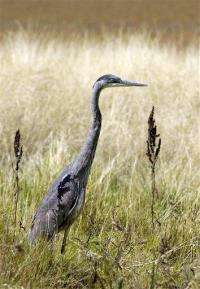
FILE - This Oct. 14, 2003 file photo shows a great blue heron wandering at the Bear River Migratory Bird Refuge, southwest of Brigham City, Utah. A new Interior Department report identifies 101 high-priority conservation projects, including the Bear River Migratory Bird Refuge, across the nation as part of America’s Great Outdoors Initiative. (AP Photo/Douglas C. Pizac, File)

(AP) -- An Interior Department report released Thursday identifies 101 high-priority conservation projects across the nation as part of President Barack Obama's initiative to protect public lands, but it says most will have to find funding somewhere besides the U.S. government.

The report outlines two projects in each state and one in the District of Columbia in various stages of development, ranging from the creation of an all-season trail system in Alaska's Denali State Park to the completion of a 32-mile trail through urban areas in central Florida.

Representatives from all 50 states who were asked to identify specific projects in which the federal government could form partnerships as part of the America's Great Outdoors Initiative.

Some could be completed within in a few years, while others would take several decades, Interior Secretary Ken Salazar said.

Salazar said he didn't know the total cost, and the report says the federal agency won't be able to fund most of them, "given the fiscal constraints facing the federal government."

"We could do more if we had more funding," Salazar said. "I'm hopeful that as Congress considers appropriations for the future, they will recognize is important for very important reasons, such as jobs."

Many of the projects have already launched, and the will be able to help the state and local groups leading them by reallocating existing revenue within the agency and by providing technical assistance, he said.

The agency could also help the groups by acquiring conservation easements and grants, according to the report.

The report is part of the Obama administration's conservation initiative meant to protect public land, encourage more people to enjoy the outdoors and bolster employment in tourism and recreation.

When Obama announced the initiative earlier in February, it aimed to double federal spending on land and water conservation to $900 million to buy private land for public use and provide grants to states.

The Obama administration came under fire last year for an internal memo that identified several areas in the West as potential national monuments. Critics had pointed to that as a sign the administration aimed to unilaterally lock up land from development.

Bob Ekey, spokesman for the Wilderness Society, said the new report shows the Interior Department has decided upon a more collaborative approach. The agency is focused on community-based conservation, which makes the projects slower to develop but means more people are involved, he said.

"It's gone more slowly than a lot of us would like to see, but it has great promise in helping people connect to the land and to nature," Ekey said.

Salazar, conscious of the concerns raised by the national monument memo, said it's important to protect rural landscapes but in a way that maintains private ownership.

"The reality is, all these projects have very strong local, county and state support," Salazar said. "The days of the federal government buying up large stretches of land ... are over. We aren't going to do that anymore."

U.S. Rep Denny Rehberg, the Montana Republican who has been vocal following the national monuments memo in his criticism of the department's conservation plans, said in a statement Thursday that he hopes the administration has turned a corner.

"After two years of leaked secret memos and top-down wilderness plans, I'm hopeful the Obama administration is finally beginning to realize the importance of public input. It's critical that land initiatives be based on consensus and not just collaboration" Rehberg said.

©2011 The Associated Press. All rights reserved. This material may not be published, broadcast, rewritten or redistributed.


Rank 5 /5 (1 vote)
Relevant PhysicsForums posts

More news stories

Land and sea species differ in climate change response: study

(Phys.org) -- Marine and terrestrial species will likely differ in their responses to climate warming, new research by Simon Fraser University and Australia’s University of Tasmania has found.

Space & Earth / Environment

created 4 hours ago | popularity 3.7 / 5 (3) | comments 5 | with audio podcast

Yale study concludes public apathy over climate change unrelated to science literacy

Are members of the public divided about climate change because they don't understand the science behind it? If Americans knew more basic science and were more proficient in technical reasoning, would public consensus match ...

Space & Earth / Environment

created 6 hours ago | popularity 4.8 / 5 (5) | comments 12 | with audio podcast

10 million years needed to recover from mass extinction

It took some 10 million years for Earth to recover from the greatest mass extinction of all time, latest research has revealed.

Space & Earth / Earth Sciences

created 6 hours ago | popularity 5 / 5 (3) | comments 1 | with audio podcast

Sophisticated simulations predict future warming

The chances of our planet being hit by a global warming of 3 degrees Celsius by 2050 is as likely as it being hit by an increase of 1.4 degrees, new research shows. Presented in the journal Nature Geoscience, the British study ...

Space & Earth / Earth Sciences

created May 22, 2012 | popularity 4.4 / 5 (9) | comments 51

Aliens don't want to eat us, says former SETI director

Alien life probably isn’t interested in having us for dinner, enslaving us or laying eggs in our bellies, according to a recent statement by former SETI director Jill Tarter.

Space & Earth / Space Exploration

created May 25, 2012 | popularity 4.4 / 5 (15) | comments 41


Stunning image of smallest possible five-ringed structure

Scientists have created and imaged the smallest possible five-ringed structure – about 100,000 times thinner than a human hair – and you'll probably recognise its shape.

'Unzipped' carbon nanotubes could help energize fuel cells, batteries

Multi-walled carbon nanotubes riddled with defects and impurities on the outside could replace some of the expensive platinum catalysts used in fuel cells and metal-air batteries, according to scientists at ...

Change in developmental timing was crucial in the evolutionary shift from dinosaurs to birds: study

At first glance, it's hard to see how a common house sparrow and a Tyrannosaurus Rex might have anything in common. After all, one is a bird that weighs less than an ounce, and the other is a dinosaur that ...

Computer model used to pinpoint prime materials for efficient carbon capture

When power plants begin capturing their carbon emissions to reduce greenhouse gases – and to most in the electric power industry, it's a question of when, not if – it will be an expensive undertaking.

T cells 'hunt' parasites like animal predators seek prey, study shows

By pairing an intimate knowledge of immune-system function with a deep understanding of statistical physics, a cross-disciplinary team at the University of Pennsylvania has arrived at a surprising finding: T cells use a movement ...

Scientists develop ultra-sensitive test that detects diseases in their earliest stages

Scientists have developed an ultra-sensitive test that should enable them to detect signs of a disease in its earliest stages, in research published today in the journal Nature Materials.