HzO demos cell phone water-proofing product (w/ video)
November 16, 2011 by Bob Yirka
(PhysOrg.com) -- A company called HzO has unveiled what it calls an invisible vapor coating for electronic and other devices to prevent water damage, this week at the New York Press Preview prior to the annual CES show in Las Vegas in January. The demo showed a smartphone being dropped into a bowl of water and receiving a call while still submerged. After retrieval from the water, the phone appears to work as normal. The company says its product doesnt seal the case of the phone, but the electronics inside.
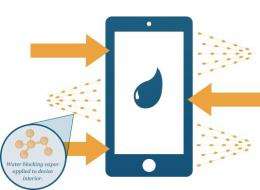
At the demo, company President and CEO Paul S. Clayson explained that the company employs a nano-scale film barrier, that according to an official video put out by the company, covers all the nooks and crannies that occur inside (and out presumably) of virtually any device. To that effect, a treated business card was also dropped into the water and survived without soaking up so much as a drop.
This video is not supported by your browser at this time.
At this time it appears the name of the product and the name of the company are one and the same, i.e. HzO. The company says it has formed an alliance with Zagg, a company that currently makes protective electronic skins to ward off scratches and other damage to Smartphones, iPhones, etc. to market the first devices treated with the new technology.The whole idea, the company says, is to protect consumers from the device killing attributes of water. On their website , they say that millions of cell phones are killed every year due to spillage or phones being dropped into water (mainly into toilets by men presumably).
Also, the company says their product coats at the molecular or nanoscale level which means it should be virtually invisible (thus it wont distort the display) and perhaps cant be felt either. More will be known when January rolls around and consumers get the chance to get their hands on a treated device at CES.
This video is not supported by your browser at this time.
At this point, it appears that the product would have to be applied by the manufacturer, seeing as how the company says that water does indeed penetrate the device, it just isnt allowed to cause any havoc once in there. Also unclear is just how such devices are actually treated, (an official company video calls it a unique technology process) though it appears that it is sprayed on. Common sense would say that the individual parts of the phone are sprayed, both inside and out, and then the device is assembled. Though clearly in this case the phone was disassembled by HzO (since they dont manufacture the Galaxy S II used in the demo) sprayed, then reassembled, which might mean a new niche market is about to emerge if the new product works as well as advertised.© 2011 PhysOrg.com
-
From lemons to lemonade: Reaction uses carbon dioxide to make carbon-based semiconductor,
32 comments
-
Thioridazine kills cancer stem cells in human while avoiding toxic side-effects of conventional cancer treatments,
3 comments
-
SpaceX private rocket blasts off for space station (Update),
42 comments
-
Climate scientists say they have solved riddle of rising sea,
31 comments
-
SpaceX capsule has 'new car' smell, astronauts say (Update),
4 comments
-
Need a rigid insulation material???
22 hours ago
-
magnets or EMF in car bumpers to protect from fender bender
May 26, 2012
-
length of wire in a coil of known dimensions?
May 25, 2012
-
India Engineering Powerhouse
May 25, 2012
-
electromagnet core dereference between hard and soft iron
May 25, 2012
-
Measuring water pressure in an open tank
May 24, 2012
- More from Physics Forums - General Engineering
More news stories
Browser wars flare in mobile space
The browser wars are heating up again, but this time the fight is for dominance of the mobile Internet.
14 hours ago |
5 / 5 (2) |
3
Probability of contamination from severe nuclear reactor accidents is higher than expected: study
Catastrophic nuclear accidents such as the core meltdowns in Chernobyl and Fukushima are more likely to happen than previously assumed. Based on the operating hours of all civil nuclear reactors and the number ...
Technology / Energy & Green Tech
May 22, 2012 |
3.6 / 5 (25) |
56
|
HyperSolar shows dirty water no barrier to power world
(Phys.org) -- The Santa Barbara, California, company, HyperSolar, is set to transparently share the ups and downs of its research experiences toward the companys ultimate vision, successfully producing ...
SpotterRF debuts Radar Backpack Kit (w/ Video)
(Phys.org) -- SpotterRF has announced a special radar backpack kit designed to enhance situational awareness for soldiers on the ground. The company says its special radar is designed for warfighters as part ...
Tesla to launch electric sedan in US on June 22
Tesla Motors said Tuesday it would begin deliveries of "the world's first premium electric sedan" on June 22, slightly ahead of schedule.
Technology / Energy & Green Tech
May 22, 2012 |
4.5 / 5 (12) |
18
Stunning image of smallest possible five-ringed structure
Scientists have created and imaged the smallest possible five-ringed structure about 100,000 times thinner than a human hair and you'll probably recognise its shape.
'Unzipped' carbon nanotubes could help energize fuel cells, batteries
Multi-walled carbon nanotubes riddled with defects and impurities on the outside could replace some of the expensive platinum catalysts used in fuel cells and metal-air batteries, according to scientists at ...
Change in developmental timing was crucial in the evolutionary shift from dinosaurs to birds: study
At first glance, it's hard to see how a common house sparrow and a Tyrannosaurus Rex might have anything in common. After all, one is a bird that weighs less than an ounce, and the other is a dinosaur that ...
Computer model used to pinpoint prime materials for efficient carbon capture
When power plants begin capturing their carbon emissions to reduce greenhouse gases and to most in the electric power industry, it's a question of when, not if it will be an expensive undertaking.
T cells 'hunt' parasites like animal predators seek prey, study shows
By pairing an intimate knowledge of immune-system function with a deep understanding of statistical physics, a cross-disciplinary team at the University of Pennsylvania has arrived at a surprising finding: T cells use a movement ...
Land and sea species differ in climate change response: study
(Phys.org) -- Marine and terrestrial species will likely differ in their responses to climate warming, new research by Simon Fraser University and Australia’s University of Tasmania has found.
Nov 16, 2011
Rank: 1 / 5 (6)
Nov 16, 2011
Rank: not rated yet
Nov 16, 2011
Rank: 2.3 / 5 (3)
Nov 16, 2011
Rank: not rated yet
Old readers remember when we had mechanical wristwatches, before when Timex came out with a really durable watch. You had to take off your watch before any hard work, and an unprotected walk in the rain finished the watch.
Those times are so far away it seems almost untrue. And with this, a few years from now, nobody remembers how bringing the phone to the pool or the beach or the boat felt like asking for disaster.
Nov 16, 2011
Rank: 5 / 5 (1)
From the HzO company website (link above):
"Consumer Electronics Are Just The Beginning
Every year, over one million phones are damaged by water. That's why we have decided to start our fight against moisture damage with consumer electronics
like phones and mp3 players. However, HzO can be applied to almost any surface to provide protection against water, weather, and corrosion. The possibilities are endless. A few of the many potential applications for HzO protection include electronics, textiles, and automotive. "
This stuff sounds uber-cool. Sometimes tech comes along and actually fills a need that, while not important in the great scheme of things, is going to affect a whole lot of people. Hope this works.
Nov 17, 2011
Rank: not rated yet
The driving forces behind ANY decisions will be cost and the product's effects on sensitive rf circuitry.
I for one would welcome a "ruggedized" cell phone becoming the norm.
Nov 17, 2011
Rank: not rated yet
Yes, there have been similar solutions. This one looks to be an order of magnitude more efficient. "Virtually invisible" so it "won't distort the display" seems to me to be unprecedented.
Nov 17, 2011
Rank: 5 / 5 (1)
Seems to me that if you left the phone underwater, or failed to remove the water thoroughly after taking it out, it would still corrode horribly and be rendered useless after a while, unless everything was wired permanently in and then sealed with the substance, and you'd have no physical keys or switches on the device.
The real trick in the video is that the water is de-ionized so it won't cause any troubles regardless of the fact that it gets in to the electronics. It conducts so little electricity that it's not a problem, unlike tap water which would start a galvanic reaction between the battery terminals.