Human, artificial intelligence join forces to pinpoint fossil locations
November 21, 2011

Human, artificial intelligence join forces to pinpoint fossil locations

Enlarge

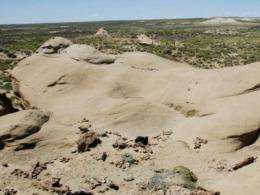
The Great Divide Basin, a 4,000-square-mile stretch of rocky desert in Wyoming. Credit: Courtesy of Robert Anemone

In 1991, a team led by Washington University in St. Louis paleoanthropologist Glenn Conroy, PhD, discovered the fossils of the first — and still the only — known pre-human ape ever found south of the equator in Africa after only 30 minutes of searching a limestone cave in Namibia.

Traditionally, fossil-hunters often could only make educated guesses as to where fossils lie. The rest lay with chance — finding the proverbial needle in a haystack.

"I don't want to say it's total luck," says Conroy, professor of physical anthropology in Arts & Sciences, "but it's a combination of hard work, meticulous planning and, well, a good dose of luck."

But thanks to a software model used by Conroy and researchers at Western Michigan University, fossil-hunters' reliance on luck when finding fossils may be diminishing.

Using artificial neural networks (ANNs) — computer networks that imitate the workings of the human brain — Conroy and colleagues Robert Anemone, PhD, and Charles Emerson, PhD, developed a computer model that can pinpoint productive fossil sites in the Great Divide Basin, a 4,000-square-mile stretch of rocky desert in Wyoming.

The basin has proved to be a productive area for fossil hunters, yielding 50 million- to 70 million-year-old early mammal fossils.

The software builds on satellite imagery and maps fossil-hunters have used for years to locate the best fossil sites. It just takes the process a step further, Conroy says.

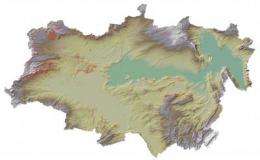
With information gathered from maps and satellite imagery — such as elevation, slope, terrain and many other landscape features — the ANN was "trained" to use details of existing fossiliferous areas to accurately predict the locations of other fossil sites elsewhere in the Great Divide Basin.
Human, artificial intelligence join forces to pinpoint fossil locations
Enlarge

This map shows sites (in red) in the Great Divide Basin with a 95 percent probability of containing fossils that also have slopes of greater than 5 percent. Credit: Courtesy of Robert Anemone

Because few sites are 100 percent identical, researchers had to "teach" the ANNs to recognize sites that shared key features in common. With the help of guidance from the scientists, the ANNs use pattern recognition to identify sites that share similar features.

"The beauty and power of neural networks lie in the fact that they are capable of learning," says Conroy, also a professor of anatomy and neurobiology at the School of Medicine. "You just need to give them a rule to deal with things they don't know."

Conroy and colleagues tested the software at the Great Divide Basin last summer. The ANNs correctly identified 79 percent of the area's known fossil sites, and 99 percent of the sites it tagged contained fossils.

Next up, the scientists tested the software on the nearby Bison Basin, also in Wyoming. Despite having been taught to recognize fossil sites at a neighboring location (the Great Divide Basin), the ANNs correctly identified four fossil sites in the Bison Basin.

"That gave us encouragement that a blind test based on a neural network for a different basin still gave us pretty good predictive results," Conroy says.

Next, Conroy is planning to continue to use the software to search for early hominid sites in South Africa.

The scientists hope this new application of existing technology will help increase the efficiency of paleontological fieldwork.

"In the old days, we'd all bring different maps, and start walking," Conroy says. "Now, we're talking about ways to improve one's chances."

Provided by Washington University in St. Louis search and more info website

4.7 /5 (3 votes)  

Rank 4.7 /5 (3 votes)
Relevant PhysicsForums posts

More news stories

Change in developmental timing was crucial in the evolutionary shift from dinosaurs to birds: study

At first glance, it's hard to see how a common house sparrow and a Tyrannosaurus Rex might have anything in common. After all, one is a bird that weighs less than an ounce, and the other is a dinosaur that ...

Other Sciences / Archaeology & Fossils

created 6 hours ago | popularity 5 / 5 (4) | comments 0 | with audio podcast

Social welfare cuts ultimately come with heavy price, researchers say

(Phys.org) -- Slashing government funding for Medicaid, food stamps and other programs that serve the poor – while politically popular with some lawmakers and many conservatives – may do more harm ...

Other Sciences / Social Sciences

created May 24, 2012 | popularity 4.2 / 5 (20) | comments 155

Ancient Bethlehem seal unearthed in Jerusalem

Israeli archaeologists have discovered a 2,700-year-old seal that bears the inscription "Bethlehem," the Israel Antiquities Authority announced Wednesday, in what experts believe to be the oldest artifact ...

Other Sciences / Archaeology & Fossils

created May 23, 2012 | popularity 3.3 / 5 (15) | comments 24

Dollars and sense: Why are some people morally against tax?

As the U.S. presidential election campaigns heat up, the economic debate is dominated by bailouts, austerity and, inevitably, taxation. Now a new study published in Symbolic Interaction asks why tax is such an important issue ...

Other Sciences / Social Sciences

created May 23, 2012 | popularity 2.3 / 5 (3) | comments 19

Oldest Jewish archaeological evidence on the Iberian Peninsula

German archaeologists of the Friedrich Schiller University Jena found one of the oldest archaeological evidence so far of Jewish Culture on the Iberian Peninsula at an excavation site in the south of Portugal, ...

Other Sciences / Archaeology & Fossils

created May 25, 2012 | popularity 4.2 / 5 (6) | comments 12


Stunning image of smallest possible five-ringed structure

Scientists have created and imaged the smallest possible five-ringed structure – about 100,000 times thinner than a human hair – and you'll probably recognise its shape.

'Unzipped' carbon nanotubes could help energize fuel cells, batteries

Multi-walled carbon nanotubes riddled with defects and impurities on the outside could replace some of the expensive platinum catalysts used in fuel cells and metal-air batteries, according to scientists at ...

Computer model used to pinpoint prime materials for efficient carbon capture

When power plants begin capturing their carbon emissions to reduce greenhouse gases – and to most in the electric power industry, it's a question of when, not if – it will be an expensive undertaking.

T cells 'hunt' parasites like animal predators seek prey, study shows

By pairing an intimate knowledge of immune-system function with a deep understanding of statistical physics, a cross-disciplinary team at the University of Pennsylvania has arrived at a surprising finding: T cells use a movement ...

Land and sea species differ in climate change response: study

(Phys.org) -- Marine and terrestrial species will likely differ in their responses to climate warming, new research by Simon Fraser University and Australia’s University of Tasmania has found.

Yale study concludes public apathy over climate change unrelated to science literacy

Are members of the public divided about climate change because they don't understand the science behind it? If Americans knew more basic science and were more proficient in technical reasoning, would public consensus match ...