Honey bee mystery protein is a freight train for health and lifespan
November 29, 2011

Honey bee mystery protein is a freight train for health and lifespan

Enlarge

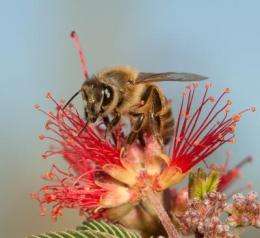
Researchers at the Norwegian University of Life Sciences and the University of Bergen have studied the molecular structure of vitellogenin and made new discoveries. Credit: Christofer Bang

Why are bee colonies worldwide suffering mysterious deaths? A unique study describes a single bee protein that can promote bee health and solve a major economic challenge.

Honey are the most effective of many and vitally important to food production.

Honey bee health is a topic of considerable concern due to massive deaths of in the USA and Europe. Recently, the European Union reacted by promising more resources for research, estimating European pollination to an of EUR 22 billion.

"Detailed studies on the molecules that keep bees healthy are extremely important to the food industry as well as the global provision of food," said dr. Heli Havukainen, who defended her PhD thesis at the Norwegian University of Life Sciences (UMB) on November 25. Her study of honey bees is a collaboration between UMB and the University of Bergen (UiB), Norway.

More protein = better health and longer life

One of these molecules is a protein called vitellogenin. "Simply put, the more vitellogenin in bees, the longer they live. Vitellogenin also guides bees to do different social tasks, such caregiving or foraging. It also supports the and is an antioxidant that promotes stress resistance. In my research, I set out to find out how this molecule is shaped and how it behaves on a nano-scale. This provides us with more knowledge about how vitellogenin is good for honey bees," Havukainen said.

Like a freight train

Under the supervision of Professor Gro Amdam (UMB and Arizona State University) and Associate Professor Øyvind Halskau (UiB), Havukainen discovered that vitellogenin can be described as a freight train consisting of a locomotive and a carriage. The protein carries fat as its cargo, which it picks up in the bees' belly-fat cells - the main station. The vitellogenin "train" travels in the bee's blood and delivers the fat cargo at different local stops or stations.
Honey bee mystery protein is a freight train for health and lifespan
Enlarge

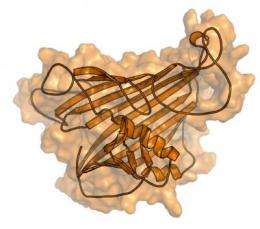
This is an illustration of the "locomotive" part of the vitellogenin protein in honey bees. Credit: Heli Havukainen

"I found out that, instead of starting the train journey from the fat cell main station, some vitellogenin molecules are divided in two, so the locomotive is separated from its cargo. The cargo cannot move without a locomotive and it stays in the fat cells, while the locomotive disappears. We soon realised that this is a typical behaviour for the vitellogenin molecule," Havukainen said.

Prior to this study, scientists believed vitellogenin to be one entity, like a cargo ship, unable to separate from its cargo. Therefore, Havukainen's new discovery is a big step forward for research that aims to keep bees healthy and long lived.

"We figured out that vitellogenin can drop its fat cargo as a reaction to changing chemical conditions. How this "drop" occurs and which factor makes the locomotive move and leave its cargo are important questions in the protein world, and probably equally important to the bee," Havukainen said.

What's up with the train hitch?

The research group believes that the separation of vitellogenin in two parts is a key to understanding how the protein works. They are now in search of the factor that breaks the fragile connection, or the train hitch of the , and lets the locomotive go.

"My discovery is that vitellogenin is not one entity. It consists of two functional parts. Now, I want to stop the separation process, so the locomotive and fat cargo are always together. This will help us figure out why the locomotive sometimes ditches its cargo and travels around on its own, and what the consequences are for the bees. This way, we can learn how vitellogenin affects social behaviour, immunity and , and ultimately global food production and provision, Havukainen said.

Provided by Norwegian University of Life Sciences

4.3 /5 (4 votes)  

Filter


Move the slider to adjust rank threshold, so that you can hide some of the comments.


Display comments: newest first

DavidMcC
Nov 29, 2011

Rank: 5 / 5 (2)
There appear to be many factors contributing to colony collapse disorder (CCD) in honey bees, but one possible factor that may have been overlooked is hive design. One of the functions of non-foraging bees in a hive is "policing the gates"., and it has been shown that these "security officials" are also "health officials", as they are capable of detecting the Varroa mite, which makes a significant contribution to CCD. Thus, the success of hive infections depends on the relative inability in the wild of the foragers to give the officials the slip. Yet, in most modern man-made hives, this is surely encouraged, by having a wide-open entrance area. Thus, another aspect of the problem might be simply to try shrinking the entrance size, as in the more traditional designs of beehive, to find a compromise between the current problem and the opposite limit, in which a long queue of returning bees builds up at the entrance.
Telekinetic
Nov 29, 2011

Rank: not rated yet
How about shutting down Bayer's production of its pesticides like clothianidin- a proven killer of honey bees. It amazes me that this corporation, a user of SLAVE labor in Germany during the war, still exists.
DavidMcC
Nov 30, 2011

Rank: not rated yet
How about shutting down Bayer's production of its pesticides like clothianidin- a proven killer of honey bees. It amazes me that this corporation, a user of SLAVE labor in Germany during the war, still exists.


Good idea!
Rank 4.3 /5 (4 votes)
Relevant PhysicsForums posts

More news stories

Manufacturing genes to attack flu virus

An international research team has manufactured a new protein that can combat deadly flu epidemics.

Biology / Biotechnology

created 6 hours ago | popularity not rated yet | comments 0 | with audio podcast

Scientist: Evolution debate will soon be history

(AP) -- Richard Leakey predicts skepticism over evolution will soon be history. Not that the avowed atheist has any doubts himself.

Biology / Evolution

created May 26, 2012 | popularity 3.5 / 5 (20) | comments 91

More plant species responding to global warming than previously thought

(Phys.org) -- Far more wild plant species may be responding to global warming than previous large-scale estimates have suggested.

Biology / Ecology

created May 22, 2012 | popularity 4.6 / 5 (14) | comments 18 | with audio podcast

For monogamous sparrows, it doesn't pay to stray (but they do it anyway)

It's quite common for a female song sparrow to stray from her breeding partner and mate with the male next door, but a new study shows that sleeping around can be costly.

Biology / Plants & Animals

created May 22, 2012 | popularity 5 / 5 (2) | comments 8 | with audio podcast

Thousands of shellfish found dead in Peru

Thousands of crustaceans were found dead off the coast of Lima following the mystery mass death of dolphins and pelicans, the Peruvian Navy said Friday.

Biology / Ecology

created May 26, 2012 | popularity 4.7 / 5 (7) | comments 7


Stunning image of smallest possible five-ringed structure

Scientists have created and imaged the smallest possible five-ringed structure – about 100,000 times thinner than a human hair – and you'll probably recognise its shape.

'Unzipped' carbon nanotubes could help energize fuel cells, batteries

Multi-walled carbon nanotubes riddled with defects and impurities on the outside could replace some of the expensive platinum catalysts used in fuel cells and metal-air batteries, according to scientists at ...

Change in developmental timing was crucial in the evolutionary shift from dinosaurs to birds: study

At first glance, it's hard to see how a common house sparrow and a Tyrannosaurus Rex might have anything in common. After all, one is a bird that weighs less than an ounce, and the other is a dinosaur that ...

Computer model used to pinpoint prime materials for efficient carbon capture

When power plants begin capturing their carbon emissions to reduce greenhouse gases – and to most in the electric power industry, it's a question of when, not if – it will be an expensive undertaking.

T cells 'hunt' parasites like animal predators seek prey, study shows

By pairing an intimate knowledge of immune-system function with a deep understanding of statistical physics, a cross-disciplinary team at the University of Pennsylvania has arrived at a surprising finding: T cells use a movement ...

Land and sea species differ in climate change response: study

(Phys.org) -- Marine and terrestrial species will likely differ in their responses to climate warming, new research by Simon Fraser University and Australia’s University of Tasmania has found.