Happy birthday, Sir William Herschel!
November 16, 2011 by Tammy Plotner, Universe Today

Happy birthday, Sir William Herschel!

Enlarge

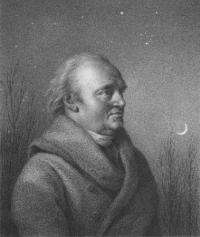
On this day in 1738, an astronomy legend was born – Sir William Herschel. Among this British astronomer and musician’s many accomplishments, Herschel was credited with the discovery of the planet Uranus in 1781; detecting the motion of the Sun in the Milky Way in 1785; finding Castor’s binary companion in 1804 – and he was the first to record infrared radiation. Herschel was well known as the discoverer of many clusters, nebulae, and galaxies. This came through his countless nights studying the sky and writing catalogs whose information we still use today. Let’s take a brief, closer look at just who he was…

Born as Frederick William Herschel, this Hanover, Germany native had nine brothers and sisters. During his teenage years, he and his brother, Jakob, were oboists in a military band. When war ensued, his father sent the pair to England to escape. Once there, Herschel continued his musical career by playing cello and harpsichord – eventually composing 24 symphonies, a handful of concertos and religious music. He continued to be a musician, with many appointments, until middle age. Most of his family also migrated to England, the most famous of which is his sister Caroline, who came to live with him in 1772.

But it wasn’t music that was Herschel’s passion. After he met English Astronomer Royal Nevil Maskelyne, he began construction on his own reflector telescope, spending up to 16 hours a day grinding and polishing the speculum metal primary mirrors. By age 35 he’d begun his astronomical journey in earnest – and a year later he began recording his observations from the Great Orion Nebula to the rings of Saturn. Sir William’s interest was taken by the study of double stars and with a 160mm telescope of his own construction, he began a systematic search for binaries among “every star in the Heavens” in October, 1779 and continued listing discoveries through 1792, eventually compiling three catalogs.
Happy birthday, Sir William Herschel!
Enlarge


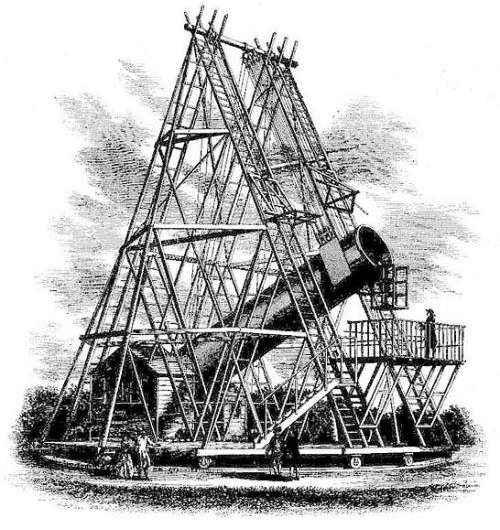
During this time he continued to support himself and his sister with his music. In her biography, Caroline recounts how he would rush home between acts to scan the skies – and how she often had to clean pitch from mirror-making from his clothes to make him presentable. From 1782 to 1802, Sir William swept the skies, recording all he saw and sharing his discoveries with other astronomers. So devoted was he, that he even gave Caroline her own telescope in 1783, encouraging her to also make her own observations and discoveries. Herschel published his discoveries as three catalogues, a walloping 2400 entries, filled with distant nebulae and cosmic wonders. Over the time of his astronomical career, Herschel constructed more than four hundred telescopes – the most famous of which had an almost 50 inch diameter mirror and a 40 foot focal length!

In later years, he and Caroline moved on to Windsor Road in Slough… a residence which would eventually be come to known as “Observatory House”. It was during this time he married and eventually had a son – John. Caroline also moved on, yet continued to be his secretarial assistant. Sir William’s astronomical career was quite illustrious – so much so that this article only highlights a few of his accomplishments. He observed and recorded the satellites of his discovery, Uranus, along with more obscure moons belonging to Saturn. He did work with infrared radiation, popularized the term “asteroid”, studied the martian polar caps – revealing them as seasonal – and may very well have been the first to discover the rings of Uranus. His lack of a formal “astronomical education” never slowed Sir William Herschel down!

“I have looked further into space than ever human being did before me. I have observed stars of which the light, it can be proved, must take two million years to reach the Earth.”

Herschel’s life ended at a ripe old age of 84… Passing on at his beloved Observatory House. His son, John Herschel, would carry on in his father’s footsteps and also became a famous astronomer. While few of us will ever be able to match Herschel’s passion for astronomy, at least we can take a moment to look at the stars and wish this astronomy “great” a very happy birthday!

Source: Universe Today

Filter


Move the slider to adjust rank threshold, so that you can hide some of the comments.


Display comments: newest first

omatumr
Nov 16, 2011

Rank: 4.3 / 5 (3)
Thanks for the story!

Sir William Herschel certainly deserves recognition for his pioneering studies of the cosmos and our place in it.

With kind regards,
Oliver K. Manuel
Former NASA Principal
Investigator for Apollo
http://myprofile....anuelo09

jsdarkdestruction
Nov 17, 2011

Rank: 5 / 5 (1)
Yes, he was a great man. thank you sir william herschel for the advances you helped make and happy birthday. We are not perfect but we are continuing in your pioneering spirit the best we can.
Rank 5 /5 (1 vote)
Relevant PhysicsForums posts
  • Distance of planets from stars and revolution
    created6 hours ago
  • revamping general concept and cosmological principle
    createdMay 25, 2012
  • Transiting Exoplanet Light Curve
    createdMay 25, 2012
  • Math behind Theoretical Physics
    createdMay 24, 2012
  • Do we know whats at the center of galaxies yet?
    createdMay 23, 2012
  • Structure of the Milky Way?
    createdMay 20, 2012
  • More from Physics Forums - General Astronomy

More news stories

Land and sea species differ in climate change response: study

(Phys.org) -- Marine and terrestrial species will likely differ in their responses to climate warming, new research by Simon Fraser University and Australia’s University of Tasmania has found.

Space & Earth / Environment

created 4 hours ago | popularity 3.7 / 5 (3) | comments 5 | with audio podcast

Yale study concludes public apathy over climate change unrelated to science literacy

Are members of the public divided about climate change because they don't understand the science behind it? If Americans knew more basic science and were more proficient in technical reasoning, would public consensus match ...

Space & Earth / Environment

created 6 hours ago | popularity 4.8 / 5 (5) | comments 12 | with audio podcast

10 million years needed to recover from mass extinction

It took some 10 million years for Earth to recover from the greatest mass extinction of all time, latest research has revealed.

Space & Earth / Earth Sciences

created 6 hours ago | popularity 5 / 5 (3) | comments 1 | with audio podcast

Sophisticated simulations predict future warming

The chances of our planet being hit by a global warming of 3 degrees Celsius by 2050 is as likely as it being hit by an increase of 1.4 degrees, new research shows. Presented in the journal Nature Geoscience, the British study ...

Space & Earth / Earth Sciences

created May 22, 2012 | popularity 4.4 / 5 (9) | comments 51

Aliens don't want to eat us, says former SETI director

Alien life probably isn’t interested in having us for dinner, enslaving us or laying eggs in our bellies, according to a recent statement by former SETI director Jill Tarter.

Space & Earth / Space Exploration

created May 25, 2012 | popularity 4.4 / 5 (15) | comments 41


Stunning image of smallest possible five-ringed structure

Scientists have created and imaged the smallest possible five-ringed structure – about 100,000 times thinner than a human hair – and you'll probably recognise its shape.

'Unzipped' carbon nanotubes could help energize fuel cells, batteries

Multi-walled carbon nanotubes riddled with defects and impurities on the outside could replace some of the expensive platinum catalysts used in fuel cells and metal-air batteries, according to scientists at ...

Change in developmental timing was crucial in the evolutionary shift from dinosaurs to birds: study

At first glance, it's hard to see how a common house sparrow and a Tyrannosaurus Rex might have anything in common. After all, one is a bird that weighs less than an ounce, and the other is a dinosaur that ...

Computer model used to pinpoint prime materials for efficient carbon capture

When power plants begin capturing their carbon emissions to reduce greenhouse gases – and to most in the electric power industry, it's a question of when, not if – it will be an expensive undertaking.

T cells 'hunt' parasites like animal predators seek prey, study shows

By pairing an intimate knowledge of immune-system function with a deep understanding of statistical physics, a cross-disciplinary team at the University of Pennsylvania has arrived at a surprising finding: T cells use a movement ...

Scientists develop ultra-sensitive test that detects diseases in their earliest stages

Scientists have developed an ultra-sensitive test that should enable them to detect signs of a disease in its earliest stages, in research published today in the journal Nature Materials.