Grizzly bears still need protecting, US court rules
November 23, 2011

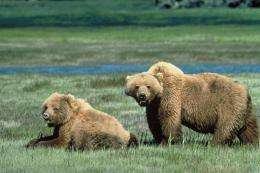
A US court has rules grizzly bears cannot be taken off the  Endangered Species Act protection list

Enlarge

Conservationists welcomed a US appeals court ruling that grizzly bears still need protecting, after federal authorities sought to have them taken off an endangered species list.

Conservationists welcomed a US appeals court ruling that grizzly bears still need protecting, after federal authorities sought to have them taken off an endangered species list.

The Ninth Circuit Court ruled that the US Fish and Wildlife Service cannot take away Endangered from grizzlies in the Greater Yellowstone region of the Rocky Mountains.

Specifically it said the disappearance of whitebark pine, a crucial for grizzlies, potentially threatens the long-term survival of the bears, known as "ursus horribilis" in Latin, reports said.

"This case involves one of the American West’s most iconic wild animals in one of its most iconic landscapes," wrote Richard Tallman a member of the three-judge panel which returned the verdict.

"Based on the evidence of a relationship between reduced whitebark pine seed availability, increased grizzly mortality to reduced grizzly reproduction, it is logical to conclude that an overall decline in the region’s whitebark pine population would have a negative effect on its grizzly bear population."

The former Seattle lawyer was cited by the Seattle Post-Intelligencer newspaper as saying: "Now that this threat has emerged, the Service cannot take a full-speed-ahead, damn the torpedoes approach to de-listing."

Mike Clark, executive director of conservation group the Greater Yellowstone Coalition, hailed the verdict.

"We appreciate the strong language of the 9th Circuit Court saying that USFWS must further study the demise of the whitebark pine and its impact upon grizzlies before it can delist the Yellowstone griz," he said.

"Secondly, we look forward to working with the feds and state officials on plans that ultimately will delist the griz when it is appropriate. But the court has clearly ruled that such a time is not yet upon us."

Grizzlies used to range widely across the and the Great Plains, but hunting drastically reduced their numbers.

Today they are found only in scattered locations, mainly national parks including Yellowstone, which covers parts of the US states of Montana, Idaho and Wyoming.

They can weigh up to 1,500 pounds (680 kilograms) and sport large shoulder humps. Despite their size, they can run up to 35 miles (55 kilometers) per hour, according to the US .

(c) 2011 AFP

Filter


Move the slider to adjust rank threshold, so that you can hide some of the comments.


Display comments: newest first

CapitalismPrevails
Nov 23, 2011

Rank: 2.5 / 5 (4)
I live in Montana and the threat of wolves and grizzly bears passing through my backyard is getting more realistic every day through more and more local encounters. I bet every one of these federal judges would think their decision over if they were in my shoes. This is why federal judges should not be appointed for life.
gfbtbb
Nov 23, 2011

Rank: 3.7 / 5 (3)
3S
Shoot. Shovel. Shut up.
kdizzle
Nov 23, 2011

Rank: 3.3 / 5 (3)
If humans would stop deforesting and fragmenting their natural habitat, they wouldn't show up your backyard! We are only one of millions of species on this planet, of which many are threatened by premature extinction from mostly anthropogenic causes. If you want grizzlies and wolves to respect "your" property, respect theirs.
CapitalismPrevails
Nov 23, 2011

Rank: 2 / 5 (4)
Kdizzle,
Ok than stop consuming. Go vegetarian and ban people eating steaks and burgers etc. We are the top of the food chain and the land is here to use and to stay stagnate. There's no reason bears and wolves can't be regulated like game animals.
Rank 3 /5 (2 votes)
Relevant PhysicsForums posts

More news stories

Manufacturing genes to attack flu virus

An international research team has manufactured a new protein that can combat deadly flu epidemics.

Biology / Biotechnology

created 6 hours ago | popularity not rated yet | comments 0 | with audio podcast

Scientist: Evolution debate will soon be history

(AP) -- Richard Leakey predicts skepticism over evolution will soon be history. Not that the avowed atheist has any doubts himself.

Biology / Evolution

created May 26, 2012 | popularity 3.5 / 5 (20) | comments 91

More plant species responding to global warming than previously thought

(Phys.org) -- Far more wild plant species may be responding to global warming than previous large-scale estimates have suggested.

Biology / Ecology

created May 22, 2012 | popularity 4.6 / 5 (14) | comments 18 | with audio podcast

For monogamous sparrows, it doesn't pay to stray (but they do it anyway)

It's quite common for a female song sparrow to stray from her breeding partner and mate with the male next door, but a new study shows that sleeping around can be costly.

Biology / Plants & Animals

created May 22, 2012 | popularity 5 / 5 (2) | comments 8 | with audio podcast

Thousands of shellfish found dead in Peru

Thousands of crustaceans were found dead off the coast of Lima following the mystery mass death of dolphins and pelicans, the Peruvian Navy said Friday.

Biology / Ecology

created May 26, 2012 | popularity 4.7 / 5 (7) | comments 7


Stunning image of smallest possible five-ringed structure

Scientists have created and imaged the smallest possible five-ringed structure – about 100,000 times thinner than a human hair – and you'll probably recognise its shape.

'Unzipped' carbon nanotubes could help energize fuel cells, batteries

Multi-walled carbon nanotubes riddled with defects and impurities on the outside could replace some of the expensive platinum catalysts used in fuel cells and metal-air batteries, according to scientists at ...

Change in developmental timing was crucial in the evolutionary shift from dinosaurs to birds: study

At first glance, it's hard to see how a common house sparrow and a Tyrannosaurus Rex might have anything in common. After all, one is a bird that weighs less than an ounce, and the other is a dinosaur that ...

Computer model used to pinpoint prime materials for efficient carbon capture

When power plants begin capturing their carbon emissions to reduce greenhouse gases – and to most in the electric power industry, it's a question of when, not if – it will be an expensive undertaking.

T cells 'hunt' parasites like animal predators seek prey, study shows

By pairing an intimate knowledge of immune-system function with a deep understanding of statistical physics, a cross-disciplinary team at the University of Pennsylvania has arrived at a surprising finding: T cells use a movement ...

Land and sea species differ in climate change response: study

(Phys.org) -- Marine and terrestrial species will likely differ in their responses to climate warming, new research by Simon Fraser University and Australia’s University of Tasmania has found.