Medicago genome sequence sheds new light on how plants evolved nitrogen-fixing symbioses
November 16, 2011

Genome sequence sheds new light on how plants evolved nitrogen-fixing symbioses

Enlarge

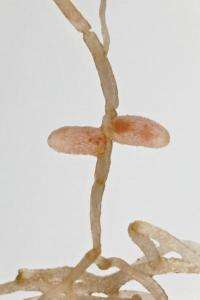
This is a magnified image of nodules on the root of Medicago. Nodules house the symbiotic bacteria key to the nitrogen fixation process. Credit: Andrew Davis, John Innes Centre

The genome of Medicago, a close relative of alfalfa and a long-established model for the study of legume biology, has been sequenced by an international team of scientists, capturing around 94 per cent of its genes.

The research gives new insights into the evolution of the Papilionoid subfamily of legumes, which includes peas, soybean and all legumes grown as crops.

Plants in this family can house and work with bacteria to provide them with nitrogen from the air. The new findings suggest this useful trait can be partly attributed to a genetic event 58 million years ago, when duplicate genes of the whole were created.

The duplication of genes allows new mutations and functions to occur, while maintaining the roles of original genes.

"The details of the genome shed new light on Medicago, the that will help unlock the workings of we hope within our lifetime," said Professor Giles Oldroyd from the John Innes Centre on Norwich Research Park.

"A whole appears to have played a crucial role in the dramatic radiation of papilionoid legumes," said director of the The Centre Professor Jane Rogers, also based on Norwich Research Park.

"This shaped their genomes and contributed to their success, enhancing their value to humans."

One outcome was the emergence of additional genes that went on to become specialised for functions related to the root nodule. This organ is formed by legumes to house symbiotic nitrogen-fixing rhizobial bacteria, which do the job of providing their hosts with a form nitrogen they can use while the provides the bacteria with sugars and proteins.

The new findings indicate that some important components for nodulation might have evolved from ancient genes and were then duplicated and added to 58 Mya. The capacity for interaction with and fungi is derived from ancient machinery that was added to following the whole genome duplication, leading to the complex relationship that benefits Medicago and other legumes today.

"Legume symbiosis with rhizobia is the largest source of natural, non-synthetic, nitrogen fertilizer in agriculture," said Professor Nevin Young from the University of Minnesota.

"We sequenced the Medicago genome primarily to learn about its evolution."

The scientists also found in the Medicago genome more NBS-LRR genes, a class of resistance genes, than in any other plant genome to date.

"This is potentially a useful resource to exploit," said Professor Oldroyd.

More information: Journal paper: The Medicago Genome Provides Insight into the Evolution of Rhizobial Symbioses: http://dx.doi.org/ … /nature10625

Provided by Norwich BioScience Institutes

Filter


Move the slider to adjust rank threshold, so that you can hide some of the comments.


Display comments: newest first

SemiNerd
Nov 16, 2011

Rank: not rated yet
Some bright guy will eventually get the idea of cloning human beings and doubling the chromosome count. Bizarre? yes. Survivable? doubtful. But just remember if someday to see a 10 foot super human kicking in your door, you heard it here first!
antonima
Nov 16, 2011

Rank: 5 / 5 (1)
Whats interesting is how the legume drives the evolution of soil microbes to symbiosis. A group of scientists in France showed that by giving a pathogen nitrogen fixation genes, and reducing its pathogenicity, the pathogen will evolve to become a symbiont inside of the legume root system. The legume rhizome will selectively feed the microbes which can fix nitrogen - this way the legume picks out and 'breeds' bacteria capable of fixing nitrogen for it.
Rank 5 /5 (2 votes)
Relevant PhysicsForums posts

More news stories

Manufacturing genes to attack flu virus

An international research team has manufactured a new protein that can combat deadly flu epidemics.

Biology / Biotechnology

created 2 hours ago | popularity not rated yet | comments 0 | with audio podcast

Scientist: Evolution debate will soon be history

(AP) -- Richard Leakey predicts skepticism over evolution will soon be history. Not that the avowed atheist has any doubts himself.

Biology / Evolution

created 20 hours ago | popularity 3.4 / 5 (19) | comments 78

More plant species responding to global warming than previously thought

(Phys.org) -- Far more wild plant species may be responding to global warming than previous large-scale estimates have suggested.

Biology / Ecology

created May 22, 2012 | popularity 4.6 / 5 (14) | comments 18 | with audio podcast

Thousands of shellfish found dead in Peru

Thousands of crustaceans were found dead off the coast of Lima following the mystery mass death of dolphins and pelicans, the Peruvian Navy said Friday.

Biology / Ecology

created May 26, 2012 | popularity 4.8 / 5 (5) | comments 7

For monogamous sparrows, it doesn't pay to stray (but they do it anyway)

It's quite common for a female song sparrow to stray from her breeding partner and mate with the male next door, but a new study shows that sleeping around can be costly.

Biology / Plants & Animals

created May 22, 2012 | popularity 5 / 5 (2) | comments 8 | with audio podcast


Land and sea species differ in climate change response: study

(Phys.org) -- Marine and terrestrial species will likely differ in their responses to climate warming, new research by Simon Fraser University and Australia’s University of Tasmania has found.

Almost half of new vets seek disability

(AP) -- America's newest veterans are filing for disability benefits at a historic rate, claiming to be the most medically and mentally troubled generation of former troops the nation has ever seen.

'Unzipped' carbon nanotubes could help energize fuel cells, batteries

Multi-walled carbon nanotubes riddled with defects and impurities on the outside could replace some of the expensive platinum catalysts used in fuel cells and metal-air batteries, according to scientists at ...

T cells 'hunt' parasites like animal predators seek prey, study shows

By pairing an intimate knowledge of immune-system function with a deep understanding of statistical physics, a cross-disciplinary team at the University of Pennsylvania has arrived at a surprising finding: T cells use a movement ...

Computer model used to pinpoint prime materials for efficient carbon capture

When power plants begin capturing their carbon emissions to reduce greenhouse gases – and to most in the electric power industry, it's a question of when, not if – it will be an expensive undertaking.

Change in developmental timing was crucial in the evolutionary shift from dinosaurs to birds: study

At first glance, it's hard to see how a common house sparrow and a Tyrannosaurus Rex might have anything in common. After all, one is a bird that weighs less than an ounce, and the other is a dinosaur that ...