Frogs' amazing leaps due to springy tendons
Nov 16, 2011
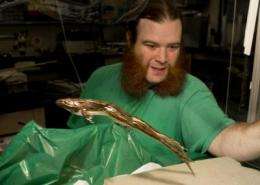
The Northern leopard frog loads its tendons before leaping. "Muscles alone couldn’t produce jumps that good," said graduate student Henry Astley. Credit: Mike Cohea, Brown University

Some species of frogs and many other animals are able to jump far beyond what appear to be their capabilities. The trained contestants in the frog-jumping competition in Calaveras County, Calif., come to mind, but even ordinary frogs can leap several times farther than their physiology would seem to allow.

"Muscles alone couldn't produce jumps that good," said Henry Astley, who studies the of frog jumping at Brown University.

In a paper published in Biology Letters, Astley and Thomas Roberts, associate professor of biology, show that the key to frogs' leaping lies in their stretchy tendons: Before jumping, the leg muscle shortens, loading energy into the tendon, which then recoils like a spring to propel the frog up, up and away. Even though as much as a quarter of a frog's body mass is in its legs, it would be physically incapable of jumping as far without the tendon's services.

This video is not supported by your browser at this time.
Researchers at Brown University have presented the first empirical glimpse into how frogs leap far beyond their capabilities. The key is the shortening of the calf muscles, which loads energy into an elongated, springy tendon. Credit: Roberts lab, Brown University

"In order to get truly exceptional jumping performance, you need some sort of elastic structure," said Astley, a fourth-year graduate student in Roberts's lab in the Department of Ecology and .

Astley and Roberts examined jumps by the northern leopard frog (Rana pipiens), a pond frog common in the northeast United States. The pair implanted metal beads into the shin bone, ankle bone and leg muscle of four frogs and then recorded their leaps with 3-D X-ray video technology developed at Brown. The video, filmed at 500 frames per second and displaying the jump about 17 times slower than normal, tracks the changes in the leg muscle's length and joint movement before, during and after a jump.

As the frog readies itself to leap, its calf muscle shortens. After about 100 milliseconds, the calf muscle stops moving, and the energy has been fully loaded into the stretched tendon. At the moment the frog jumps, the tendon, which wraps around the ankle bone, releases its energy, much like a catapult or archer's bow, causing a very rapid extension of the ankle joint that propels the frog forward. The entire jump — from preparation to leap — lasts about a fifth of a second, the experiments showed. Other frog species jump much faster.

"It's the first time we've really gotten the inner workings, that we've put all the pieces (to frog jumping) together," Astley said. "We now have a clearer idea what's going on."

How the tendons, muscles and joints work in jumping may help explain how other animals are such head-scratching leapers — invertebrates like the humble flea or the grasshopper or vertebrates like guinea fowl and bush babies.

"Frogs are interesting in their own right, but we are also confident that this study gives us insight into how muscles and tendons work together in animal movement," said Roberts. "Other studies have presented evidence for an elastic mechanism, but Henry's gives us the first glimpse of how it actually works."

Explore further: Front-row seats to climate change

Related Stories

Frog muscles survive big sleep

May 10, 2007

A rare Australian frog that burrows underground for a summer siesta resurfaces more than nine months later in just as good a shape as before its rest, according to UQ research.

Tendons absorb shocks muscles won't handle

Sep 27, 2011

Anyone who has hiked down a mountain knows the soreness that comes a day or two after means the leg muscles have endured a serious workout. While the pain is real, it's not well understood how leg muscles ...

Micro-frog springs toxic surprise

Nov 03, 2010

A "robber frog" whose body is just 10 millimetres (three-eighths of an inch) long eats toxic mites and exudes their poison on its skin to deter predators, scientists reported on Wednesday.

Recommended for you

Front-row seats to climate change

May 17, 2013

By day, insects provide the white noise of the South, but the night belongs to the amphibians. In a typical year, the Southern air hangs heavy from the humidity and the sounds of wildlife.

Captured in silken netting and sticky hairs

May 16, 2013

The great ecological success of spiders is often substantiated by the evolution of silk and webs. Biologists of the Kiel University and the University of Bern now found an alternative adaptation to hunting ...

User comments : 4

Adjust slider to filter visible comments by rank

Display comments: newest first

Isaacsname
5 / 5 (3) Nov 16, 2011
Are they sure it's not due to the fright of massive sideburns ?
panorama
5 / 5 (3) Nov 16, 2011
Are they sure it's not due to the fright of massive sideburns ?

Looks like he has the chops to see this study through...eh...eh...
ibuyufo
not rated yet Nov 16, 2011
I read the headline was about the frog's ability to jump but looking at the picture I did not see any frogs.
Silan
5 / 5 (1) Nov 17, 2011
I was just about to comment "Hands up if you came here to see beard, not the frog" but you've all beat me to it. :)

More news stories

Tiger, tiger, not burning so bright

(Phys.org) —India's tigers are facing extinction owing to a collapse in the variety of their mating partners, according to new research carried out by scientists at Cardiff University.

Galaxy's Ring of Fire

Johnny Cash may have preferred this galaxy's burning ring of fire to the one he sang about falling into in his popular song. The "starburst ring" seen at center in red and yellow hues is not the product of ...

US seizes Bitcoin operator accounts

US authorities seized the accounts of a Bitcoin digital currency exchange operator, claiming it was functioning as an "unlicensed money service business," court documents showed Friday.