Fossil moths show their true colors
November 15, 2011

Fossil moths show their true colors

Enlarge

Image: PLoS Biology, doi:10.1371/journal.pbio.1001200

The brightest hues in nature are produced by tiny patterns in, say, feathers or scales rather than pigments. These so-called "structural colors" are widespread, giving opals their fire, people their blue eyes, and peacocks their brilliant feathers. Many animals use this type of color for communication, notably butterflies and moths (Lepidoptera), which display the biggest range of structural colors and put them to uses from advertising their toxicity to choosing the best mates. But despite the importance of structural colors in their lives, little is known about how lepidopterans developed these key social signals. Now, in the Nov. 15 issue of PLoS Biology, palaeobiologist Maria McNamara (Yale University) and colleagues bring us closer to the origins of structural colors by reconstructing them in fossil moths that are 47 million years old.

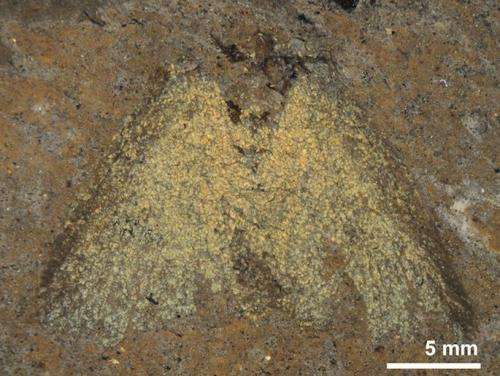
This is the first evidence of structurally colored scales in fossil lepidopterans. The fossil moths came from the Messel oil shale in Germany, a site famous for exquisite fossil preservation.
Fossil moths show their true colors
Enlarge

Image: PLoS Biology, doi:10.1371/journal.pbio.1001200

Although the original colors of the fossil moths were not preserved, the researchers were able to reconstruct them because the tiny color-producing patterns in the moth scales were intact. "The level of detail preserved in the scales of the fossil moths is just spectacular", said McNamara. The fossil moths owe their color to a stack of layers inside the scales. These layers form a fossil multilayer , which usually produces iridescent colour that changes depending on viewing angle. But other details of the fossil scales suppressed this effect, producing instead muted colors. "The moths basically wanted to appear the same colour from different angles – they didn't want flashy iridescence" said McNamara.

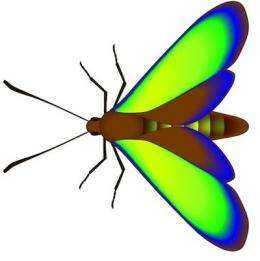
Today, the front wings of the ancient moths look mostly blue, presumably because the chemistry of the cuticle was altered during the process of fossilization. The researchers reconstructed the original colors via mathematical analysis of the scale ultrastructure, revealing that the wings had actually been yellow-green when the moths were alive. Modern butterflies and moths use bright, contrasting colors to communicate with each other, and muted greens to camouflage themselves in leafy habitats. This makes it likely that the fossil moths used their yellow-green wings to blend in with leaves, suggesting that this strategy for hiding in plain sight had evolved as early as 47 million years ago amongst lepidopterans.

The fossils are thought to be from extinct relatives of today's forester moths, which feed on flower nectar. If this was also true of these ancient moths, their yellow-green wings would have stood out while feeding. The researchers suggest that being easy to see on flowers could have served as a warning to predators. Modern forester moths can synthesize cyanide, making them taste bad, and their ancestors may have already developed this capability.

These findings shed light on the evolution of tactics for predator avoidance and deterrence in forester moths. In addition, by showing that the original structural colors of fossil can be reconstructed, this works leads the way toward finding the origins of the many ways butterfly and moth species use this type of color to communicate amongst each other as well as with predators. "Reconstructing the original colors of ancient animals gives us really good insights into their behaviour" said McNamara. "These moth fossils hint that we can even do this for fossils that don't have obvious color".

More information: McNamara ME, Briggs DEG, Orr PJ, Wedmann S, Noh H, et al. (2011) Fossilized Biophotonic Nanostructures Reveal the Original Colors of 47-Million-Year-Old Moths. PLoS Biol 9(11): e1001200. doi:10.1371/journal.pbio.1001200

Provided by Public Library of Science search and more info website

Filter


Move the slider to adjust rank threshold, so that you can hide some of the comments.


Display comments: newest first

kevinrtrs
Nov 16, 2011

Rank: 1 / 5 (5)
suggesting that this strategy for hiding in plain sight had evolved as early as 47 million years ago amongst lepidopterans.

shed light on the evolution of tactics for predator avoidance and deterrence in forester moths.


Seems like evolution has an exceptional ability to DESIGN much needed survival structures. The use of strategy and tactics is normally associated with much evaluation of options and creative input, i.e. PLANNING ahead. So how can evolution do this? Please explain.
barakn
Nov 16, 2011

Rank: 5 / 5 (1)
It is not our job to fill in the numerous gaps in your education.
roboferret
Nov 16, 2011

Rank: not rated yet
Really Kev?
Badly camouflaged moths get eaten more often than better camouflaged ones. With me so far?

The better camouflaged moths get to reproduce more; the others less. The camouflaged population increases, the others decrease. I don't see what's so hard to understand.
Regardless of the definition you try to impose, tactics and strategies are adaptive and can evolve. In humans this is called "learning". Do some.
aroc91
Nov 17, 2011

Rank: not rated yet
suggesting that this strategy for hiding in plain sight had evolved as early as 47 million years ago amongst lepidopterans.

shed light on the evolution of tactics for predator avoidance and deterrence in forester moths.


Seems like evolution has an exceptional ability to DESIGN much needed survival structures. The use of strategy and tactics is normally associated with much evaluation of options and creative input, i.e. PLANNING ahead. So how can evolution do this? Please explain.


Way to COMPLETELY misinterpret it.
Rank 4 /5 (1 vote)
Relevant PhysicsForums posts

More news stories

Change in developmental timing was crucial in the evolutionary shift from dinosaurs to birds: study

At first glance, it's hard to see how a common house sparrow and a Tyrannosaurus Rex might have anything in common. After all, one is a bird that weighs less than an ounce, and the other is a dinosaur that ...

Other Sciences / Archaeology & Fossils

created 2 hours ago | popularity 5 / 5 (2) | comments 0 | with audio podcast

Social welfare cuts ultimately come with heavy price, researchers say

(Phys.org) -- Slashing government funding for Medicaid, food stamps and other programs that serve the poor – while politically popular with some lawmakers and many conservatives – may do more harm ...

Other Sciences / Social Sciences

created May 24, 2012 | popularity 4.3 / 5 (16) | comments 152

Ancient Bethlehem seal unearthed in Jerusalem

Israeli archaeologists have discovered a 2,700-year-old seal that bears the inscription "Bethlehem," the Israel Antiquities Authority announced Wednesday, in what experts believe to be the oldest artifact ...

Other Sciences / Archaeology & Fossils

created May 23, 2012 | popularity 3.5 / 5 (14) | comments 23

Oldest Jewish archaeological evidence on the Iberian Peninsula

German archaeologists of the Friedrich Schiller University Jena found one of the oldest archaeological evidence so far of Jewish Culture on the Iberian Peninsula at an excavation site in the south of Portugal, ...

Other Sciences / Archaeology & Fossils

created May 25, 2012 | popularity 4.2 / 5 (6) | comments 12

Dollars and sense: Why are some people morally against tax?

As the U.S. presidential election campaigns heat up, the economic debate is dominated by bailouts, austerity and, inevitably, taxation. Now a new study published in Symbolic Interaction asks why tax is such an important issue ...

Other Sciences / Social Sciences

created May 23, 2012 | popularity 3 / 5 (2) | comments 12


Land and sea species differ in climate change response: study

(Phys.org) -- Marine and terrestrial species will likely differ in their responses to climate warming, new research by Simon Fraser University and Australia’s University of Tasmania has found.

Almost half of new vets seek disability

(AP) -- America's newest veterans are filing for disability benefits at a historic rate, claiming to be the most medically and mentally troubled generation of former troops the nation has ever seen.

'Unzipped' carbon nanotubes could help energize fuel cells, batteries

Multi-walled carbon nanotubes riddled with defects and impurities on the outside could replace some of the expensive platinum catalysts used in fuel cells and metal-air batteries, according to scientists at ...

T cells 'hunt' parasites like animal predators seek prey, study shows

By pairing an intimate knowledge of immune-system function with a deep understanding of statistical physics, a cross-disciplinary team at the University of Pennsylvania has arrived at a surprising finding: T cells use a movement ...

Computer model used to pinpoint prime materials for efficient carbon capture

When power plants begin capturing their carbon emissions to reduce greenhouse gases – and to most in the electric power industry, it's a question of when, not if – it will be an expensive undertaking.

Yale study concludes public apathy over climate change unrelated to science literacy

Are members of the public divided about climate change because they don't understand the science behind it? If Americans knew more basic science and were more proficient in technical reasoning, would public consensus match ...