Flinders phone software goes global
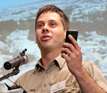
A revolutionary software program which allows mobile phones to communicate when normal phone lines are down has earned Flinders University’s Dr. Paul Gardner-Stephen (pictured) a place in the finals of an international competition.
Dr. Gardner-Stephen’s Serval Project – developed in response to the devastating 2010 Haiti earthquake – is one of 11 finalists in the Ashoka Changemakers Citizen Media Competition, beating a field of about 500 entrants worldwide.
Using sophisticated mesh technology, the Serval Project creates a virtual network which enables mobile phones to work where conventional mobile phone coverage has been destroyed or simply does not exist.
Instead of relying on conventional phone towers, the Serval system allows people to make calls by “bouncing” off other devices which are carrying the software in a range of about 100 metres.
Only two phones are needed to start a network and the technology can be shared from phone to phone at any time, eliminating any start-up or operating costs.
Dr. Gardner-Stephen, Research Fellow (Rural, Remote and Humanitarian Telecommunications) in Flinders School of Computer Science, Engineering and Mathematics, said it felt “fantastic” to be a finalist in the global competition.
“It’s great to see our international recognition increasing,” Dr. Gardner-Stephen said.
“We’re starting to build partnerships with overseas entities, universities, not-for-profit groups and social action groups that can all see the value in what we’re doing and see the Serval Project now represents the leading edge of technology in this area,” he said.
“All this is in addition to the considerable support we’ve received from the Shuttleworth Foundation in South Africa, which has generously backed the project with a USD400,000 fellowship grant.”
The software is expected to be publicly available as a free Android phone application by August 2012, and later rolled out across the Nokia and iPhone markets.
In addition to making free calls, Dr. Gardner-Stephen said the software can also share crucial information such as files, maps and data in times of disaster.
“If there was an earthquake, for instance, you could use the map to record the location of a collapsed building, food and water supplies or people who need help and that information would start appearing on maps of everyone’s phone who is running the software,” Dr. Gardner-Stephen said.
“When disaster strikes the first thing you want to do is call your family and make sure they’re OK, and if you knew they were OK you’d probably go help other people,” he said.
“But if the communication lines were down and you couldn’t contact them you’d probably go looking for them, they’d go looking for you and although you’re actually all fine you’re not able to help anyone else because you want to know your family is OK first.”
Dr. Gardner-Stephen said the software could also be applied to rural and remote communities, for example allowing friends travelling in the outback to call each other for free from car to car, as well as in poverty-stricken communities across the world.
“We’re already working in outback areas to trial the technology so we can provide remote communities with mobile phone and internet access,” he said.
“And if we can enable people in poverty to make free calls, send text messages and transfer files then hopefully we can improve their economic situation and quality of life – and that shouldn’t be overlooked, whether it’s in poverty or disaster.”
In another coup for Dr. Gardner-Stephen, the Serval Project has made it to the finals of the World Embedded Software Contest for the second year running.
The finals, to be held in Korea later this month, will be represented by two Flinders students who have helped work on the software.
Voting in the Ashoka Changemakers Citizen Media Competition closes November 23.
More information: To vote for the Serval Project click here.
Provided by Flinders University


