Flexible learning in a virtual microscope lab
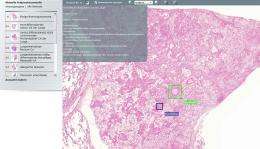
For every medical student, examining specimens under the microscope is part of the syllabus. However, the opening hours of the labs and the number of enlargers are limited. Thanks to a new online platform, students are now able to learn with greater flexibility and independence.
Under the microscope lies a specimen of a liver. Deep in concentration, a student is analyzing the structure of the tissue when the university official asks her to finish up – the lab is about to close. This is a situation that may be familiar to many students. After all, the examination of specimens is an important course component; to practice and consolidate the theory presented in lectures. Customarily at the beginning of the semester, students are each given a case containing 50 to 100 specimens with which they can work independently. To do so, however, they are dependent on the university infrastructure. There is another disadvantage: “Each specimen is, by nature, unique – so each student sees something different under the microscope”, says PD Dr. Thomas Wittenberg from the Fraunhofer Institute for Integrated Circuits IIS in Erlangen.
Researchers at the IIS, the Erlangen University Clinic as well as at the University of Erlangen-Nürnberg have now created an additional facility that is available to students around the clock: a platform for web-based microscopy. So far, the project partners have made digital images of 200 specimens at 40x magnification and have put them into a database. Here, students can look up and research specimens using specific keywords such as body part or diagnostic findings. At the click of a mouse, the image can be viewed with a specific degree of enlargement (5x, 10x, 20x, 40x) or with seamless zooming. Image details which present the relevant tissue changes or other characteristics are interactively labeled.
The crux of this development work is that in order to make even the slightest details easily discernible, the images have to be made available at a very high resolution. This means image files quickly reach sizes of up to 5 GB; with a standard broadband connection, downloading would take forever. So the researchers employ a creative trick: “So that students can work with these huge data effectively, we divide the images into individual image tiles. Depending on which image section the user is looking at, at any given time, only the corresponding tile in the required resolution has to be transmitted. It’s similar to how Google Earth works,” explains Wittenberg’s colleague Sven Friedl. Depending on the image section, the resolution is reduced in pyramid fashion, step by step: the larger the image section, the lower the resolution and vice versa.
The platform is not meant to replace “real” microscopy, but rather to supplement it, as Friedl is keen to point out. “We want to give students the opportunity to be able to study more flexibly than before. Plus, our databank makes a much more extensive collection of specimens available to them”, says the scientist.
Proof that demand for such a resource exists came with the initial test run: Since the summer term of 2011, students at the University of Erlangen have been able to use the platform as a supplement to pathology lectures. They receive password-protected access to the database at the time of registering online for the lectures, and thereafter there is ongoing evaluation of student satisfaction and learning success. “The feedback has been entirely positive”, reports Friedl happily. In the future, the collaboration is to be expanded to include other institutes and universities. From November 16 – 19 at the MEDICA trade fair in Düsseldorf, the project partners will present the online platform as well as further solutions for the automatic analysis of microscopic image data, at the joint Fraunhofer booth in Hall 10, Booth F05.
Provided by Fraunhofer-Gesellschaft


