'Fishy lawnmowers' help save Pacific corals
Can fish save coral reefs from dying? UC Santa Barbara researchers have found one case where fish have helped coral reefs to recover from cyclones and predators.
Coral reefs worldwide are increasingly disturbed by environmental events that are causing their decline, yet some coral reefs recover. UCSB researchers have discovered that the health of coral reefs in the South Pacific island of Moorea, in French Polynesia, may be due to protection by parrotfish and surgeonfish that eat algae, along with the protection of reefs that shelter juvenile fish.
The findings are published in a recent issue of the journal PLoS ONE. The UCSB research team is part of the Moorea Coral Reef Long-Term Ecological Research (MCR LTER) project, funded by the National Science Foundation.
In many cases, especially in the case of severely damaged reefs in the Caribbean, coral reefs that suffer large losses of live coral often become overgrown with algae and never return to a state where the reefs are again largely covered by live coral. In contrast, the reefs surrounding Moorea experienced large losses of live coral in the past –– most recently in the early 1980's –– and have returned each time to a system dominated by healthy, live corals.
"We wanted to know why Moorea's reefs seem to act differently than other reefs," said Tom Adam, first author, research associate with MCR LTER, and postdoctoral fellow at UCSB's Marine Science Institute. "Specifically, we wanted to know what ecological factors might be responsible for the dramatic patterns of recovery observed in Moorea."
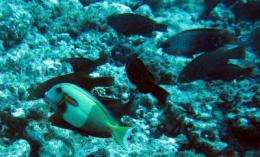
The research team was surprised by its findings. The biomass of herbivores on the reef –– fish and other animals that eat plants like algae –– increased dramatically following the loss of live coral. "What was surprising to us was that the numbers of these species also increased dramatically," said Andrew Brooks, co-author, deputy program director of MCR LTER, and associate project scientist with MSI. "We were not simply seeing a case of bigger, fatter fishes –– we were seeing many more parrotfishes and surgeonfishes, all of whom happened to be bigger and fatter. We wanted to know where these new fishes were coming from."
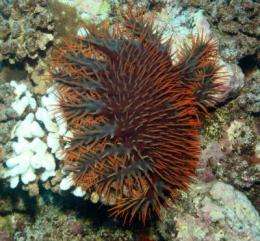
The researchers also found that not all of the coral reefs around Moorea were affected equally by an outbreak of predatory crown-of-thorns sea stars or by cyclones. The crown-of-thorns sea stars did eat virtually all of the live coral on the barrier reef –– the reef that separates the shallow lagoons from the deeper ocean. However, neither the sea stars nor the cyclones had much impact on the corals growing on the fringing reef –– the reef that grows against the island.
"We discovered that these fringing reefs act as a nursery ground for baby fishes, most notably herbivorous fishes," said Brooks. "With more food available in the form of algae, the survivorship of these baby parrotfishes and surgeonfishes increased, providing more individuals to help control the algae on the fore reef. In effect, the large numbers of parrotfishes and surgeonfishes are acting like thousands of fishy lawnmowers, keeping the algae cropped down to levels low enough that there is still space for new baby corals to settle onto the reef and begin to grow."
A major reason the reefs in the Caribbean do not recover after serious disturbances is because these reefs lack healthy populations of parrotfishes and surgeonfishes, due to the effects of overfishing, explained Adam. "Without these species to help crop the algae down, these reefs quickly become overgrown with algae, a situation that makes it very hard for corals to re-establish themselves," he said.
Managers have tried to reverse the trend of overfishing through the creation of Marine Protected Areas (MPAs), where fishing is severely restricted or prohibited. "Our results suggest that this strategy may not be enough to reverse the trend of coral reefs becoming algal reefs," said Brooks. "Our new and very novel results suggest that it also is vital to protect the fringing reefs that serve as nursery grounds. Without these nursery grounds, populations of parrotfishes and surgeonfishes can't respond to increasing amounts of algae on the reefs by outputting more baby herbivores."
In short, the research team found that by using MPAs, managers can help protect adult fish, producing bigger, fatter fish. "But if you don't protect the nursery habitat –– the babies produced by these bigger fish, or by fish in other, nearby areas –– you can't increase the overall numbers of the important algae-eating fish on the reef," said Brooks.
According to the scientists, it appears that Moorea's reefs may recover. "One final bit of good news is that we are seeing tens of thousands of baby corals, some less than a half-inch in diameter, on the fore reefs surrounding Moorea," said Brooks.
MCR researchers will follow the coral reef recovery process over the next decade or more, in search of additional information that can aid managers of the world's coral reefs.
Provided by University of California - Santa Barbara


