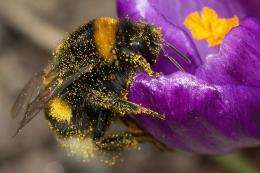
A fecal diet keeps bumblebees healthy

November 16, 2011 by Deborah Braconnier report

bumblebee

Enlarge

Image credit: Wikipedia.

(PhysOrg.com) -- New research published in the Proceedings of the National Academy of Science shows that a diet of bumble feces at the start of a bumblebee’s adult life is essential for the protection against parasites.

Bumblebees start their life out as tiny larvae. They spin a cocoon and emerge as a hungry bumblebee ready to face the world. Their first meal is ideally the feces of other bumblebees. This fecal matter contains bacteria that help the bumblebee’s immune system.

As humans, we have what is known as “gut bacteria.” It is found in our intestinal tract and helps in the breakdown of foods and keeps back bacteria under control. In this same way, bumblebees need this bacteria found in the feces to help protect them from parasites.

During the cocoon process, the larvae is essentially sterilized and all traces of bacteria are removed so the new adult bumblebee emerges with no natural bacterial protection, so researchers believe this is the reasoning behind their first dietary choice.

The researchers, led by Hauke Koch and Paul Schmid-Hempel of the Swiss Federation Institute of Technology have found that these gut bacteria acquired through eating feces acts as a transmissible immune system.

This gut bacteria protects the bees from the parasite Crithidia bombi and can pass from bee to bee quite quickly, affecting the entire colony. Koch and Schmid-Hempel discovered that when a is raised in a sterile environment without the opportunity to eat the feces, they are more likely to suffer with the parasite.

The researchers examined the guts of wild bees and found that the Betaproteobacteria provided the best defense against Crithidia and in bees with high levels, the parasite was not present. However, when they looked at that came from a sterile environment and had not had the chance to ingest the bacteria, the parasite was built up in their system as much as six times as those with the bacteria.

More information: Socially transmitted gut microbiota protect bumble bees against an intestinal parasite, PNAS, Published online before print November 14, 2011, doi: 10.1073/pnas.1110474108

Abstract
Populations of important pollinators, such as bumble bees and honey bees, are declining at alarming rates worldwide. Parasites are likely contributing to this phenomenon. A distinct resident community of bacteria has recently been identified in bumble bees and honey bees that is not shared with related solitary bee species. We now show that the presence of these microbiota protects bee hosts against a widespread and highly virulent natural parasite (Crithidia bombi) in an experimental setting. We add further support to this antagonistic relationship from patterns found in field data. For the successful establishment of these microbiota and a protective effect, exposure to feces from nest mates was needed after pupal eclosion. Transmission of beneficial gut bacteria could therefore represent an important benefit of sociality. Our results stress the importance of considering the host microbiota as an “extended immune phenotype” in addition to the host immune system itself and provide a unique perspective to understanding bees in health and disease.

Journal reference: Proceedings of the National Academy of Sciences search and more info website

© 2011 PhysOrg.com

Filter


Move the slider to adjust rank threshold, so that you can hide some of the comments.


Display comments: newest first

sherriffwoody
Nov 17, 2011

Rank: not rated yet
This is the same with people. People who live to clean are more likely to get food posioning. Families I know who live like pigs seem to be the resilient. Do you think as natural animals we had access to sterile environments, did our ancestors suffer from food posioning etc. No, they built up tolerences and could handle the bad things that make some modern humans sick.
Rank 5 /5 (3 votes)
Relevant PhysicsForums posts

More news stories

Manufacturing genes to attack flu virus

An international research team has manufactured a new protein that can combat deadly flu epidemics.

Biology / Biotechnology

created 2 hours ago | popularity not rated yet | comments 0 | with audio podcast

Scientist: Evolution debate will soon be history

(AP) -- Richard Leakey predicts skepticism over evolution will soon be history. Not that the avowed atheist has any doubts himself.

Biology / Evolution

created 20 hours ago | popularity 3.4 / 5 (19) | comments 78

More plant species responding to global warming than previously thought

(Phys.org) -- Far more wild plant species may be responding to global warming than previous large-scale estimates have suggested.

Biology / Ecology

created May 22, 2012 | popularity 4.6 / 5 (14) | comments 18 | with audio podcast

Thousands of shellfish found dead in Peru

Thousands of crustaceans were found dead off the coast of Lima following the mystery mass death of dolphins and pelicans, the Peruvian Navy said Friday.

Biology / Ecology

created May 26, 2012 | popularity 4.8 / 5 (5) | comments 7

For monogamous sparrows, it doesn't pay to stray (but they do it anyway)

It's quite common for a female song sparrow to stray from her breeding partner and mate with the male next door, but a new study shows that sleeping around can be costly.

Biology / Plants & Animals

created May 22, 2012 | popularity 5 / 5 (2) | comments 8 | with audio podcast


Land and sea species differ in climate change response: study

(Phys.org) -- Marine and terrestrial species will likely differ in their responses to climate warming, new research by Simon Fraser University and Australia’s University of Tasmania has found.

Almost half of new vets seek disability

(AP) -- America's newest veterans are filing for disability benefits at a historic rate, claiming to be the most medically and mentally troubled generation of former troops the nation has ever seen.

'Unzipped' carbon nanotubes could help energize fuel cells, batteries

Multi-walled carbon nanotubes riddled with defects and impurities on the outside could replace some of the expensive platinum catalysts used in fuel cells and metal-air batteries, according to scientists at ...

T cells 'hunt' parasites like animal predators seek prey, study shows

By pairing an intimate knowledge of immune-system function with a deep understanding of statistical physics, a cross-disciplinary team at the University of Pennsylvania has arrived at a surprising finding: T cells use a movement ...

Computer model used to pinpoint prime materials for efficient carbon capture

When power plants begin capturing their carbon emissions to reduce greenhouse gases – and to most in the electric power industry, it's a question of when, not if – it will be an expensive undertaking.

Change in developmental timing was crucial in the evolutionary shift from dinosaurs to birds: study

At first glance, it's hard to see how a common house sparrow and a Tyrannosaurus Rex might have anything in common. After all, one is a bird that weighs less than an ounce, and the other is a dinosaur that ...