New evidence of interhuman aggression and human induced trauma 126,000 years ago
November 21, 2011

New evidence of interhuman aggression and human induced trauma 126,000 years ago

Enlarge

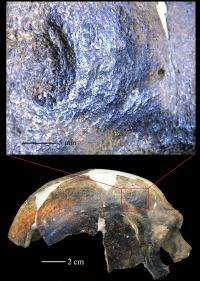
This is the right superolateral view of the Maba cranium showing the position (A) and detail (B) of the depressed lesion. Credit: University of the Witwatersrand

The study of a cranium of an East Asian human from the late Middle Pleistocene age from Maba, China, brings to the fore evidence that interhuman aggression and human induced trauma occurred 126,000 years ago.

The report, published today in the , suggests that a 14mm ridged, healed lesion with bone depressed inward to the brain resulted from localised blunt force trauma due to an accident or, more probably, interhuman .

"This wound is very similar to what is observed today when someone is struck forcibly with a heavy blunt object. As such it joins a small sample of Ice Age humans with probable evidence of humanly induced trauma, and could possibly be the oldest example of interhuman aggression and human induced trauma documented. Its remodelled, healed condition also indicates the survival of a serious , a circumstance that is increasingly documented for archaic and modern Homo through the Pleistocene," comments Prof. Lynne Schepartz from the School of Anatomical Sciences at the University of the Witwatersrand, one of the co-authors of the paper.
New evidence of interhuman aggression and human induced trauma 126,000 years ago
Enlarge

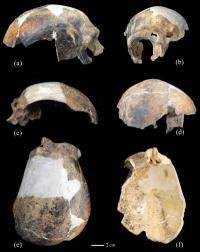
This is the reconstructed Maba 1 cranium (A) Right lateral view (B) anterior view (C) left lateral view (D) posterior view (E) superior view (F) basal view Credit: University of the Witwatersrand

"It is not possible to assess whether the incident was accidental or intentional, or whether it resulted from a short-term disagreement, or premeditated aggression."

Why is this study important?

"The identification of traumatic in human fossils is of interest for assessing the relative risk of injury to different human groups, the location of trauma, and the behavioural implications," adds Schepartz.

"It also helps us to identify and understand some the earliest forms of interhuman aggression, and the abilities of Pleistocene humans to survive serious injury and post-traumatic disabilities. Maba would have needed social support and help in terms of care and feeding to recover from this wound."
New evidence of interhuman aggression and human induced trauma 126,000 years ago
Enlarge

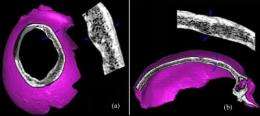
These are CT reconstructions depicting the lesion on the Maba cranium. Credit: University of the Witwatersrand

The Maba cranium was discovered with the remains of other mammals in June 1958, in a cave at Lion Rock in Guangdong province, China. The Maba cranium and associated animal bones were unearthed at a depth of 1 metre by farmers removing cave sediments for fertiliser.

The Maba cranium, which is housed in the Institute of Vertebrate Paleontology and Paleoanthropology at the Chinese Academy of Sciences, was analysed visually using stereomicroscopy and a high-resolution industrial CT scanner. This state-of-the-art imaging technology enabled the researchers to investigate the inner structure of the bone to verify that healing had occurred.

Provided by University of the Witwatersrand

4.3 /5 (6 votes)  

Filter


Move the slider to adjust rank threshold, so that you can hide some of the comments.


Display comments: newest first

Jeffhans1
Nov 21, 2011

Rank: 2.3 / 5 (3)
Wait according to what I just read in the article, they determined someone survived brain trauma. No where does it identify how this injury occurred. This seems to be another example of people drawing conclusions with insufficient evidence. Hunting with Stone Age tools was a very dangerous and accident prone occupation.
gwrede
Nov 21, 2011

Rank: 2.3 / 5 (3)
Wow, humans were aggressive already at that time. OMG! -- Of course any non-scientist could have told these guys that our ancestors most likely were aggressive already before the time of the dinosaurs. The dinosaurs were, and even the smallest insects are. Amazing news would be if we haven't always been.
StarGazer2011
Nov 21, 2011

Rank: 1.9 / 5 (8)
Its a post-socialist article of faith that primitive humans were peace loving, and its only european culture and material posessions which created violence. This article needs to be viewed through that cultural prejudice.
Rank 4.3 /5 (6 votes)
Relevant PhysicsForums posts

More news stories

Change in developmental timing was crucial in the evolutionary shift from dinosaurs to birds: study

At first glance, it's hard to see how a common house sparrow and a Tyrannosaurus Rex might have anything in common. After all, one is a bird that weighs less than an ounce, and the other is a dinosaur that ...

Other Sciences / Archaeology & Fossils

created 2 hours ago | popularity 5 / 5 (2) | comments 0 | with audio podcast

Social welfare cuts ultimately come with heavy price, researchers say

(Phys.org) -- Slashing government funding for Medicaid, food stamps and other programs that serve the poor – while politically popular with some lawmakers and many conservatives – may do more harm ...

Other Sciences / Social Sciences

created May 24, 2012 | popularity 4.3 / 5 (16) | comments 152

Ancient Bethlehem seal unearthed in Jerusalem

Israeli archaeologists have discovered a 2,700-year-old seal that bears the inscription "Bethlehem," the Israel Antiquities Authority announced Wednesday, in what experts believe to be the oldest artifact ...

Other Sciences / Archaeology & Fossils

created May 23, 2012 | popularity 3.5 / 5 (14) | comments 23

Oldest Jewish archaeological evidence on the Iberian Peninsula

German archaeologists of the Friedrich Schiller University Jena found one of the oldest archaeological evidence so far of Jewish Culture on the Iberian Peninsula at an excavation site in the south of Portugal, ...

Other Sciences / Archaeology & Fossils

created May 25, 2012 | popularity 4.2 / 5 (6) | comments 12

Dollars and sense: Why are some people morally against tax?

As the U.S. presidential election campaigns heat up, the economic debate is dominated by bailouts, austerity and, inevitably, taxation. Now a new study published in Symbolic Interaction asks why tax is such an important issue ...

Other Sciences / Social Sciences

created May 23, 2012 | popularity 3 / 5 (2) | comments 12


Land and sea species differ in climate change response: study

(Phys.org) -- Marine and terrestrial species will likely differ in their responses to climate warming, new research by Simon Fraser University and Australia’s University of Tasmania has found.

Almost half of new vets seek disability

(AP) -- America's newest veterans are filing for disability benefits at a historic rate, claiming to be the most medically and mentally troubled generation of former troops the nation has ever seen.

'Unzipped' carbon nanotubes could help energize fuel cells, batteries

Multi-walled carbon nanotubes riddled with defects and impurities on the outside could replace some of the expensive platinum catalysts used in fuel cells and metal-air batteries, according to scientists at ...

T cells 'hunt' parasites like animal predators seek prey, study shows

By pairing an intimate knowledge of immune-system function with a deep understanding of statistical physics, a cross-disciplinary team at the University of Pennsylvania has arrived at a surprising finding: T cells use a movement ...

Computer model used to pinpoint prime materials for efficient carbon capture

When power plants begin capturing their carbon emissions to reduce greenhouse gases – and to most in the electric power industry, it's a question of when, not if – it will be an expensive undertaking.

Yale study concludes public apathy over climate change unrelated to science literacy

Are members of the public divided about climate change because they don't understand the science behind it? If Americans knew more basic science and were more proficient in technical reasoning, would public consensus match ...