First elucidation of cause of long-term stability deterioration in solid oxide fuel cells
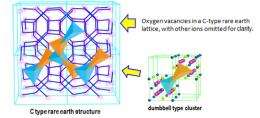
Figure:Dumbbell type oxygen vacancy clusters in a C-type rare earth structure
NIMS and the University of Queensland Centre for Microscopy and Microanalysis, the Dalian Polytechnic University, and the Dalian Institute of Chemical Physics, Chinese Academy of Science, clarified for the first time the cluster structure which has an extremely large effect on the long-term stability of solid oxide fuel cells (SOFC) for independent distributed power generation.
Dr. Toshiyuki Mori, Group Leader of the Hetero-interface Design Group, Battery and Fuel Cell Field, Global Research Center for Environment and Energy Based on Materials Science (GREEN), National Institute for Materials Science (Japan), and Dr. Zhipeng Li, a Postdoctoral Researcher at GREEN, in joint research with Prof. John Drennan of the University of Queensland Centre for Microscopy and Microanalysis (Australia), the Dalian Polytechnic University (China), and the Dalian Institute of Chemical Physics, Chinese Academy of Science (China), clarified for the first time the cluster structure which has an extremely large effect on the long-term stability of solid oxide fuel cells (SOFC) for independent distributed power generation. This result was achieved by transmission electron microscope (TEM) observation and computer simulation based on the results thereof.
Active development of fuel cells for home use and large-scale generating systems using SOFC has been underway up to the present. However, while it was possible to manufacture devices which sufficiently satisfied performance requirements, elements of instability remained from the viewpoints of reliability and life, and these were major obstacles to practical application.
In this experiment, the nanoscale defect structures of high performance specimens and specimens which exhibited serious deterioration in performance were observed using a high resolution transmission electron microscope (TEM), and their distinctive features were then analyzed in computer simulations. This research ascertained for the first time that a “new oxygen defect cluster structure” which has a structure different from the “oxygen defect (oxygen vacancy) cluster structure” long considered to be the cause of reduced performance, forms in the material, triggering a phase transition, and this has a negative impact on the reliability and durability of fuel cells.
Various puzzling phenomena in SOFC, had been un-explained until now. These are (1) reason why a crystal phase transition occurs together with performance deterioration, (2) reason why adequate reliability cannot be maintained, etc., and they can be interpreted rationally using a model of this oxygen defect cluster structure. As a result effective solutions to these problems can be proposed based on materials science, and the development of high performance, high reliability, long life SOFC materials for use in independent distributed generation is expected to become possible.
These research results were published online on November 7 in “Rapid communications” in the journal of the American Institute of Physics, Physical Review B.
Journal reference:
Physical Review B
Provided by National Institute for Materials Science
-
From lemons to lemonade: Reaction uses carbon dioxide to make carbon-based semiconductor,
32 comments
-
Thioridazine kills cancer stem cells in human while avoiding toxic side-effects of conventional cancer treatments,
3 comments
-
SpaceX private rocket blasts off for space station (Update),
42 comments
-
Climate scientists say they have solved riddle of rising sea,
31 comments
-
SpaceX capsule has 'new car' smell, astronauts say (Update),
4 comments
-
Laser noise spectrum
1 hour ago
-
Transparency of molten substances?
May 25, 2012
-
saturated paramagnetic and ferromagnetic
May 24, 2012
-
How to calculate the bandstructure of Twisted Bilayer Graphene
May 23, 2012
-
vast computational richness from swapping one proton
May 22, 2012
-
Oscillator strength of mixed LH- and HH-excitons
May 22, 2012
- More from Physics Forums - Atomic, Solid State, Comp. Physics
More news stories
Is a classical electrodynamics law incompatible with special relativity?
(Phys.org) -- The laws of classical electromagnetism that were developed in the 19th century are the same laws that scientists use today. They include Maxwell’s four equations along with the Lorentz la ...
Landmark calculation clears the way to answering how matter is formed
(Phys.org) -- An international collaboration of scientists, including Thomas Blum, associate professor of physics, is reporting in landmark detail the decay process of a subatomic particle called a kaon ...
May 25, 2012 |
4.3 / 5 (22) |
51
|
Lying in wait for WIMPs: Researchers seek to dramatically increase sensitivity of Large Underground Xenon detector
Although it's invisible, dark matter accounts for at least 80 percent of the matter in the universe. No one knows what it is, but most scientists would bet on weakly interacting massive particles, or WIMPs.
May 23, 2012 |
4 / 5 (7) |
15
|
Hawaii lab turns laser-powered bubbles into microrobots
(Phys.org) -- A team of scientists from the University of Hawaii are working on microrobots created from bubbles of air in a saline solution. The bubbles take on their title of robots as a laser ...
Sound increases the efficiency of boiling
Scientists at the Georgia Institute of Technology achieved a 17-percent increase in boiling efficiency by using an acoustic field to enhance heat transfer. The acoustic field does this by efficiently removing vapor bubbles ...
May 24, 2012 |
5 / 5 (2) |
2
'Unzipped' carbon nanotubes could help energize fuel cells, batteries
Multi-walled carbon nanotubes riddled with defects and impurities on the outside could replace some of the expensive platinum catalysts used in fuel cells and metal-air batteries, according to scientists at ...
T cells 'hunt' parasites like animal predators seek prey, study shows
By pairing an intimate knowledge of immune-system function with a deep understanding of statistical physics, a cross-disciplinary team at the University of Pennsylvania has arrived at a surprising finding: T cells use a movement ...
Computer model used to pinpoint prime materials for efficient carbon capture
When power plants begin capturing their carbon emissions to reduce greenhouse gases and to most in the electric power industry, it's a question of when, not if it will be an expensive undertaking.
Change in developmental timing was crucial in the evolutionary shift from dinosaurs to birds: study
At first glance, it's hard to see how a common house sparrow and a Tyrannosaurus Rex might have anything in common. After all, one is a bird that weighs less than an ounce, and the other is a dinosaur that ...
Yale study concludes public apathy over climate change unrelated to science literacy
Are members of the public divided about climate change because they don't understand the science behind it? If Americans knew more basic science and were more proficient in technical reasoning, would public consensus match ...
Same gene that stunts infants' growth also makes them grow too big: research
UCLA geneticists have identified the mutation responsible for IMAGe* syndrome, a rare disorder that stunts infants' growth. The twist? The mutation occurs on the same gene that causes Beckwith-Wiedemann syndrome, which makes ...