The Delta robot: Swiss-made and fastest in the world
November 14, 2011 By Sandy Evangelista
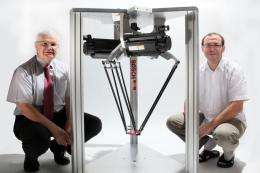
Credit: 2011 EPFL Alain Herzog
Its the story of a long dynasty of industrial robots. Deltas three arms began by packaging chocolates, before being used in watchmaking, tele-surgery and the processing of materials....
More than 200 operations per minute! Its not a firearm, but rather an outstanding packaging tool. The Delta robot made light work of hundreds of packets of Smarties at the Triennial Interpack Exhibition in Düsseldorf. The inventor of the concept, Reymond Clavel, was presenting in Germany the most recent version of the Delta robot, resulting of a collaboration with Bosch. The performance of Delta Direct Drive is impressive the robot can achieve acceleration of over 15 g, and this represents an increase in performance of 50% compared to robots of the previous generation.
This video is not supported by your browser at this time.
Increasing speed and maintaining precisionThe challenge in developing this new variant was daunting it involved increasing the speed of the Delta robot, while maintaining its precision. Previously, less powerful motors required the addition of a mechanical component, enabling a more effective transmission of the movement, but this limited the maximum speed of the robot. Scientists have now been able to take advantage of the progress made in motorization in both power and cost and this avoids the use of any such linking components. Thus, they have really gone up a gear. Reymond Clavel reveals: The idea of direct drive had been tucked away in a drawer for ages, but then again, twenty years ago the cost of such motors would have been much too high.
A success story
In 1985, the first Delta robot revolutionized the packaging world with its three arms and its gripping device. And unthinkable at the time a quarter of a century later, it has become a standard in industrial packaging. Reymond Clavel explains: In fact, I was astonished to note that around 140 Delta robots were working all around the Düsseldorf fair. A belated success for this robot, which had taken off rather too slowly for its inventors liking. He continues: To be honest, when we had developed the first Delta, I was so enthusiastic that I expected lots of companies to rush to my office to buy one. Not at all! In fact, two years passed before we signed our first licence transfer, because our robot had scared off the industrialists. Its very fine structure, which looked like an umbrella to them, was disconcerting. They thought that it wasnt robust enough. Time has proved them wrong.
From chocolates to neurosurgery
Originally conceived to manipulate small, light objects such as chocolates, over time the Delta has been used for many other applications. Together with the team from the Laboratoire de systèmes robotiques, Mohamed Bouri is developing new variants of the highly dynamic tool: In particular, we have developed ultra-high-precision robots, designed for use in the areas of electro-erosion, which involves machining very hard materials. These robots are also used in the manipulation and positioning of optical elements.
Other members of the Delta family have been developed in areas which demand the highest possible speed and precision, for example in watchmaking. Working together with neurosurgeons at the University Hospital Center of the canton of Vaud, a tactile feedback device has been developed to enable the surgeon to perform his hand movements. Reymond Clavel is convinced the future of the Delta robot is assured. It will be adapted for use in many important areas: processing; packaging, surgery, watchmaking and wait for it chocolates!
Provided by Ecole Polytechnique Federale de Lausanne
-
From lemons to lemonade: Reaction uses carbon dioxide to make carbon-based semiconductor,
32 comments
-
Thioridazine kills cancer stem cells in human while avoiding toxic side-effects of conventional cancer treatments,
3 comments
-
SpaceX private rocket blasts off for space station (Update),
42 comments
-
Climate scientists say they have solved riddle of rising sea,
31 comments
-
SpaceX capsule has 'new car' smell, astronauts say (Update),
4 comments
-
Need a rigid insulation material???
18 hours ago
-
magnets or EMF in car bumpers to protect from fender bender
May 26, 2012
-
length of wire in a coil of known dimensions?
May 25, 2012
-
India Engineering Powerhouse
May 25, 2012
-
electromagnet core dereference between hard and soft iron
May 25, 2012
-
Measuring water pressure in an open tank
May 24, 2012
- More from Physics Forums - General Engineering
More news stories
Nvidia trumpets Tegra 3 phone design wins for 2012
(Phys.org) -- Nvidias competitive war paint has a name, Tegra 3. On the heels of Nvidia announcements about lowering costs of its Tegra 3 processors and Nvidia-enabled tablets running Android Ice Cream ...
Dell tablet leak: 10.1-inch display, two-battery choice
(Phys.org) -- Headline after headline talks about vendors tablets in the wings as likely number-one contenders for the iPad. Such claims have justifiably been taken with a grain of salt, considering ...
Nvidia says Kai platform will turn price tide for tablets
(Phys.org) -- In March, Nvidia gave some signs that they were working to lower the cost of their Tegra 3 processors and they suggested consumers might see prices for Android tablets as low as $199. Connect ...
OmniVision tops up sensors for cameras, phones
(Phys.org) -- OmniVision has announced two high-resolution image sensors for the digital still and digital video camera market (DS/DVC) and higher end smartphones. In end-user language, it is a claim for superior ...
MIT researchers devise new means to synchronize a group of robots (w/ Video)
(Phys.org) -- For several years, roboticists have been working out ways to get a group of robots to perform synchronized activities as demonstrated most often in dance routines. Its not just about trying ...
Land and sea species differ in climate change response: study
(Phys.org) -- Marine and terrestrial species will likely differ in their responses to climate warming, new research by Simon Fraser University and Australia’s University of Tasmania has found.
'Unzipped' carbon nanotubes could help energize fuel cells, batteries
Multi-walled carbon nanotubes riddled with defects and impurities on the outside could replace some of the expensive platinum catalysts used in fuel cells and metal-air batteries, according to scientists at ...
T cells 'hunt' parasites like animal predators seek prey, study shows
By pairing an intimate knowledge of immune-system function with a deep understanding of statistical physics, a cross-disciplinary team at the University of Pennsylvania has arrived at a surprising finding: T cells use a movement ...
Computer model used to pinpoint prime materials for efficient carbon capture
When power plants begin capturing their carbon emissions to reduce greenhouse gases and to most in the electric power industry, it's a question of when, not if it will be an expensive undertaking.
Change in developmental timing was crucial in the evolutionary shift from dinosaurs to birds: study
At first glance, it's hard to see how a common house sparrow and a Tyrannosaurus Rex might have anything in common. After all, one is a bird that weighs less than an ounce, and the other is a dinosaur that ...
Yale study concludes public apathy over climate change unrelated to science literacy
Are members of the public divided about climate change because they don't understand the science behind it? If Americans knew more basic science and were more proficient in technical reasoning, would public consensus match ...
Nov 14, 2011
Rank: 5 / 5 (1)
Nov 15, 2011
Rank: not rated yet
For a wee video - check - http://www.youtub...vc2lMt54