New coatings process lowers fuel consumption
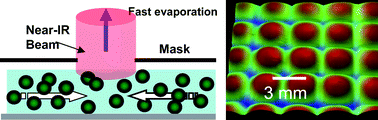
(PhysOrg.com) -- Researchers at the University of Surrey have invented a new process to make bespoke coatings that could one day reduce the 'drag resistance' of ships and aeroplanes and thereby lower fuel consumption.
The coatings have textures that could reduce the carbon footprint of the transport industry by lowering the drag of moving through air or water. In turn, vessels will consume less energy in propulsion.
The team of physicists at the University of Surrey is now collaborating with six companies through funding from an EPSRC Knowledge Transfer Account (KTA). The project is developing ways for industrial manufacturers to use the process to create novel coatings to decorate household goods.
Using their simple, low-cost process, it is possible to create plastic coatings with small bumps and ridges in sizes ranging from less than a millimetre to a couple of centimetres. With the right design, this texture will reduce the drag forces when large vessels pass through air or water.
Professor Joseph Keddie, of the Department of Physics, who led the research, said: Its an exciting prospect to have an impact on the energy consumed by planes and ships through a straightforward, inexpensive technology. Our process can create coatings with nearly any desired texture to meet the particular requirements of an application.
This new technology has grown out of several years of polymer and colloids research within the Soft Matter Physics Group in collaboration with industrial partners. Our KTA project will help to transfer our research ideas into industrial manufacturing.
There are also other numerous high-tech applications where the University of Surreys work can be used, such as to create tiny lenses to focus light. Applications of these micro lenses are in digital cameras, photocopiers, and solar cells.
The researchers call their process infrared radiation-assisted evaporative lithography. They use beams of infrared light to heat certain spots on wet coatings made of tiny plastic particles in water. The hotter spots evaporate more quickly, and the plastic particles are then guided there as the evaporating water is replaced. The process is simple to use and does not require expensive equipment. The textured coatings can be used to cover nearly any surface.
The research has recently been published, with co-authors at AkzoNobel and at the University of Cambridge, as a cover article in the prestigious Royal Society of Chemistry journal, Soft Matter. The scientists have also filed an international patent application on their process and are looking for partners to apply the new technology in applications.
The coatings can also have an attractive visual appearance and interesting textures, making them exciting for new designs on domestic products.
Our novel process uses fundamental concepts of science to create objects with tremendous aesthetic appeal. The coatings are beautiful to see, said Dr Argyrios Georgiadis, whose experimental work paved the way for the technology.
More information: Bespoke periodic topography in hard polymer films by infrared radiation-assisted evaporative lithography, Soft Matter, 2011, 7, 11098-11102. DOI: 10.1039/C1SM06527K
Abstract
Polymer coatings with periodic topographic patterns, repeating over millimetre length scales, are created from lateral flows in an aqueous dispersion of colloidal particles. The flow is driven by differences in evaporation rate across the wet film surface created by IR radiative heating through a shadow mask. This new process, which we call IR radiation-assisted evaporative lithography (IRAEL), combines IR particle sintering with the concept of evaporative lithography. We show that the height of the surface features increases with an increase in several key parameters: the initial thickness of the film, the volume fraction of particles, and the pitch of the pattern. The results are interpreted by using models of geometry and particle transport. The patterned coatings can function as paintable microlens arrays, applicable to nearly any surface. Compared with existing methods for creating textured coatings, IRAEL is simpler, inexpensive, able to create a wide variety of bespoke surfaces, and applicable to nearly any substrate without prior preparation.
Journal reference:
Soft Matter
Provided by University of Surrey
-
From lemons to lemonade: Reaction uses carbon dioxide to make carbon-based semiconductor,
32 comments
-
Thioridazine kills cancer stem cells in human while avoiding toxic side-effects of conventional cancer treatments,
3 comments
-
SpaceX private rocket blasts off for space station (Update),
42 comments
-
Climate scientists say they have solved riddle of rising sea,
31 comments
-
SpaceX capsule has 'new car' smell, astronauts say (Update),
4 comments
-
Calculating partial pressures Pa and Pw
55 minutes ago
-
Gibbs Free Energy Change/Entropy
11 hours ago
-
What's the rule to covalent character
12 hours ago
-
Schwartz reagent-- NMR/MS/IR
May 26, 2012
-
High school chemistry EEI
May 25, 2012
-
oxidation of I- by KMnO4
May 25, 2012
- More from Physics Forums - Chemistry
More news stories
Computer model used to pinpoint prime materials for efficient carbon capture
When power plants begin capturing their carbon emissions to reduce greenhouse gases and to most in the electric power industry, it's a question of when, not if it will be an expensive undertaking.
3 hours ago |
not rated yet |
0
|
Scientists develop ultra-sensitive test that detects diseases in their earliest stages
Scientists have developed an ultra-sensitive test that should enable them to detect signs of a disease in its earliest stages, in research published today in the journal Nature Materials.
Chemistry / Analytical Chemistry
3 hours ago |
not rated yet |
0
|
New CO2-removing catalyst can take the heat
(Phys.org) -- The current method of removing the greenhouse gas carbon dioxide (CO2) from the flues of coal-fired power plants uses so much energy that no one bothers to use it. So says Roger Aines, principal ...
May 24, 2012 |
5 / 5 (9) |
10
|
High-speed method to aid search for solar energy storage catalysts
Eons ago, nature solved the problem of converting solar energy to fuels by inventing the process of photosynthesis.
May 25, 2012 |
5 / 5 (3) |
4
|
Researchers demonstrate possible primitive mechanism of chemical info self-replication
(Phys.org) -- When scientists think about the replication of information in chemistry, they usually have in mind something akin to what happens in living organisms when DNA gets copied: a double-stranded molecule ...
May 25, 2012 |
5 / 5 (4) |
2
|
Land and sea species differ in climate change response: study
(Phys.org) -- Marine and terrestrial species will likely differ in their responses to climate warming, new research by Simon Fraser University and Australia’s University of Tasmania has found.
'Unzipped' carbon nanotubes could help energize fuel cells, batteries
Multi-walled carbon nanotubes riddled with defects and impurities on the outside could replace some of the expensive platinum catalysts used in fuel cells and metal-air batteries, according to scientists at ...
T cells 'hunt' parasites like animal predators seek prey, study shows
By pairing an intimate knowledge of immune-system function with a deep understanding of statistical physics, a cross-disciplinary team at the University of Pennsylvania has arrived at a surprising finding: T cells use a movement ...
Change in developmental timing was crucial in the evolutionary shift from dinosaurs to birds: study
At first glance, it's hard to see how a common house sparrow and a Tyrannosaurus Rex might have anything in common. After all, one is a bird that weighs less than an ounce, and the other is a dinosaur that ...
Nvidia trumpets Tegra 3 phone design wins for 2012
(Phys.org) -- Nvidias competitive war paint has a name, Tegra 3. On the heels of Nvidia announcements about lowering costs of its Tegra 3 processors and Nvidia-enabled tablets running Android Ice Cream ...
Yale study concludes public apathy over climate change unrelated to science literacy
Are members of the public divided about climate change because they don't understand the science behind it? If Americans knew more basic science and were more proficient in technical reasoning, would public consensus match ...
Nov 22, 2011
Rank: 5 / 5 (1)
They did mention that some coatings had large feature sizes (couple cm), which may be less prone to fouling (but it's unstated how feature size relates to efficiency).
Shark skin is like sandpaper which allows the animal to slip through the water, so a similar type of coating might be effective for shipping.
Nov 23, 2011
Rank: not rated yet
Yes...while readnig the article I was thinking this exact same thing.
Now combine this with a structure that creates the Lotus effect and we could have something here.
Might necessitate new cleaning methods, though. Scrubbing off barnacles and the like is a very harsh process which might damage such a delicate microstructures.
Nov 23, 2011
Rank: not rated yet
Nov 28, 2011
Rank: not rated yet