Brain control? Shining light on pupil constriction
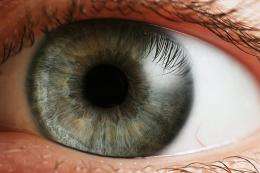
Human eye. Image: Wikipedia.
(PhysOrg.com) -- Youve seen it on television: A doctor shines a bright light into an unconscious patients eye to check for brain death. If the pupil constricts, the brain is OK, because in mammals, the brain controls the pupil. Or does it? Now, researchers at Johns Hopkins have discovered that in most mammals, in fact in most vertebrates, the pupil can constrict without any input from the brain. Their work, which also describes for the first time the molecular mechanism underlying this process, appears in the Nov. 3 issue of Nature.
It was established more than 40 years ago that animals like amphibians and fish have photosensitive irises and dont necessarily require the brain for the pupillary light reflex, whereas it was thought that mammals generally required brain circuitry, says King-Wai Yau, Ph.D., professor of neuroscience and ophthalmology at the Johns Hopkins University School of Medicine and member of the Institute for Basic Biomedical Sciences Center for Sensory Biology. But in neither case did anyone know what the molecular switch was, and now we have found that its the pigment melanopsin.
The research team examined isolated irises from a wide range of mammals by attaching a tiny meter that measures the force of the sphincter muscle that constricts the pupil. They then shined a bright light onto this muscle and measured any contraction. Irises from nocturnal animals including mouse, rat, hamster, dog, cat, rabbit and the Nile grass rat all showed responses to light. Irises from diurnal animals including guinea pig, ground squirrel and pig did not, nor did those from rhesus monkey, marmoset, owl monkey and bush baby, even though the owl monkey and bush baby are nocturnal.
Most non-primate mammals are considered nocturnal or crepuscular active at dawn and dusk including those, like dogs, that have been domesticated and have picked up human circadian rhythms, says Yau. We dont really know why primates, including us, as well as other daytime functioning animals dont have this ability. According to Yau, the eyes of nocturnal animals, because they function in the dark, contain more cells that are sensitive to low light and exposure to bright light could cause eye damage. Perhaps, he suggests, the built-in pupil reflex is a good way to protect the eye.
So of course we wanted to know what pigment molecules are involved in triggering pupil constriction, says Yau. Having previously genetically engineered mice to lack melanopsin, the team first tested the pupillary light reflex on irises from these mice. That was a really exciting resultthey didnt respond to the light, says Tian Xue, a research associate with Yau. They also tested mice engineered to lack other light-capturing pigments, but all of them responded normally, suggesting that only melanopsin is required for the local pupil reflex. Using mouse genetics, the team then continued to try to identify other proteins that work with melanopsin to cause the pupil to contract in response to light.
Because melanopsin is closely related to the pigment responsible for capturing light in fly eyes, and that molecular pathway has been well studied, Yaus team hypothesized that the mammalian counterparts to these fly molecules might be what works with melanopsin. So they tested mice engineered to lack some of these molecules. They found that irises from mice lacking the PLC enzyme were unresponsive to light, showing that PLC also is involved in this reflex.
There still are a lot of things we dont know that we would like to study, says Yau. Now that we know what captures the light and starts the local reflex, we would like to know what proteins in the muscle trigger the actual contraction.
Provided by
Johns Hopkins University
-
From lemons to lemonade: Reaction uses carbon dioxide to make carbon-based semiconductor,
32 comments
-
Thioridazine kills cancer stem cells in human while avoiding toxic side-effects of conventional cancer treatments,
3 comments
-
SpaceX private rocket blasts off for space station (Update),
42 comments
-
Climate scientists say they have solved riddle of rising sea,
31 comments
-
SpaceX capsule has 'new car' smell, astronauts say (Update),
4 comments
-
What would stain as translucent on light-coloured fabric?
23 hours ago
-
How do I identify different bacteria on culture plates?
May 26, 2012
-
Why Do Dogs do Strange things...
May 25, 2012
-
What does exophillic and endophillic mean in terms of mosquito and their control?
May 24, 2012
-
Semen stains glows under black lights (uv light)?
May 23, 2012
-
Question on Human Chromosome 2
May 23, 2012
- More from Physics Forums - Biology
More news stories
Scientist: Evolution debate will soon be history
(AP) -- Richard Leakey predicts skepticism over evolution will soon be history. Not that the avowed atheist has any doubts himself.
22 hours ago |
3.5 / 5 (20) |
85
Manufacturing genes to attack flu virus
An international research team has manufactured a new protein that can combat deadly flu epidemics.
3 hours ago |
not rated yet |
0
|
More plant species responding to global warming than previously thought
(Phys.org) -- Far more wild plant species may be responding to global warming than previous large-scale estimates have suggested.
May 22, 2012 |
4.6 / 5 (14) |
18
|
Thousands of shellfish found dead in Peru
Thousands of crustaceans were found dead off the coast of Lima following the mystery mass death of dolphins and pelicans, the Peruvian Navy said Friday.
May 26, 2012 |
4.7 / 5 (6) |
7
For monogamous sparrows, it doesn't pay to stray (but they do it anyway)
It's quite common for a female song sparrow to stray from her breeding partner and mate with the male next door, but a new study shows that sleeping around can be costly.
May 22, 2012 |
5 / 5 (2) |
8
|
Land and sea species differ in climate change response: study
(Phys.org) -- Marine and terrestrial species will likely differ in their responses to climate warming, new research by Simon Fraser University and Australia’s University of Tasmania has found.
'Unzipped' carbon nanotubes could help energize fuel cells, batteries
Multi-walled carbon nanotubes riddled with defects and impurities on the outside could replace some of the expensive platinum catalysts used in fuel cells and metal-air batteries, according to scientists at ...
T cells 'hunt' parasites like animal predators seek prey, study shows
By pairing an intimate knowledge of immune-system function with a deep understanding of statistical physics, a cross-disciplinary team at the University of Pennsylvania has arrived at a surprising finding: T cells use a movement ...
Computer model used to pinpoint prime materials for efficient carbon capture
When power plants begin capturing their carbon emissions to reduce greenhouse gases and to most in the electric power industry, it's a question of when, not if it will be an expensive undertaking.
Change in developmental timing was crucial in the evolutionary shift from dinosaurs to birds: study
At first glance, it's hard to see how a common house sparrow and a Tyrannosaurus Rex might have anything in common. After all, one is a bird that weighs less than an ounce, and the other is a dinosaur that ...
Nvidia trumpets Tegra 3 phone design wins for 2012
(Phys.org) -- Nvidias competitive war paint has a name, Tegra 3. On the heels of Nvidia announcements about lowering costs of its Tegra 3 processors and Nvidia-enabled tablets running Android Ice Cream ...
Nov 02, 2011
Rank: 1 / 5 (1)
That is the 'big' picture. And your puzzle piece to the big picture is noble prize worthy - if that is what impresses you.
Kudos and congratulations to all of you.
Nov 07, 2011
Rank: not rated yet