Beam-line science to take us on a virtual journey to the center of the Earth
November 22, 2011

Beam-line science to take us on a virtual journey to the centre of the Earth

Enlarge

A new agreement between Macquarie University and the Australian Nuclear Science and Technology Organisation (ANSTO), will help us better understand everything from where earthquakes might occur to where gold is deposited.

The partnership provides joint funding for a senior-level research appointment in the University's Department of Earth and Planetary Sciences. This arrangement is the first of its kind between the University and ANSTO.

The successful appointee will help lead work to replicate environments 400 kilometres beneath earth's surface: specifically a layer called the , which is the source of most magma or beneath the surface.

The study of the physical and chemical processes at these depths will provide a better understanding of the earth, including how mineral deposits are formed.

And by providing a fuller working model of the processes that occur in the earth's interior, scientists hope to better understand how to predict and anticipate geologic events such as earthquakes and volcanic eruptions.

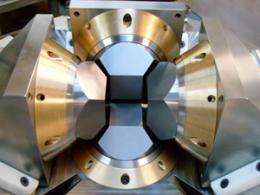
Along with the appointment is building of the first multi-anvil experimental facility on the Australian Synchrotron: delivering the first high pressure synchrotron facility for geoscience research. Each anvil is effectively a hydraulic ram.

(This new equipment and research facility will be funded by Macquarie University and an Australian Research Council Linkage Infrastructure, Equipment and Facilities grant.)

The new researcher will use both the Melbourne-based synchrotron and the Sydney-based OPAL research reactor. To this point, high-pressure research has been conducted primarily in the US and Japan, so this is an Australian first.

"We are pleased to announce this joint venture which will take advantage of unique Australian infrastructure and forms part of the increasing momentum within the earth science community to use such facilities," said Professor Jim Piper, the University's Deputy Vice-Chancellor (Research).

"The multi-anvil research facility will enable real time, high pressure, high temperature experiments on deep earth materials. The experiments will inform models for the chemical and physical evolution of the and other planets," he said.

Dr Rob Robinson is the Head of ANSTO's Bragg Institute, which leads Australia in the use of neutron scattering and x-ray techniques to solve complex research and industrial problems.

"This project is a great example of how ANSTO can collaborate with both the university sector and the Australian Synchrotron to deliver research that benefits science and the community in general," Dr Robinson said.

"There could be numerous exciting applications for this science, both now and as it is further developed.

"In the future, ANSTO will also look to develop a sister high-pressure facility on our campus, which would run on the OPAL Reactor's neutron beam lines and investigate the behaviour of light elements in these systems."

Head of Science at the Australian Synchrotron, Professor Andrew Peel, also welcomed the announcement saying it places Australian scientists at the forefront of geoscience research.

Provided by Macquarie University


Rank not rated yet
Relevant PhysicsForums posts

More news stories

Land and sea species differ in climate change response: study

(Phys.org) -- Marine and terrestrial species will likely differ in their responses to climate warming, new research by Simon Fraser University and Australia’s University of Tasmania has found.

Space & Earth / Environment

created 55 minutes ago | popularity not rated yet | comments 1 | with audio podcast

Yale study concludes public apathy over climate change unrelated to science literacy

Are members of the public divided about climate change because they don't understand the science behind it? If Americans knew more basic science and were more proficient in technical reasoning, would public consensus match ...

Space & Earth / Environment

created 2 hours ago | popularity 4 / 5 (1) | comments 10 | with audio podcast

10 million years needed to recover from mass extinction

It took some 10 million years for Earth to recover from the greatest mass extinction of all time, latest research has revealed.

Space & Earth / Earth Sciences

created 2 hours ago | popularity not rated yet | comments 1 | with audio podcast

Sophisticated simulations predict future warming

The chances of our planet being hit by a global warming of 3 degrees Celsius by 2050 is as likely as it being hit by an increase of 1.4 degrees, new research shows. Presented in the journal Nature Geoscience, the British study ...

Space & Earth / Earth Sciences

created May 22, 2012 | popularity 4.4 / 5 (9) | comments 51

Aliens don't want to eat us, says former SETI director

Alien life probably isn’t interested in having us for dinner, enslaving us or laying eggs in our bellies, according to a recent statement by former SETI director Jill Tarter.

Space & Earth / Space Exploration

created May 25, 2012 | popularity 4.4 / 5 (14) | comments 39


Almost half of new vets seek disability

(AP) -- America's newest veterans are filing for disability benefits at a historic rate, claiming to be the most medically and mentally troubled generation of former troops the nation has ever seen.

'Unzipped' carbon nanotubes could help energize fuel cells, batteries

Multi-walled carbon nanotubes riddled with defects and impurities on the outside could replace some of the expensive platinum catalysts used in fuel cells and metal-air batteries, according to scientists at ...

T cells 'hunt' parasites like animal predators seek prey, study shows

By pairing an intimate knowledge of immune-system function with a deep understanding of statistical physics, a cross-disciplinary team at the University of Pennsylvania has arrived at a surprising finding: T cells use a movement ...

Computer model used to pinpoint prime materials for efficient carbon capture

When power plants begin capturing their carbon emissions to reduce greenhouse gases – and to most in the electric power industry, it's a question of when, not if – it will be an expensive undertaking.

Change in developmental timing was crucial in the evolutionary shift from dinosaurs to birds: study

At first glance, it's hard to see how a common house sparrow and a Tyrannosaurus Rex might have anything in common. After all, one is a bird that weighs less than an ounce, and the other is a dinosaur that ...

Nvidia trumpets Tegra 3 phone design wins for 2012

(Phys.org) -- Nvidia’s competitive war paint has a name, Tegra 3. On the heels of Nvidia announcements about lowering costs of its Tegra 3 processors and Nvidia-enabled tablets running Android Ice Cream ...