
Beacons in space
November 3, 2011 By Helmut Hornung
Pulsars are among the most exotic objects in the universe. They resemble gigantic atomic nuclei and rotate around their own axis at an incredible speed. These cosmic beacons mark the end of massive suns. Theoretically predicted in the 1930s, they were discovered three decades later by a young astronomer purely by chance.
Cambridge, England, end of September 1967. The 24-year-old astronomy student Jocelyn Bell is hard at work on her doctoral thesis. She is evaluating data from a new radio telescope long strips of paper, dozens of meters long with bumpy curves. After 30 meters of paper, the students trained eye detects an irregularity. A few weeks later Jocelyn Bell investigates this perturbation in more detail. She discovers that they are pulses which are repeated at intervals of precisely 1.33730109 seconds.
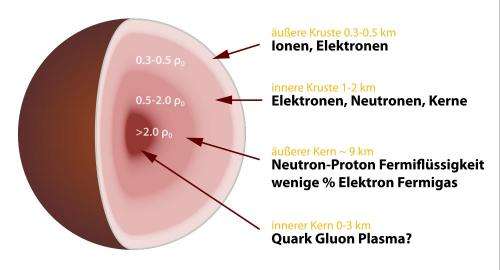
Exotic cosmic body: Schematic structure of a neutron star. (c) Robert Schulze
What does it mean? They cannot be produced by humans, because the signals always return when the mysterious transmitter caused by the apparent daily rotation of the sky moves past the stationary telescope. There are two possible options: either the pulses originate from an astronomical object but from which one? - or from an alien civilization that is trying to communicate with Earth! And in fact Bell and her doctoral supervisor Anthony Hewish call the mysterious signal Little Green Man.Shortly before Christmas, Jocelyn Bell examines the recordings from a different region in the sky - and promptly finds a further transmitter. This time with a period of 1.2 seconds. Is there really a second alien people broadcasting on a different frequency? This seems extremely unlikely. Therefore, the only explanation is an astronomical one. But what lies behind the ticking of these cosmic quartz clocks? The answer is astonishing: objects whose existence scientists had theoretically predicted back in 1934. Their work, however, went unnoticed for 33 years before being confirmed by Jocelyn Bell.
The young researcher had discovered neutron stars which reveal their identity as pulsars. Incidentally, somebody else had listened to the signals from space in summer 1967: Charles Schisler, a young soldier in a radar station in Alaska. However, for reasons of military nondisclosure, Schisler kept the secret to himself for 40 years, only breaking his silence in the summer of 2007.
How are these pulsars formed? When a star with more than eight solar masses comes to the end of its life, its interior is thrown out of equilibrium. After the elements iron and nickel have been created in its core in the final, brief life phase, the fusion process comes to a halt. The radiation pressure acting towards the outside decreases, the force of gravity acting inwards gains the upper hand. Finally, disaster strikes in the form of a supernova: while the outer regions of the star are ejected into space, the core collapses. If its mass is between 1.4 and around 3 solar masses, the collapse comes to a standstill: a neutron star is formed.
The matter at the core of the dead star is compressed to such an extent here that a piece the size of a sugar cube would weigh tens of millions of tonnes on Earth. At this extreme density of 1011 to 1012 kilograms per cubic centimetre, protons and electrons are squeezed into each other and produce neutrons. These bodies have a diameter of just over 20 kilometres. Moreover, the neutron stars must have extremely smooth surfaces; the mountains have a height of five millimetres at most.
Finally, the neutron spheres rotate rapidly about their axis, like an ice-skater pirouetting with their arms down by their sides. This is also the secret of the pulsars: while the burnt-out stars rotate with tremendous speed the speed record is currently held by a neutron star that rotates about its axis 716 times per second charged particles are accelerated along extremely strong magnetic field lines and radiate electromagnetic radiation in different wavelength ranges.
This radiation is bundled along the axis of the magnetic field like a cone. If the neutron star now turns on its rotational axis, which is at an angle to the axis of the magnetic field, bundles of radiation are produced which sweep across their surroundings, like two searchlight beams. If the pulses meet the Earth, the astronomers observe a pulsar. Their rotational period of seconds or milliseconds has such a high degree of precision that they are considered to be the most reliable clocks imaginable.
The researchers have so far discovered more than 1,700 pulsars. There are an estimated 500,000 in the Milky Way alone. The celestial bodies radiate not only in the radio frequency part of the spectrum, where Jocelyn Bell found them. Special instruments freeze their flicker and visualise the pulses in the visible part of the spectrum. And today the researchers also know of X-ray and gamma pulsars. Even though not all pulsars can be observed in all frequency ranges, the scientists assume that the energy they radiate is distributed across the whole spectrum. The fundamental mechanisms are not yet completely understood, however.
One theory states that, at the magnetic field poles, the lower energy radio waves are bundled together to form a radiation cone which is narrower than that of the high-energy gamma radiation. Most of the radiation is emitted along the sheath of the cone, however. In this model, the cones fan out differently depending on the type of radiation, and so radio and gamma radiation leave the pulsar in different spatial directions. An observer on Earth therefore sees either a gamma or a radio pulsar.
The pulsars are thus still something of a mystery 44 years after their discovery. They have been dynamite for the scientific community in a different way as well: Anthony Hewish was awarded the 1974 Nobel Prize for Physics. The true discoverer, Jocelyn Bell, went away empty-handed.
Provided by
Max-Planck-Gesellschaft
-
From lemons to lemonade: Reaction uses carbon dioxide to make carbon-based semiconductor,
32 comments
-
Thioridazine kills cancer stem cells in human while avoiding toxic side-effects of conventional cancer treatments,
3 comments
-
SpaceX private rocket blasts off for space station (Update),
42 comments
-
Climate scientists say they have solved riddle of rising sea,
31 comments
-
SpaceX capsule has 'new car' smell, astronauts say (Update),
4 comments
-
Distance of planets from stars and revolution
3 hours ago
-
revamping general concept and cosmological principle
May 25, 2012
-
Transiting Exoplanet Light Curve
May 25, 2012
-
Math behind Theoretical Physics
May 24, 2012
-
Do we know whats at the center of galaxies yet?
May 23, 2012
-
Structure of the Milky Way?
May 20, 2012
- More from Physics Forums - General Astronomy
More news stories
Land and sea species differ in climate change response: study
(Phys.org) -- Marine and terrestrial species will likely differ in their responses to climate warming, new research by Simon Fraser University and Australia’s University of Tasmania has found.
55 minutes ago |
not rated yet |
1
|
Yale study concludes public apathy over climate change unrelated to science literacy
Are members of the public divided about climate change because they don't understand the science behind it? If Americans knew more basic science and were more proficient in technical reasoning, would public consensus match ...
2 hours ago |
4 / 5 (1) |
10
|
10 million years needed to recover from mass extinction
It took some 10 million years for Earth to recover from the greatest mass extinction of all time, latest research has revealed.
Space & Earth / Earth Sciences
2 hours ago |
not rated yet |
1
|
Sophisticated simulations predict future warming
The chances of our planet being hit by a global warming of 3 degrees Celsius by 2050 is as likely as it being hit by an increase of 1.4 degrees, new research shows. Presented in the journal Nature Geoscience, the British study ...
Space & Earth / Earth Sciences
May 22, 2012 |
4.4 / 5 (9) |
51
Aliens don't want to eat us, says former SETI director
Alien life probably isnt interested in having us for dinner, enslaving us or laying eggs in our bellies, according to a recent statement by former SETI director Jill Tarter.
Space & Earth / Space Exploration
May 25, 2012 |
4.4 / 5 (14) |
39
Almost half of new vets seek disability
(AP) -- America's newest veterans are filing for disability benefits at a historic rate, claiming to be the most medically and mentally troubled generation of former troops the nation has ever seen.
'Unzipped' carbon nanotubes could help energize fuel cells, batteries
Multi-walled carbon nanotubes riddled with defects and impurities on the outside could replace some of the expensive platinum catalysts used in fuel cells and metal-air batteries, according to scientists at ...
T cells 'hunt' parasites like animal predators seek prey, study shows
By pairing an intimate knowledge of immune-system function with a deep understanding of statistical physics, a cross-disciplinary team at the University of Pennsylvania has arrived at a surprising finding: T cells use a movement ...
Computer model used to pinpoint prime materials for efficient carbon capture
When power plants begin capturing their carbon emissions to reduce greenhouse gases and to most in the electric power industry, it's a question of when, not if it will be an expensive undertaking.
Change in developmental timing was crucial in the evolutionary shift from dinosaurs to birds: study
At first glance, it's hard to see how a common house sparrow and a Tyrannosaurus Rex might have anything in common. After all, one is a bird that weighs less than an ounce, and the other is a dinosaur that ...
Nvidia trumpets Tegra 3 phone design wins for 2012
(Phys.org) -- Nvidias competitive war paint has a name, Tegra 3. On the heels of Nvidia announcements about lowering costs of its Tegra 3 processors and Nvidia-enabled tablets running Android Ice Cream ...

Nov 03, 2011
Rank: 5 / 5 (3)
Woha...at 20km diameter and 716 revolutions per second that star has a surface velocity of almost 15% of the speed of light at the equator (assuming it all rotates as one mass - which isn't entirely certain). I just wish we could park a probe above such an object (not in the direction of the axis rotation, obviously). Some serious relativistic effects would be observable.
Nov 03, 2011
Rank: not rated yet
Nov 03, 2011
Rank: 2 / 5 (1)
Neutron stars just dont make much sence to me, i could see electrical charge swapping this fast abd causing pulses, but not the planet rotating this fast.
If they were this dense and rotating that fast, wouldnt they have a affect on the fabric of space around them. frame dragging i think its called. IE, wouldnt matter be more linded up around such objects.
Also, can you use them as gravitational lenzes
finaly, can we mesure the size of one of these bodys ? i assume we calculate the size, but would there be any way of varifying it.
Nov 03, 2011
Rank: not rated yet
Yes, that is why I thought a probe would be neat.
Nov 04, 2011
Rank: 5 / 5 (2)
Yes. Unless Einstein is wrong about GR.
If you are close enough OR if a star should just happen to pass behind one. Which has to be a VERY rare occurrence.
We can measure the mass IF it has companion. The only way to measure the size is by occultation. Something bright enough has to pass behind it. While we are looking.
Ethelred
Nov 04, 2011
Rank: 5 / 5 (1)
When i said about it affecting the space aroud it, i was thinking along the lines of wouldnt there be a sort of pattern to the formation of matter or clumping to gether of matter, along it poles or becons. or just slightly ofset to them.
same as we see patterens forming because of electrical feilds lines on small things,
whatever patterns, if any, form around such dense objects, should give us an indication as to what space might be made out of on the smallest scale.
when i think of these patterns around magnetic lines, i think dougnuts. or a brane folded into a doughnit, constantly trying to resolve itself. if you understand my odd description.