Awesome action animation depicts Russia’s bold robot retriever to Mars moon Phobos
Nov 08, 2011 By Ken Kremer, Universe Today
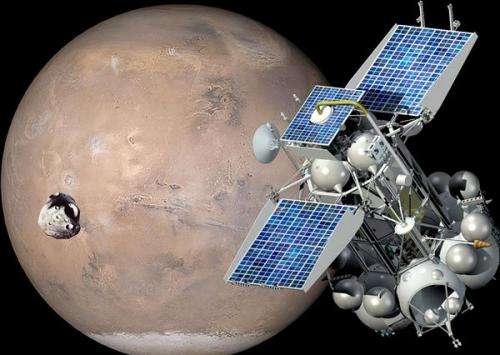
Russia’s Phobos-Grunt interplanetary spacecraft is scheduled to blast off on November 9, 2011 from the Baikonur Cosmodrome on a bold roundtrip mission to land on Phobos surface and ship the first ever soil samples back to Earth by 2014. Credit Roscosmos.

In less than 48 hours, Russia’s bold Phobos-Grunt mechanized probe will embark on a historic flight to haul humanities first ever soil samples back from the tiny Martian moon Phobos. Liftoff from the Baikonur Cosmodrome remains on target for November 9 (Nov 8 US EDT).

This video is not supported by your browser at this time.
On October 21, the Phobos-Grunt spacecraft arrived at the Baikonur Cosmodrome and was uncrated and moved to assembly building 31 for fueling, final preflight processing and encapsulation in the nose cone. Credit: Roscosmos

For an exquisite view of every step of this first-of-its-kind robot retriever, watch this spectacular action packed animation (below) outlining the entire 3 year round trip voyage. The simulation was produced by Roscosmos, Russia’s Federal Space Agency and the famous IKI Space Research Institute. It’s set to cool music – so don’t’ worry, you don’t need to understand Russian.
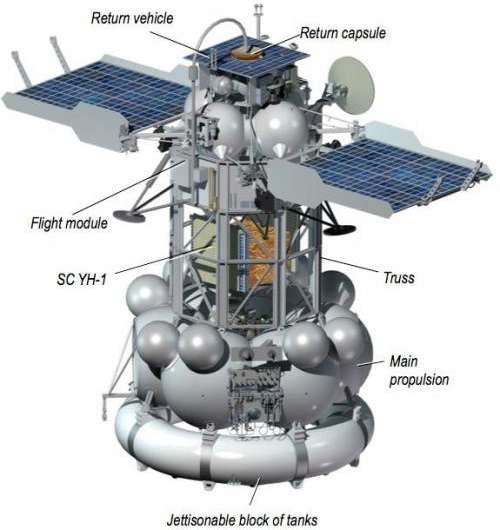
Labeled Schematic of Phobos-Grunt and Yinghou-1 (YH-1) orbiter. Credit: Roskosmos

Another video below shows the arrival and uncrating of the actual Phobos-Grunt spacecraft at Baikonur in October 2011.

This video is not supported by your browser at this time.
Every step of Russia’s Phobos-Grunt soil retrieval mission. Credit: Roscosmos/IKI

The highly detailed animation begins with the blastoff of the Zenit booster rocket and swiftly progresses through Earth orbit departure, Phobos-Grunt orbit insertion, deployment of the piggybacked Yinghuo-1 (YH-1) mini satellite from China, Phobos-Grunt scientific reconnaissance of Phobos and search for a safe landing site, radar guided propulsive landing, robotic arm manipulation and soil sample collection and analysis, sample transfer to the Earth return capsule and departure, plummeting through Earth’s atmosphere and Russian helicopter retrieval of the precious cargo carrier.

Explore further: Collisions of coronal mass ejections can be super-elastic

add to favorites email to friend print save as pdf

Related Stories

Russia aims for first conquest of Mars

Nov 07, 2011

Russia on Wednesday launches a probe for Mars that aims to collect a chunk of a Martian moon and become Moscow's first successful planetary mission since the collapse of the Soviet Union.

Phobos flyby images (w/ Video)

Mar 15, 2010

Images from the recent flyby of Phobos, on 7 March 2010, are released today. The images show Mars' rocky moon in exquisite detail, with a resolution of just 4.4 metres per pixel. They show the proposed landing ...

Russia delays Mars probe launch until 2012: report

Sep 16, 2009

Russia will pushed back its flagship satellite mission to Mars' moon until 2011 in a move which will delay the joint launch of China's first Mars probe, space sources were cited as saying Wednesday.

Recommended for you

NASA head views progress on asteroid lasso mission

4 hours ago

Surrounded by engineers, NASA chief Charles Bolden inspected a prototype spacecraft engine that could power an audacious mission to lasso an asteroid and tow it closer to Earth for astronauts to explore.

Ecuador satellite collides with Russian space junk

4 hours ago

A small Ecuadoran satellite collided in orbit with the remains of a Russian rocket, but it is too soon to know how much damage it might have sustained, Quito's space agency said Thursday.

Forecast for Titan: Wild weather could be ahead

May 22, 2013

(Phys.org) —Saturn's moon Titan might be in for some wild weather as it heads into its spring and summer, if two new models are correct. Scientists think that as the seasons change in Titan's northern hemisphere, ...

SDO observes mid-level solar flare

May 22, 2013

UPDATE 16:30 p.m. EDT: The M7-class flare was also associated with a coronal mass ejection or CME, another solar phenomenon that can send billions of tons of particles into space. While this CME was not Ea ...

User comments : 6

Adjust slider to filter visible comments by rank

Display comments: newest first

GSwift7
not rated yet Nov 08, 2011
wow, that is a bold mission plan. Anybody want to place bets on whether the Ghost of Mars in hungry or not?

With an escape velocity of only 25 mph, most riding lawn mowers have enough power to lift off. It would be interesting to be able to watch the lander while it is taking samples. It wouldn't take much to make the lander move around when the sample arm is scooping up samples. I also wonder about the funnel they have for the samples that are getting analyzed on the lander. Even a little bit of static cling would be enough to overcome the microgravity. We're only talking about aproximately .008 g, if my back-o-the-envelope math is right.
JohnnyZupp
not rated yet Nov 08, 2011
The lander would have to dig in in order to hold, otherwise any extended scoop arm movement will kick it back into space, this means some kind of docking process need to be done instead of landing, it's got to have some kind of way to hold on to the surface, what if it's so hard that it can't be penetrated, then the only option to glue itself on, then how do you lift off after ?
GSwift7
not rated yet Nov 08, 2011
From the looks of the video, they appear to be using maneuvering thrusters to keep it pushed down. Notice the downward burn right after it touches down. I assume that's meant to settle it on the surface. There doesn't appear to be any kind of lock-down mechanism. Looks like plain old flat feet to me. In fact I don't see any shock absorbers. It certainly makes an interesting engineering problem.
JohnnyZupp
not rated yet Nov 08, 2011
Yes, it looks like, but Phobos is 18 miles in diameter, there is no gravitation force strong enough to pull the module down, creating vacuum under the leg wouldn't work neither because it's already in vacuum, I think it will glue itself on like a sticker pad, because it wouldn't need to lift off: the return module will...
Vendicar_Decarian
1 / 5 (2) Nov 09, 2011
This is a very complex mission for anyone, but especially Russia which has not had good luck producing reliable, complex systems.

I think the Ghost of Mars is hungry for this mission.
ROBTHEGOB
not rated yet Nov 09, 2011
Too complicated; the more complicated, the bigger the chance of failure. I wish them luck.

More news stories

Hubble reveals the ring nebula's true shape

(Phys.org) —The Ring Nebula's distinctive shape makes it a popular illustration for astronomy books. But new observations by NASA's Hubble Space Telescope of the glowing gas shroud around an old, dying, ...

NASA head views progress on asteroid lasso mission

Surrounded by engineers, NASA chief Charles Bolden inspected a prototype spacecraft engine that could power an audacious mission to lasso an asteroid and tow it closer to Earth for astronauts to explore.

A hidden population of exotic neutron stars

(Phys.org) —Magnetars – the dense remains of dead stars that erupt sporadically with bursts of high-energy radiation - are some of the most extreme objects known in the Universe. A major campaign using ...

Controlling mood through the motions of mitochondria

(Medical Xpress)—Regulating the distribution of power in neurons is done by a system that makes the national electric grid look simple by comparison. Each neuron has several thousand mitochondria confined ...

Google Drive sports new view and scan enhancements

(Phys.org) —Google Drive has a new look and functions. The makeover in Google Drive features scanning and interface enhancements that put the user into "card" mode. The enhancements make it easy for the ...