Ancient environment drives marine biodiversity, study says
November 24, 2011 by Jill Sakai

Ancient environment led to Earth's current marine biodiversity

Enlarge

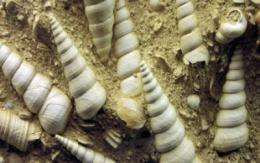
Fossil snails known as turritellid gastropods; they're about 13 million years old. Credit: Shanan Peters

Much of our knowledge about past life has come from the fossil record – but how accurately does that reflect the true history and drivers of biodiversity on Earth?

"It's a question that goes back a long way to the time of Darwin, who looked at the and tried to understand what it tells us about the history of life," says Shanan Peters, an assistant professor of geoscience at the University of Wisconsin–Madison.

In fact, the fossil record can tell us a great deal, he says in a new study. In a report published Friday, Nov. 25 in Science magazine, he and colleague Bjarte Hannisdal, of the University of Bergen in Norway, show that the evolution of marine life over the past 500 million years has been robustly and independently driven by both ocean chemistry and sea level changes.

The time period studied covered most of the Phanerozoic eon, which extends to the present and includes the evolution of most plant and animal life.

Hannisdal and Peters analyzed fossil data from the Paleobiology Database along with paleoenvironmental proxy records and data on the rock record that link to ancient global climates, tectonic movement, continental flooding, and changes in biogeochemistry, particularly with respect to oxygen, carbon, and sulfur cycles. They used a method called information transfer that allowed them to identify causal relationships – not just general associations – between diversity and environmental proxy records.

"We find an interesting web of connections between these different systems that combine to drive what we see in the fossil record," Peters says. "Genus diversity carries a very direct and strong signal of the sulfur isotopic signal. Similarly, the signal from sea level, how much the continents are covered by shallow seas, independently propagates into the history of marine animal diversity."

The dramatic changes in seen in the fossil record at many different timescales – including both proliferations and mass extinctions as marine animals diversified, evolved, and moved onto land – likely arose through biological responses to changes in the global carbon and sulfur cycles and sea level through geologic time.

The strength of the interactions also shows that the fossil record, despite its incompleteness and the influence of sampling, is a good representation of marine biodiversity over the past half-billion years.

"These results show that the number of species in the oceans through time has been influenced by the amount and availability of carbon, oxygen and sulfur, and by sea level," says Lisa Boush, program director in the National Science Foundation's Division of Earth Sciences, which funded the research. "The study allows us to better understand how modern changes in the environment might affect biodiversity today and in the future."

Peters says the findings also emphasize the interconnectedness of physical, chemical, and biological processes on Earth.

"Earth systems are all connected. It's important to realize that because when we perturb one thing, we're not just affecting that one thing. There are consequences throughout the whole Earth system," he says. "The challenge is understanding how perturbation of one thing – for example, the carbon cycle – will eventually affect the future biodiversity of the planet."

Provided by University of Wisconsin-Madison search and more info website

Filter


Move the slider to adjust rank threshold, so that you can hide some of the comments.


Display comments: newest first

omatumr
Nov 24, 2011

Rank: 1 / 5 (3)
Yes, biodiversity has always been, and continues to be, driven by continuous climate change.

Earth's climate has changed because the Sun itself has changed, ever since iron-rich debris started to accrete into Earth's core as an object orbiting a pulsar:

http://science.na...planets/

See also: "Origin and Evolution of Life Constraints on the Solar
Model", Journal of Modern Physics 2, 587-594 (2011)

http://dl.dropbox...5079.pdf

With kind regards,
Oliver K. Manuel
http://myprofile....anuelo09
flicktheswitch
Nov 24, 2011

Rank: 3 / 5 (2)
Yay!
Omatumr, from way out of left field, somehow manages to bend marine biodiversity around to.... Iron rich stars again? wtf?

Please try to stay relatively on topic.

Coming soon to an article near you... more desperate attempts to link every article to single-issue crank-dom.
jsdarkdestruction
Nov 26, 2011

Rank: 3 / 5 (2)
Oliver Manuel's recent efforts to plaster Physorg.com and other public news sites with his theories and personal URLs are a bit puzzling, as scientists have a variety of publications available to communicate directly to each other in. My best guess is that he is desperately trying to prop up his legacy in light of his arrest in his university office on 7 charges of rape and sodomy based on allegations by 4 of his own children. The charges have been reduced to one count of felony attempted sodomy, not necessarily because of his innocence, but because of the statute of limitations. One can only guess how the recent charges and decades of family strife have affected his ability to reason rationally and to remain objective while defending his unpopular theories.

http://www.homefa...uel.html

http://mominer.ms...hildren/
Rank not rated yet
Relevant PhysicsForums posts

More news stories

Land and sea species differ in climate change response: study

(Phys.org) -- Marine and terrestrial species will likely differ in their responses to climate warming, new research by Simon Fraser University and Australia’s University of Tasmania has found.

Space & Earth / Environment

created 55 minutes ago | popularity not rated yet | comments 1 | with audio podcast

Yale study concludes public apathy over climate change unrelated to science literacy

Are members of the public divided about climate change because they don't understand the science behind it? If Americans knew more basic science and were more proficient in technical reasoning, would public consensus match ...

Space & Earth / Environment

created 2 hours ago | popularity 4 / 5 (1) | comments 10 | with audio podcast

10 million years needed to recover from mass extinction

It took some 10 million years for Earth to recover from the greatest mass extinction of all time, latest research has revealed.

Space & Earth / Earth Sciences

created 2 hours ago | popularity not rated yet | comments 1 | with audio podcast

Sophisticated simulations predict future warming

The chances of our planet being hit by a global warming of 3 degrees Celsius by 2050 is as likely as it being hit by an increase of 1.4 degrees, new research shows. Presented in the journal Nature Geoscience, the British study ...

Space & Earth / Earth Sciences

created May 22, 2012 | popularity 4.4 / 5 (9) | comments 51

Aliens don't want to eat us, says former SETI director

Alien life probably isn’t interested in having us for dinner, enslaving us or laying eggs in our bellies, according to a recent statement by former SETI director Jill Tarter.

Space & Earth / Space Exploration

created May 25, 2012 | popularity 4.4 / 5 (14) | comments 39


Almost half of new vets seek disability

(AP) -- America's newest veterans are filing for disability benefits at a historic rate, claiming to be the most medically and mentally troubled generation of former troops the nation has ever seen.

'Unzipped' carbon nanotubes could help energize fuel cells, batteries

Multi-walled carbon nanotubes riddled with defects and impurities on the outside could replace some of the expensive platinum catalysts used in fuel cells and metal-air batteries, according to scientists at ...

T cells 'hunt' parasites like animal predators seek prey, study shows

By pairing an intimate knowledge of immune-system function with a deep understanding of statistical physics, a cross-disciplinary team at the University of Pennsylvania has arrived at a surprising finding: T cells use a movement ...

Computer model used to pinpoint prime materials for efficient carbon capture

When power plants begin capturing their carbon emissions to reduce greenhouse gases – and to most in the electric power industry, it's a question of when, not if – it will be an expensive undertaking.

Change in developmental timing was crucial in the evolutionary shift from dinosaurs to birds: study

At first glance, it's hard to see how a common house sparrow and a Tyrannosaurus Rex might have anything in common. After all, one is a bird that weighs less than an ounce, and the other is a dinosaur that ...

Nvidia trumpets Tegra 3 phone design wins for 2012

(Phys.org) -- Nvidia’s competitive war paint has a name, Tegra 3. On the heels of Nvidia announcements about lowering costs of its Tegra 3 processors and Nvidia-enabled tablets running Android Ice Cream ...