Increased acidity not an even test for coral reefs
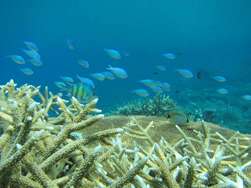
Coral reefs can both positively and negatively influence the acidity of their surrounding seawater. That is the take-home message of two papers recently published in the international journal Global Change Biology, by a group of scientists from the Australian Institute of Marine Science (Dr. Ken Anthony), the National Center for Atmospheric Research in the US (Dr. Joanie Kleypas), and from the Centre National de la Recherche Scientifique in France (Prof Jean-Pierre Gattuso). The studies provide a world-first look at how the ocean acidification threat to coral reefs varies with reef type.
As the CO2 concentration in Earth's atmosphere increases, so does the acidity of the world's oceans. This phenomenon, called "ocean acidification", threatens the life of shell- and reef-forming organisms in the sea. Coral reefs are highly vulnerable to ocean acidification as it reduces their ability to maintain coral structures and fish habitats.
But so far, assessments of the threat from ocean acidification to coral reefs have not considered how some reef areas can locally reduce this risk by decreasing acidity, whereas other areas naturally acidify their water, adding to the ocean acidification stress.
"Overall, CO2 enrichment and ocean acidification is bad news for coral reefs", says Dr. Ken Anthony, Research Team Leader for the Climate Change and Ocean Acidification team at AIMS. "But some reef areas take up more CO2 than they produce (through photosynthesis), which can lower the vulnerability of neighbouring reef areas to ocean acidification. On the other hand, reef areas with greater coral cover produce more CO2 than they consume (through calcification and respiration) and that adds locally to the ocean acidification threat".
"If we can start to understand which areas of large reef systems such as the Great Barrier Reef can counteract pH changes locally and which areas cannot, then we are better able to assess the relative risks of ocean acidification", says Dr. Joanie Kleypas.
The studies' findings emphasise the severity of the global ocean acidification threat to the healthy function of coral reefs, but add a new - and potentially positive - dimension to the problem.
"Reef managers have been faced with the problem of ocean acidification as a uniform threat affecting all reef areas equally. These new studies are a first step to help reef managers understand how some areas might in fact lower the impact of ocean acidification in neighboring areas, whereas others will further acidify themselves. Seagrass beds, for example, can significantly reduce CO2 levels in the water, providing more favourable chemical conditions for neighbouring reefs", says Dr. Anthony.
"Our studies showed that shallow-water reef areas with longer water circulation times have greater potential to influence their seawater pH, whereas reef areas more exposed to ocean currents will experience pH levels set more by the atmospheric CO2 concentration", says Dr. Gattuso.
The team is continuing their work, and aims to produce new models for how ocean acidification risks will vary over the scale of the Great Barrier Reef. They conclude by stating:
"By studying how reef, ocean and atmospheric processes interact, we hope to give reef managers a clearer picture of potential ocean acidification buffering capacity, or vulnerability, within reef areas. The creation of ocean acidification risk maps can assist in the planning of management efforts in different reef areas as the ocean pH continues to drop under increasing atmospheric CO2."
Provided by Australian Institute of Marine Science


