Zinc oxide microwires improve the performance of light-emitting diodes

Researchers have used zinc oxide microwires to significantly improve the efficiency at which gallium nitride light-emitting diodes (LED) convert electricity to ultraviolet light. The devices are believed to be the first LEDs whose performance has been enhanced by the creation of an electrical charge in a piezoelectric material using the piezo-phototronic effect.
By applying mechanical strain to the microwires, researchers at the Georgia Institute of Technology created a piezoelectric potential in the wires, and that potential was used to tune the charge transport and enhance carrier injection in the LEDs. This control of an optoelectronic device with piezoelectric potential, known as piezo-phototronics, represents another example of how materials that have both piezoelectric and semiconducting properties can be controlled mechanically.
"By utilizing this effect, we can enhance the external efficiency of these devices by a factor of more than four times, up to eight percent," said Zhong Lin Wang, a Regents professor in the Georgia Tech School of Materials Science and Engineering. "From a practical standpoint, this new effect could have many impacts for electro-optical processes – including improvements in the energy efficiency of lighting devices."
Details of the research were reported in the Sept. 14 issue of the journal Nano Letters. The research was sponsored by the Defense Advanced Research Projects Agency (DARPA) and the U.S. Department of Energy (DOE). In addition to Wang, the research team mainly included Qing Yang, a visiting scientist at Georgia Tech from the Department of Optical Engineering at Zhejiang University in China.
Because of the polarization of ions in the crystals of piezoelectric materials such as zinc oxide, mechanically compressing or otherwise straining structures made from the materials creates a piezoelectric potential – an electrical charge. In the gallium nitride LEDs, the researchers used the local piezoelectric potential to tune the charge transport at the p-n junction.
The effect was to increase the rate at which electrons and holes recombined to generate photons, enhancing the external efficiency of the device through improved light emission and higher injection current. "The effect of the piezopotential on the transport behavior of charge carriers is significant due to its modification of the band structure at the junction," Wang explained.
The zinc oxide wires form the "n" component of a p-n junction, with the gallium nitride thin film providing the "p" component. Free carriers were trapped at this interface region in a channel created by the piezoelectric charge formed by compressing the wires.
Traditional LED designs use structures such as quantum wells to trap electrons and holes, which must remain close together long enough to recombine. The longer that electrons and holes can be retained in proximity to one another, the higher the efficiency of the LED device will ultimately be.
The devices produced by the Georgia Tech team increased their emission intensity by a factor of 17 and boosted injection current by a factor of four when compressive strain of 0.093 percent was applied to the zinc oxide wire. That improved conversion efficiency by as much as a factor of 4.25.
The LEDs fabricated by the research team produced emissions at ultraviolet frequencies (about 390 nanometers), but Wang believes the frequencies can be extended into the visible light range for a variety of optoelectronic devices. "These devices are important for today's focus on green and renewable energy technology," he said.
In the experimental devices, a single zinc oxide micro/nanowire LED was fabricated by manipulating a wire on a trenched substrate. A magnesium-doped gallium nitride film was grown epitaxially on a sapphire substrate by metalorganic chemical vapor deposition, and was used to form a p-n junction with the zinc oxide wire.
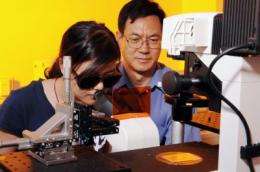
A sapphire substrate was used as the cathode that was placed side-by-side with the gallium nitride substrate with a well-controlled gap. The wire was placed across the gap in close contact with the gallium nitride. Transparent polystyrene tape was used to cover the nanowire. A force was then applied to the tape by an alumina rod connected to a piezo nanopositioning stage, creating the strain in the wire.
The researchers then studied the change in light emission produced by varying the amount of strain in 20 different devices. Half of the devices showed enhanced efficiency, while the others – fabricated with the opposite orientation of the microwires – showed a decrease. This difference was due to the reversal in the sign of the piezopotential because of the switch of the microwire orientation from +c to –c.
High-efficiency ultraviolet emitters are needed for applications in chemical, biological, aerospace, military and medical technologies. Although the internal quantum efficiencies of these LEDs can be as high as 80 percent, the external efficiency for a conventional single p-n junction thin-film LED is currently only about three percent.
Beyond LEDs, Wang believes the approach pioneered in this study can be applied to other optical devices that are controlled by electrical fields.
"This opens up a new field of using the piezoelectric effect to tune opto-electronic devices," Wang said. "Improving the efficiency of LED lighting could ultimately be very important, bringing about significant energy savings because so much of the world's energy is used for lighting."
Provided by Georgia Institute of Technology


