New Zealand braces for oil slick ship to break up
October 13, 2011 by Neil Sands

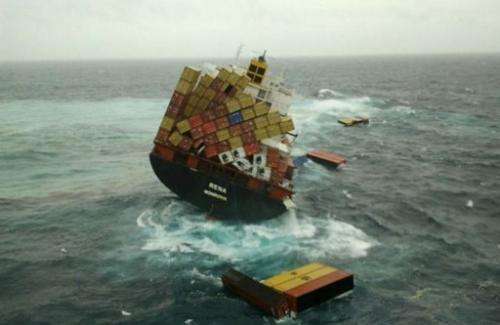
Containers floating near the grounded container ship 'Rena' in the Bay of Plenty near Tauranga

Enlarge

Containers floating near the grounded container ship 'Rena' in the Bay of Plenty near Tauranga. Salvage crews reboarded a stricken ship at the centre of New Zealand's worst sea pollution disaster on Thursday as authorities ordered people off oil-blackened beaches.

Salvage crews reboarded a stricken ship at the centre of New Zealand's worst sea pollution disaster on Thursday as authorities ordered people off oil-blackened beaches.

The crews, fearing that a breakup of the Rena was now inevitable, hoped to drain its fuel tanks to prevent further fuel from spewing into the environmentally sensitive Bay of Plenty before the ship shears in two.

Authorities ordered locals off a stretch of the coast after a hazardous substance entered the water from containers which fell from the ship. It is leaning precariously on a reef where it has been stuck fast since October 5.

Huge cracks opened up in the Rena's hull on Wednesday after a storm battered it against the reef, and while conditions eased Thursday, there was little hope it would remain in one piece.

"There's not very much room for optimism," salvage specialist Matthew Watson, whose company Svitzer is leading efforts to save the vessel, told Newstalk ZB.

"It looks as if a best-case scenario could be trying to at least get the oil off the vessel, then working out what to do with the vessel should she break up."

Asked if a split in the badly listing ship was inevitable, he replied: "You only have to look at that damage to the sides of the vessel."
New Zealand oil spill

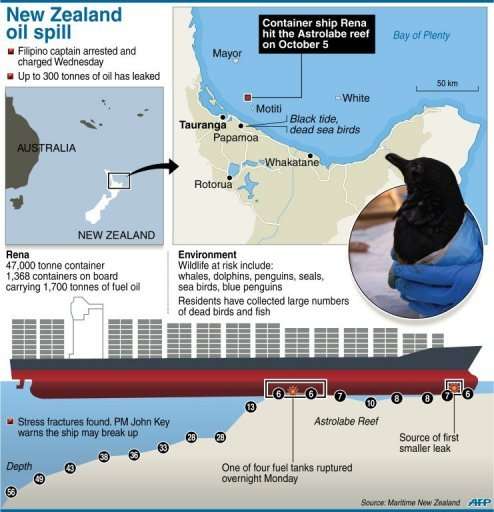
Graphic on the situation Wednesday in New Zealand's Bay of Plenty one week after a 47,000 tonne cargo ship hit a reef and started leaking fuel.

Up to 300 tonnes of heavy fuel has already leaked from the Rena, fouling beaches and killing wildlife, with authorities fearing that all 1,700 tonnes on the vessel will be released if it breaks up and sinks.

Authorities said three tugs were on standby and if the Rena split they would try to hold the stern section, where most of the oil is stored, on the Astrolabe Reef, 22 kilometres (15 miles) offshore.

If that proved impossible, the tugs would try to tow the stern to , making it easier to eventually offload the oil.

Maritime (MNZ) said a total of 88 containers had toppled from the ship deck, up from its initial estimate of 70.
Volunteers help with the clean-up of oil from the grounded container ship 'Rena' off Papamoa beach
Enlarge

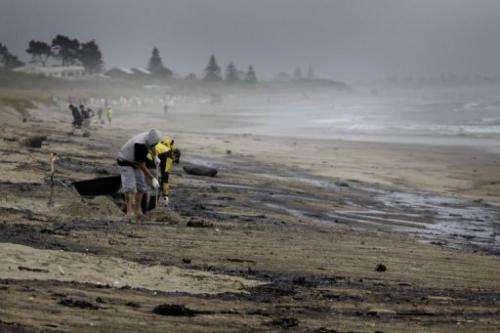
Volunteers help with the clean-up of oil from the grounded container ship 'Rena' off Papamoa beach near Tauranga on October 12, 2011. The public have been ordered off the worst-affected 35 kilometre (22 mile) stretch of coast from Mount Maunganui to Maketu, clearing the way for a "massive" cleanup operation involving 500 people.

It said one of the containers was filled with the hazardous alloy ferrosilicon, which can be dangerous when exposed to water and warned people to avoid containers which had washed ashore.

For the first time, MNZ ordered the public off the worst-affected 35 kilometre (22 mile) stretch of coast from Mount Maunganui to Maketu, clearing the way for a "massive" cleanup operation involving 500 people.

"It's hard, dirty work, but with all the agencies involved and the community pulling together, we will get this oil cleaned up," MNZ site commander Nick Quinn said as oil continued to come ashore in sluggish black waves.

Previously, the agency had only advised people not to go onto beaches in the area, one of New Zealand's most popular tourist destinations.

Residents living near affected beaches were advised to keep their windows closed as the toxic discharge released fumes that leave the eyes stinging and the throat raw.
A dead bird, soaked in oil from the grounded container ship 'Rena', lies on Papamoa Beach
Enlarge

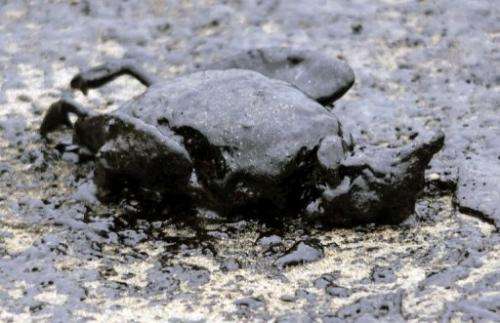
A dead shag, soaked in oil from the grounded container ship 'Rena', lies on Papamoa Beach near Tauranga. 200 dead birds have been recovered and it is expected the toll on wildlife to increase substantially. Rescue teams are trying to round up seals in the area and have caught five so far.

MNZ said 200 dead birds had been recovered and it expected the toll on wildlife to increase substantially. It said that teams were trying to round up seals in the area and had caught five so far.

The Rena's second officer, who was on navigation watch when the ship ploughed into the reef on October 5, faced a court in Tauranga, charged with operating a vessel in a manner causing unnecessary danger or risk.

The ship's Filipino captain has already been bailed on the same charge, which carries a maximum penalty of NZ$10,000 ($7,800) or one year in jail.

Both officers had their names publicly suppressed over fears for their safety as anger grows in the community.

Investigations into the accident would examine whether the crew of the Liberian-flagged vessel were celebrating the captain's 44th birthday when the crash occurred, local reports said.

Compared with some of the world's worst oil spills, the disaster remains small -- the Exxon Valdez which ran aground in 1989 in Alaska dumped 37,000 tonnes of oil into Prince William Sound.

But it is significant because of the pristine nature of New Zealand's Bay of Plenty, which contains marine reserves, wetlands and teems with wildlife including whales, dolphins, penguins, seals and rare sea birds.

(c) 2011 AFP


Rank not rated yet
Relevant PhysicsForums posts

More news stories

Land and sea species differ in climate change response: study

(Phys.org) -- Marine and terrestrial species will likely differ in their responses to climate warming, new research by Simon Fraser University and Australia’s University of Tasmania has found.

Space & Earth / Environment

created 55 minutes ago | popularity not rated yet | comments 1 | with audio podcast

Yale study concludes public apathy over climate change unrelated to science literacy

Are members of the public divided about climate change because they don't understand the science behind it? If Americans knew more basic science and were more proficient in technical reasoning, would public consensus match ...

Space & Earth / Environment

created 2 hours ago | popularity 4 / 5 (1) | comments 10 | with audio podcast

10 million years needed to recover from mass extinction

It took some 10 million years for Earth to recover from the greatest mass extinction of all time, latest research has revealed.

Space & Earth / Earth Sciences

created 2 hours ago | popularity not rated yet | comments 1 | with audio podcast

Sophisticated simulations predict future warming

The chances of our planet being hit by a global warming of 3 degrees Celsius by 2050 is as likely as it being hit by an increase of 1.4 degrees, new research shows. Presented in the journal Nature Geoscience, the British study ...

Space & Earth / Earth Sciences

created May 22, 2012 | popularity 4.4 / 5 (9) | comments 51

Aliens don't want to eat us, says former SETI director

Alien life probably isn’t interested in having us for dinner, enslaving us or laying eggs in our bellies, according to a recent statement by former SETI director Jill Tarter.

Space & Earth / Space Exploration

created May 25, 2012 | popularity 4.4 / 5 (14) | comments 39


Almost half of new vets seek disability

(AP) -- America's newest veterans are filing for disability benefits at a historic rate, claiming to be the most medically and mentally troubled generation of former troops the nation has ever seen.

'Unzipped' carbon nanotubes could help energize fuel cells, batteries

Multi-walled carbon nanotubes riddled with defects and impurities on the outside could replace some of the expensive platinum catalysts used in fuel cells and metal-air batteries, according to scientists at ...

T cells 'hunt' parasites like animal predators seek prey, study shows

By pairing an intimate knowledge of immune-system function with a deep understanding of statistical physics, a cross-disciplinary team at the University of Pennsylvania has arrived at a surprising finding: T cells use a movement ...

Computer model used to pinpoint prime materials for efficient carbon capture

When power plants begin capturing their carbon emissions to reduce greenhouse gases – and to most in the electric power industry, it's a question of when, not if – it will be an expensive undertaking.

Change in developmental timing was crucial in the evolutionary shift from dinosaurs to birds: study

At first glance, it's hard to see how a common house sparrow and a Tyrannosaurus Rex might have anything in common. After all, one is a bird that weighs less than an ounce, and the other is a dinosaur that ...

Nvidia trumpets Tegra 3 phone design wins for 2012

(Phys.org) -- Nvidia’s competitive war paint has a name, Tegra 3. On the heels of Nvidia announcements about lowering costs of its Tegra 3 processors and Nvidia-enabled tablets running Android Ice Cream ...