Researchers find world's first x-ray laser produces most coherent x-ray radiation ever
October 3, 2011 by Bob Yirka report

Researchers find world's first x-ray laser produces most coherent x-ray radiation ever

Enlarge

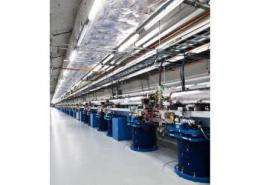
Experiments show that the world’s first X-ray laser, the Linac Coherent Light Source, produces the most coherent (laser-like) X-rays ever measured. (Photo by Brad Plummer)

(PhysOrg.com) -- The world's first x-ray laser, the Linac Coherent Light Source (LCLS), first unveiled in 2009 at the Stanford Linear Accelerator Center in Palo Alto California, has been undergoing testing by group of physicists determined to find out how many of the photons it emits are synchronized and have found, as they describe in their paper in Physical Review Letters, the x-ray radiation that it produces, is the most coherent ever measured.

Following on the heels of the maser, invented in 1957, which was based on , researchers have searched for ways to make lasers with shorter and shorter wavelengths, with the hope being that coherence could be improved. Coherence is a measurement of how in-sync the in a are; the best laser would be one where all of the photons flow perfectly in sync with one anther, but of course, at least thus far, that’s not possible. This leaves researchers working to see how close they can get. The better or higher the coherence a laser has the more precise it can be diffracted which means it can be used to create sharper images of atomic structures.

To measure the coherence of the LCLS, the researchers shone the laser beam through two successive materials, each with a tiny hole in it, then measured the bands of dark and light produced on the other end; they found the contrast to be very high. Then by slowly increasing the size of the hole, they were able to see the interference introduced by those photons that were not in sync with the others causing a decrease in visibility. It is in measuring the decrease that the coherence of the beam can be measured. For the LCLS, it was shown to be 16.8 microns.

The team also tested the laser’s monochromatic abilities, which is a way of saying they measured the coherence time of the laser. The coherence time is the time interval that the wave is considered to be predictable. To do this they examined the edge patterns created when shooting the laser beam through the very tiny holes. For the LCLS they found the coherence time was 0.55 femtoseconds. The end result was that the majority (78%) of the photons were held within the confines the of the directed beam.

This all means that researchers using such an x-ray laser will soon be able to more precisely understand the atomic structure of materials they are working on, which should prove useful for pharmaceutical, archeology and engineering projects.

More information: Coherence Properties of Individual Femtosecond Pulses of an X-Ray Free-Electron Laser, Phys. Rev. Lett. 107, 144801 (2011) DOI:10.1103/PhysRevLett.107.144801

Abstract
Measurements of the spatial and temporal coherence of single, femtosecond x-ray pulses generated by the first hard x-ray free-electron laser, the Linac Coherent Light Source, are presented. Single-shot measurements were performed at 780 eV x-ray photon energy using apertures containing double pinholes in “diffract-and-destroy” mode. We determined a coherence length of 17  μm in the vertical direction, which is approximately the size of the focused Linac Coherent Light Source beam in the same direction. The analysis of the diffraction patterns produced by the pinholes with the largest separation yields an estimate of the temporal coherence time of 0.55 fs. We find that the total degree of transverse coherence is 56% and that the x-ray pulses are adequately described by two transverse coherent modes in each direction. This leads us to the conclusion that 78% of the total power is contained in the dominant mode.

Linac Coherent Light Source (LCLS): https://slacportal … Default.aspx

© 2011 PhysOrg.com

4.4 /5 (7 votes)  

Filter


Move the slider to adjust rank threshold, so that you can hide some of the comments.


Display comments: newest first

Jwach
Oct 03, 2011

Rank: not rated yet
I assume that this paves the way for x-ray lithography?

antialias_physorg
Oct 03, 2011

Rank: 5 / 5 (1)
Well, if it's the FIRST coherent x-ray light source (which is what an x-ray laser is) isn't it to be expected that it is also the most coherent x-ray light source? This seems trivially obvious. Or am I missing something?
Jwach
Oct 03, 2011

Rank: not rated yet
Pretty sure they're saying that it is the most coherent laser ever measured, visible spectrum or otherwise. Along that line, isn't a bit of a misnomer to call it a laser? After all we're no longer dealing with "light".
YummyFur
Oct 03, 2011

Rank: not rated yet
@antialias_physorg

"This seems trivially obvious.....Or am I missing something?"

Yes it is obviously trivially obvious. And that is what you have missed.

You are obliged to give the benefit of the doubt to the researchers that perhaps something else was meant.

There are two separate ideas, 1, that it is the most coherent laser in any wavelength and 2, it is an x-ray laser.

I therefore deduce that it must necessarily follow that coherence is not an intrinsic character of wavelength. This is what puzzles me, not knowing much about lasers.

For example my first thought was, is a gamma ray laser possible, and if so would it necessarily be more coherent by the very nature of the shortness of it's wavelength or does the shortness of the wavelength make achieving a higher degree of coherence more challenging. I still wonder.
PinkElephant
Oct 03, 2011

Rank: not rated yet
that it is the most coherent laser in any wavelength
Far from it. It is the most coherent X-ray source ever: so coherent in fact, that they feel justified in calling it a laser. But optical lasers achieve much better numbers (no big surprise: optical photons are much easier to control.)
PinkElephant
Oct 03, 2011

Rank: not rated yet
@antialias_physorg,
coherent x-ray light source (which is what an x-ray laser is)
Depends on what they mean by "laser". The classical acronym (LASER) stands for "Light Amplification by Stimulated Emission of Radiation". Now are the x-rays in this light source actually produced and amplified by stimulated emission, particularly as compared to previous (less-coherent) x-ray light sources?
Isaacsname
Oct 04, 2011

Rank: not rated yet
It's a.....a....xaser
antialias_physorg
Oct 04, 2011

Rank: 5 / 5 (1)
Depends on what they mean by "laser". The classical acronym (LASER) stands for "Light Amplification by Stimulated Emission of Radiation".

It is exactly this stimulation which gives it its coherence. Lasers are, by definition, coherent light sources (spatially and temporally). A "non-coherent laser" would be what we call a light bulb.
Rank 4.4 /5 (7 votes)
Relevant PhysicsForums posts
  • How to calculate the repulsion force between a permanent and an electromagnet?
    created1 hour ago
  • Why does light allow us to see things?
    created1 hour ago
  • Room temperature superconductivity
    created1 hour ago
  • Water flow question
    created4 hours ago
  • [Drift velocity] Factors affecting velocity
    created7 hours ago
  • does cold gasoline have less energy
    created8 hours ago
  • More from Physics Forums - General Physics

More news stories

Is a classical electrodynamics law incompatible with special relativity?

(Phys.org) -- The laws of classical electromagnetism that were developed in the 19th century are the same laws that scientists use today. They include Maxwell’s four equations along with the Lorentz la ...

Physics / General Physics

created May 24, 2012 | popularity 4.7 / 5 (17) | comments 43 | with audio podcast feature

Landmark calculation clears the way to answering how matter is formed

(Phys.org) -- An international collaboration of scientists, including Thomas Blum, associate professor of physics, is reporting in landmark detail the decay process of a subatomic particle called a kaon – ...

Physics / General Physics

created May 25, 2012 | popularity 4.3 / 5 (22) | comments 51 | with audio podcast

Lying in wait for WIMPs: Researchers seek to dramatically increase sensitivity of Large Underground Xenon detector

Although it's invisible, dark matter accounts for at least 80 percent of the matter in the universe. No one knows what it is, but most scientists would bet on weakly interacting massive particles, or WIMPs.

Physics / General Physics

created May 23, 2012 | popularity 4 / 5 (7) | comments 16 | with audio podcast

Hawaii lab turns laser-powered bubbles into microrobots

(Phys.org) -- A team of scientists from the University of Hawaii are working on microrobots created from bubbles of air in a saline solution. The bubbles take on their title of “robots” as a laser ...

Physics / General Physics

created May 23, 2012 | popularity 5 / 5 (4) | comments 2 | with audio podcast weblog

Sound increases the efficiency of boiling

Scientists at the Georgia Institute of Technology achieved a 17-percent increase in boiling efficiency by using an acoustic field to enhance heat transfer. The acoustic field does this by efficiently removing vapor bubbles ...

Physics / Soft Matter

created May 24, 2012 | popularity 5 / 5 (2) | comments 2


Land and sea species differ in climate change response: study

(Phys.org) -- Marine and terrestrial species will likely differ in their responses to climate warming, new research by Simon Fraser University and Australia’s University of Tasmania has found.

Almost half of new vets seek disability

(AP) -- America's newest veterans are filing for disability benefits at a historic rate, claiming to be the most medically and mentally troubled generation of former troops the nation has ever seen.

'Unzipped' carbon nanotubes could help energize fuel cells, batteries

Multi-walled carbon nanotubes riddled with defects and impurities on the outside could replace some of the expensive platinum catalysts used in fuel cells and metal-air batteries, according to scientists at ...

T cells 'hunt' parasites like animal predators seek prey, study shows

By pairing an intimate knowledge of immune-system function with a deep understanding of statistical physics, a cross-disciplinary team at the University of Pennsylvania has arrived at a surprising finding: T cells use a movement ...

Computer model used to pinpoint prime materials for efficient carbon capture

When power plants begin capturing their carbon emissions to reduce greenhouse gases – and to most in the electric power industry, it's a question of when, not if – it will be an expensive undertaking.

Change in developmental timing was crucial in the evolutionary shift from dinosaurs to birds: study

At first glance, it's hard to see how a common house sparrow and a Tyrannosaurus Rex might have anything in common. After all, one is a bird that weighs less than an ounce, and the other is a dinosaur that ...