Feeding the world while protecting the planet
October 12, 2011

Feeding the world while protecting the planet

Enlarge

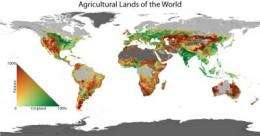
This is a global map showing how agricultural lands are distributed. Credit: Navin Ramankutty

The problem is stark: One billion people on earth don't have enough food right now. It's estimated that by 2050 there will be more than nine billion people living on the planet.

Meanwhile, current are amongst the biggest threats to the . This means that if we don't develop more , the planet will become even less able to feed its growing population than it is today.

But now a team of researchers from Canada, the U.S., Sweden and Germany has come up with a plan to double the world's food production while reducing the environmental impacts of agriculture. Their findings were recently published in the .

By combining information gathered from crop records and from around the world, they have been able to create new models of and their environmental impacts that are truly global in scope.

McGill geography professor Navin Ramankutty, one of the team leaders on the study, credits the collaboration between researchers for achieving such important results. "Lots of other scholars and thinkers have proposed solutions to global food and environmental problems. But they were often fragmented, only looking at one aspect of the problem at one time. And they often lacked the specifics and numbers to back them up. This is the first time that such a wide range of data has been brought together under one common framework, and it has allowed us to see some clear patterns. This makes it easier to develop some concrete solutions for the problems facing us."

A five-point plan for feeding the world while protecting the planet

The researchers recommend:

  1. Halting farmland expansion and land clearing for agricultural purposes, particularly in the . This can be achieved using incentives such as payment for , certification and ecotourism. This change will yield huge environmental benefits without dramatically cutting into agricultural production or economic well-being.
  2. Improving agricultural yields. Many farming regions in Africa, Latin America and Eastern Europe are not living up to their potential for producing crops – something known as "yield gaps". Improved use of existing crop varieties, better management and improved genetics could increase current food production nearly by 60 per cent.
  3. Supplementing the land more strategically. Current use of water, nutrients and agricultural chemicals suffers from what the research team calls "Goldilocks' Problem": too much in some places, too little in others, rarely just right. Strategic reallocation could substantially boost the benefit we get from precious inputs.
  4. Shifting diets. Growing animal feed or biofuels on prime croplands, no matter how efficiently, is a drain on human food supply. Dedicating croplands to direct human food production could boost calories produced per person by nearly 50 per cent. Even shifting nonfood uses such as animal feed or biofuel production away from prime cropland could make a big difference.
  5. Reducing waste. One-third of the food produced by farms ends up discarded, spoiled or eaten by pests. Eliminating waste in the path that food takes from farm to mouth could boost food available for consumption another 50 per cent.
The study also outlines approaches to the problem that would help policy-makers reach informed decisions about the agricultural choices facing them. "For the first time, we have shown that it is possible to both feed a hungry world and protect a threatened planet," said lead author Jonathan Foley, head of the University of Minnesota's Institute on the Environment. "It will take serious work. But we can do it."

Provided by McGill University search and more info website

4.6 /5 (7 votes)  

Filter


Move the slider to adjust rank threshold, so that you can hide some of the comments.


Display comments: newest first

Corban
Oct 12, 2011

Rank: 4.3 / 5 (7)
A few suggestions:

-Make bugs taste like bacon, and throw them into salads.
-US food aid cannibalizes local farmers and makes populace more dependent. Stop that.
-Eliminate food subsidies. If the other nations can make sugar better, let them. We'll sell them candy bars or something.
truth4life
Oct 12, 2011

Rank: 2.3 / 5 (4)
we're not smart enough to do the right thing
Sean_W
Oct 12, 2011

Rank: 2.8 / 5 (13)
People are not lacking enough food because there is not enough to go around. They are being starved by central planning autocrats and meddling NGO's. When people are kept from producing food while being kept from creating wealth with which to buy food, it's not poverty; it's murder. Socialism kills.
cdt
Oct 12, 2011

Rank: 3.2 / 5 (11)
People are not lacking enough food because there is not enough to go around. They are being starved by central planning autocrats and meddling NGO's. When people are kept from producing food while being kept from creating wealth with which to buy food, it's not poverty; it's murder. Socialism kills.


Don't you mean Capitalism kills? As in successful capitalism in one country kills people in less successful places.
ryggesogn2
Oct 12, 2011

Rank: 2.3 / 5 (9)
we're not smart enough to do the right thing

Individuals ARE smart enough when the socialist central planners leave them alone.
astro_optics
Oct 12, 2011

Rank: 1 / 5 (2)
WW3 would fix all that!
kaasinees
Oct 12, 2011

Rank: 1.7 / 5 (6)
we're not smart enough to do the right thing

Individuals ARE smart enough when the socialist central planners leave them alone.

I think you have it the other way around. individuals with good ideas will get the resources that person needs to accomplish something, while in a capitalist environment that person would get robbed from wealth to do anything that person wants. Socialism is one of the "weapons" that capitalists abuse to achieve their goals, like ad hominem towards socialism to try and prove your invalid point.

There is nothing socialist about central planers, its contradictory.
Void
Oct 12, 2011

Rank: 1 / 5 (1)
@Sean W.
The point of this article is not just about the distribution of food. It is about how to keep up with the growing population without hurting the earth. While I agree not all the food gets to the ones who need it due to politics I think that we still need to expand yield to feed both the rich and the poor. In that sense there may be enough to go around now but not when the population is at 9 billion. The problem is not so much how politics keeps food from needy hands but instead how to produce it more efficiently.
ekim
Oct 12, 2011

Rank: not rated yet
Termites would make an excellent protein for animal feed.
Ojorf
Oct 13, 2011

Rank: 1 / 5 (1)
Funny you should mention termites as fried they taste remarkably like bacon.
lairdwilcox
Oct 13, 2011

Rank: 3.7 / 5 (3)
Wouldn't it be a good idea to begin thinking in terms of population control? You know, less people! Virtually all of the problems we face are due to overpopulation, including environmental problems.

Imagine the population of the United States at where it was at the turn of the 19th century (1900) with 76,000,000 people. This is less than one-fourth of our present population. The pressure for resources, impact on the eivironment and so on would be much, much less.
Harkonnen
Oct 13, 2011

Rank: 3.4 / 5 (5)
I love how there isn't a single mention of using hydroponics. You can get higher yields while using less water and fertilizer.

Easier than changing people's ways(people don't care) and cheaper than genetically engineering everything.
comendant
Oct 13, 2011

Rank: 1 / 5 (1)
Everyone, including people all over this board are completely clueless on the dynamic human civilization is currently in. No body has a workable alternative and nothing is really going to happen until the last second....when the roof caves in. Society NEVER acts from foresight. You're all arguing over nothing. It's pointless. Also, its important to point out that overpopulation won't even become a problem in 20 or 40 years because we are already running out of an increasing supply of energy resources(Peak Oil). We've already reached a peak in 2008. If you know anything about biophysical economics or the work of M. King Hubbert, then you'd understand how the Price System would inevitably collapse because a requirment of the Price System is an exponentially increasing flow of energy degradation....which defies the second law of thermodynamics. So, it's really a moot point cause many people will start to die off when our global economic system can't function because it can't grow.
Aira_Moonshade
Oct 13, 2011

Rank: 5 / 5 (1)
@Harkonnen, I was thinking exactly the same. Interesting that hydroponics isn't mentioned at all even though there is easy DIY at home hydroponics [windowfarming], everyone can do it, small scale and large scale.
Shelgeyr
Oct 13, 2011

Rank: not rated yet
I'd like to throw in with a suggestion: "Aquaponics", which is the combination of hydroponics and aquaculture. Not my invention, of course, but I am a big fan and new practitioner.

I'm not affiliated in any way with the following two sites, but I do recommend them for anyone who is interested in the field: http://www.backya...nics.com and www.gardenpool.org

Enjoy!
Nanobanano
Oct 13, 2011

Rank: 5 / 5 (1)
Virtually all of the problems we face are due to overpopulation, including environmental problems.

The pressure for resources, impact on the eivironment and so on would be much, much less.


Man, you sure know your history. Because people didn't kill one another by the hundred thousands and stuff way back when world population was a few million...That whole war of the greeks and persians and stuff, and hundred years war, and so on.

If population was that much lower, you would actually have problems maintaining technological civilization, because there would be fewer people to work on R&D and purely scientific endeavors.

All of those jobs are maintained on the backs of multitudes of blue collar and white collar works and the net surplus from their efforts: schools, laboratories, hospitals, EPA, CDC, NIST, and other government private science agencies make their funding money due to the collective surplus of everyone else.
ryggesogn2
Oct 13, 2011

Rank: 1.8 / 5 (5)
Society NEVER acts from foresight.

But individuals in that DO act with foresight if not prevented by the state.
USSR had to resort to allowing individual farmers to sell food. Even Castro has now allowed people to have gardens in Havana and SELL (gasp) food.
Nanobanano
Oct 13, 2011

Rank: 2.3 / 5 (3)
Our civilization and infrastructure is so specialized that everyone has to be an expert in their respective narrow field. If you had 1/4th the population, supply chains would actually collapse, because "production" isn't the issue. People designing new components to a machine with a billion parts is the issue, even though those parts are themselves cranked out by other machines.

It takes all the excess to provide the funding for university or government to pay some astronomer to build a telescope and stare at a star on the other side of the universe. They don't get to do that on their spare time, at least not consistent, real modern science. Sure theres amateurs find stuff, but not like an observatory.

Same goes for fields of medicine and materials sciences.

how would you pay endless experimentalists in universities to sit around studying this stuff,if you base of human resources is 4 times smaller?
Howhot
Oct 13, 2011

Rank: 2 / 5 (6)
Its a major problem that is going to kick us in the teeth in about 50 years when MAN FREAKING MADE GLOBAL WARMING begins wiping out huge areas of fertile lands with droughts, or monsoons. 1st we have to get a handle on MAN MADE population growth. 9 Billion people is ridiculous. Simultaneously we need to get a handle on MAN CAUSED ENVIRONMENTAL DESTRUCTION in pursue of fosil energy; we need to make it renewable and green.
Then we need remake the Banking system to fit the peoples needs and not the 0.1% needs.

comendant
Oct 15, 2011

Rank: 2 / 5 (4)
Then we need remake the Banking system to fit the peoples needs and not the 0.1% needs.

Actually, the whole Price System(modern economics) is antiquated and is in need of a paradigm shift. Our system is obsolete because we are able to convert energy at a high rate because of Technology & Resources. So "man-hours" are pointless. Any social philosophy such as Capitalism, Communism, Fascism, Socialism, Corporatism are invalidated because they are based upon moral values of human effort. Human effort, as I explained, is obsolete because of high energy conversion and technology. There is also the fact that the Price System demands exponential physical growth to sustain its operation...which as I stated previously in another comment defies thermodynamic laws. There's also the debt aspect...
kaasinees
Oct 15, 2011

Rank: 1.2 / 5 (6)
Socialism never stops evolving, unlike capitalism which is very conservative, it does invent new ways to harvest wealth though but that is a side affect.
ryggesogn2
Oct 15, 2011

Rank: 2.2 / 5 (10)
Socialism doesn't evolve. Like a chameleon, it tries to change its appearance to hid its true nature, govt control of private property.
ShotmanMaslo
Oct 16, 2011

Rank: 5 / 5 (2)
There is more than enough food for everyone on this planet and much left. The issue is not production, but distribution of food. Thats where humanity has made little progress since dawn of mankind.
JohnMoser
Oct 16, 2011

Rank: 2.6 / 5 (5)
The creepy nazi types advocating reducing population should start with themselves. Come on, it's the right to do, isn't it?
Jeddy_Mctedder
Oct 16, 2011

Rank: not rated yet
everyone forgets the REAL golden rule. he who has the guns grabs the grub. the rest starve. you cannot eat the food your farm when other people are stealing your food, hence the need for resource protection ---organized from the lowest (self and family) to increasingly higher levels of socially organized protection.
ShotmanMaslo
Oct 17, 2011

Rank: not rated yet
The creepy nazi types advocating reducing population should start with themselves. Come on, it's the right to do, isn't it?


But its about reducing population of starving people, I dont think that includes anyone writing here on physorg. Now if I was so poor as to lack basic needs, I would be the first in line for a "food for sterilisation" program, I aint no hypocrite.

Shelgeyr
Oct 17, 2011

Rank: 1 / 5 (2)
Just to revisit...
The problem is stark: One billion people on earth don't have enough food right now.

Due to politics and war (but I repeat myself), not due to a shortage of farmland or water.

...current agricultural practices are amongst the biggest threats to the global environment.

Utter nonsense, and I'd prefer to use much harsher language.

This means that if we don't develop more sustainable practices,...

So this is obviously an opinion piece, not a science article.

I'm not going to have room enough with the character limit to red-line this total failure of a doom-screed.

kaasinees
Oct 17, 2011

Rank: 1 / 5 (2)
Due to politics and war (but I repeat myself), not due to a shortage of farmland or water.

Both are issues. We already use 60% of fresh water for agriculture alone on the planet, we deplete entire rivers and oceans of fresh water.

Utter nonsense, and I'd prefer to use much harsher language.

This is not nonsense at all. Better fresh water practices could save a lot of water.

So this is obviously an opinion piece, not a science article.

Neither are you a science article so get lost.

I'm not going to have room enough with the character limit to red-line this total failure of a doom-screed.

Nobody wants to hear it anyway.
Shelgeyr
Oct 17, 2011

Rank: 1.3 / 5 (3)
@kaasiness said:
We already use 60% of fresh water for agriculture alone on the planet, we deplete entire rivers and oceans of fresh water.


No we don't. That's absurd. Where are you getting your figures?

Neither are you a science article so get lost.


Neither am I a science article, so get lost? Seriously? What is that supposed to even mean? Are YOU a science article?

Nobody wants to hear it anyway.


Then down-rate me or ignore me. Hmmm... Apparently you cared enough to respond, so I think I scored a point on that one.

By the way, the researcher's first recommendation is not only the stupidest greenbrained non-solution to increasing the food supply that I've read in a long while, it is also wrong on every point AND internally inconsistent.

Absolutely worthy of ridicule.
kaasinees
Oct 17, 2011

Rank: 1 / 5 (1)
@kaasiness said:
We already use 60% of fresh water for agriculture alone on the planet, we deplete entire rivers and oceans of fresh water.


No we don't. That's absurd. Where are you getting your figures?

They aren't even just figures, there are examples of it.

http://landsat.gs...0012.jpg

http://maps.grida...stic_use

http://www.watery...201.html

http://www.watere...ter.html

http://en.wikiped...radation

http://www.aaas.o...bang.htm

http://web.mit.ed...te.shtml

do i need to go on?
Sepp
Oct 18, 2011

Rank: not rated yet
India and China have had sustainable agriculture for centuries, if not millennia, before we (the West) came to teach them how to do it better and ruined things. So perhaps a return to sustainable forms of agriculture (permaculture, biodynamic, etc) would be in order.

But if it's really a question of agricultural land, which eventually it may come down to, there is always the possibility to use sea water and sunlight and grow massive quantities of plankton, which is not only edible but extremely nutritious... We could make all kinds of delicious snacks out of the stuff and ease the pressure on arable land. There isn't really a lack of solutions, only a lack of the will to implement them.
Shelgeyr
Nov 02, 2011

Rank: 1 / 5 (1)
@kaasiness, sorry for the delay in responding.

The URLs you cited don't back up your argument, especially because you had said "We already use 60% of fresh water for agriculture alone on the planet" and I therefore thought you actually meant "on the planet".

I'm not going to bother rebutting each link one by one - forgive me but there is neither time nor space to do so - but IMHO you'd make a much stronger argument if you A) firmed up your hypotheses, B) didn't resort to such biased sources, and c) understood that a picture actually isn't worth a 1000 words all by itself. Yes, I know the story of the Aral Sea, but that can EASILY be argued as more a consequence of bad top-down political decisions than simply agricultural water over-usage.

Now, feel free to rephrase, but we simply do not use 60% of the fresh water on the *planet* for agriculture, nor do we deplete oceans of fresh water (an odd concept in itself since the oceans aren't fresh to start with).
Shelgeyr
Nov 02, 2011

Rank: 3 / 5 (2)
@Sepp said:
India and China have had sustainable agriculture for centuries...


A perfect illustration of the political "Great Divide". What you call "sustainable agriculture" I call "subsistence-level at best and often not even that" that we helped them vastly improve upon.

...before we (the West) came to teach them how to do it better and ruined things.


If you consider the Green Revolution "ruining things", then you either are completely ignorant of this aspect of history, OR are judging the resulting amazing (and well documented) improvements to the common welfare to be bad things.

If the former, well, "learning the facts" should set you straight. If the latter, then you must view the world through a pretty twisted set of glasses, which doesn't jive with the latter half of your answer.

So what's up with the "ruining things" bit?
Rank 4.6 /5 (7 votes)
Relevant PhysicsForums posts

More news stories

Land and sea species differ in climate change response: study

(Phys.org) -- Marine and terrestrial species will likely differ in their responses to climate warming, new research by Simon Fraser University and Australia’s University of Tasmania has found.

Space & Earth / Environment

created 55 minutes ago | popularity not rated yet | comments 1 | with audio podcast

Yale study concludes public apathy over climate change unrelated to science literacy

Are members of the public divided about climate change because they don't understand the science behind it? If Americans knew more basic science and were more proficient in technical reasoning, would public consensus match ...

Space & Earth / Environment

created 2 hours ago | popularity 4 / 5 (1) | comments 10 | with audio podcast

10 million years needed to recover from mass extinction

It took some 10 million years for Earth to recover from the greatest mass extinction of all time, latest research has revealed.

Space & Earth / Earth Sciences

created 2 hours ago | popularity not rated yet | comments 1 | with audio podcast

Sophisticated simulations predict future warming

The chances of our planet being hit by a global warming of 3 degrees Celsius by 2050 is as likely as it being hit by an increase of 1.4 degrees, new research shows. Presented in the journal Nature Geoscience, the British study ...

Space & Earth / Earth Sciences

created May 22, 2012 | popularity 4.4 / 5 (9) | comments 51

Aliens don't want to eat us, says former SETI director

Alien life probably isn’t interested in having us for dinner, enslaving us or laying eggs in our bellies, according to a recent statement by former SETI director Jill Tarter.

Space & Earth / Space Exploration

created May 25, 2012 | popularity 4.4 / 5 (14) | comments 39


Almost half of new vets seek disability

(AP) -- America's newest veterans are filing for disability benefits at a historic rate, claiming to be the most medically and mentally troubled generation of former troops the nation has ever seen.

'Unzipped' carbon nanotubes could help energize fuel cells, batteries

Multi-walled carbon nanotubes riddled with defects and impurities on the outside could replace some of the expensive platinum catalysts used in fuel cells and metal-air batteries, according to scientists at ...

T cells 'hunt' parasites like animal predators seek prey, study shows

By pairing an intimate knowledge of immune-system function with a deep understanding of statistical physics, a cross-disciplinary team at the University of Pennsylvania has arrived at a surprising finding: T cells use a movement ...

Computer model used to pinpoint prime materials for efficient carbon capture

When power plants begin capturing their carbon emissions to reduce greenhouse gases – and to most in the electric power industry, it's a question of when, not if – it will be an expensive undertaking.

Change in developmental timing was crucial in the evolutionary shift from dinosaurs to birds: study

At first glance, it's hard to see how a common house sparrow and a Tyrannosaurus Rex might have anything in common. After all, one is a bird that weighs less than an ounce, and the other is a dinosaur that ...

Nvidia trumpets Tegra 3 phone design wins for 2012

(Phys.org) -- Nvidia’s competitive war paint has a name, Tegra 3. On the heels of Nvidia announcements about lowering costs of its Tegra 3 processors and Nvidia-enabled tablets running Android Ice Cream ...