Vast amounts of solar energy radiate to the Earth, but tapping it cost-effectively remains a challenge
October 26, 2011 by David L. Chandler
With the worlds energy needs growing rapidly, can zero-carbon energy options be scaled up enough to make a significant difference? How much of a dent can these alternatives make in the worlds total energy usage over the next half-century? As the MIT Energy Initiative approaches its fifth anniversary next month, this five-part series takes a broad view of the likely scalable energy candidates.
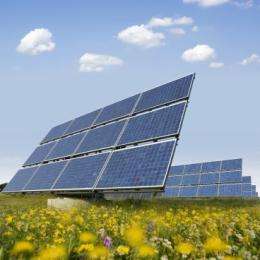
The sunlight that reaches Earth every day dwarfs all the planets other energy sources. This solar energy is clearly sufficient in scale to meet all of mankinds energy needs if it can be harnessed and stored in a cost-effective way.
Unfortunately, thats where the technology lags: Except in certain specific cases, solar energy is still too expensive to compete. But that could change if new technologies can tip the balance of solar economics.
The potential is enormous, says MIT physics professor Washington Taylor, who co-teaches a course on the physics of energy. A total of 173,000 terawatts (trillions of watts) of solar energy strikes the Earth continuously. Thats more than 10,000 times the worlds total energy use. And that energy is completely renewable at least, for the lifetime of the sun. Its finite, but were talking billions of years, Taylor says.
Since solar energy is, at least in theory, sufficient to meet all of humanitys energy needs, the question becomes: How big is the engineering challenge to get all our energy from solar? Taylor says.
Solar thermal systems covering 10 percent of the worlds deserts about 1.5 percent of the planets total land area could generate about 15 terawatts of energy, given a total efficiency of 2 percent. This amount is roughly equal to the projected growth in worldwide energy demand over the next half-century.
Such grand-scale installations have been seriously proposed. For example, there are suggestions for solar installations in the Sahara, connected to Europe via cables under the Mediterranean, that could meet all of that continents electricity needs.
Because solar installations of all types are modular, the experience gained from working with smaller arrays translates directly into what can be expected for much larger applications. Im a big fan of large-scale solar thermal, says Robert Jaffe, the Otto (1939) and Jane Morningstar Professor of Physics. It may be the only renewable technology that can be deployed at very large scale.
And we do know how to harness solar energy, even at a colossal scale. Theres no showstopper, its just a matter of price, says Daniel Nocera, the Henry Dreyfus Professor of Energy at MIT.
Nocera foresees a time when every home could have its own self-contained system: For instance, photovoltaic panels on the roof could run an electrolyzer in the basement, producing hydrogen to feed a fuel cell that generates power. All the necessary ingredients already exist, he says: I can go on Google right now, and I can put that system together. Noceras own invention, a low-cost system for producing hydrogen from water, could help over the next few years to make such systems cost-competitive.
In principle, we know multiple ways of generating electricity from the sun (direct photovoltaic, or solar thermal energy used to drive a turbine); of storing that energy (in batteries, by pumping water uphill, or by separating water into hydrogen and oxygen using an electrolyzer); and of converting that stored energy into electricity when its needed (using fuel cells powered by hydrogen, for example). Some kinds of solar power are already cost-competitive, at least in some settings, and prices have been moving steadily downward.
Costs have come down very dramatically for solar power, says Ernest J. Moniz, the Cecil and Ida Green Distinguished Professor of Physics and Engineering Systems and director of the MIT Energy Initiative, but its still not that cheap. And even as the price of solar panels themselves has dropped, there has been little reduction in the costs associated with installing them.
Like nuclear power, Moniz says, solar is characterized by high initial costs, but very low operating costs. But one significant advantage solar has over nuclear is you can do it in smaller bites, rather than needing to build multibillion-dollar plants.
Solar energy is a vibrant research topic, attracting scientists interested in many different approaches. For example, MIT researchers Angela Belcher and Paula Hammond are exploring approaches to solar power that would harness the power of biological organisms to create solar devices; Penny Chisholm and Shuguang Zhen are looking into the possibility of directly harnessing the photosynthesis done by plants or single-celled organisms; and various researchers including Vladimir Bulovic, Michael Strano, Tonio Buonassisi, Jeffrey Grossman and Yang Shao-Horn, among others, are working on ways of improving the efficiency or lowering the costs of solar photovoltaic cells.
Still others are pursuing a variety of approaches to solar thermal energy: using the suns heat to power turbines or to heat homes or water. A significant breakthrough in any of these areas could make solar power an economically viable option for the worlds energy needs. This year, for example, Alexander Slocum and others published a proposal for a solar thermal system that could provide steady, 24/7 baseload power for utility companies, helping to make it cost-competitive with other sources.
Other researchers are studying ways to make effective solar-power systems using common, inexpensive materials. For example, cadmium telluride is a very promising material for solar cells. But it turns out that tellurium, one of its ingredients, is rarer than gold, Jaffe says. We need to be able to make solar cells out of common materials, or at least things that are not exquisitely rare, he adds.
This story is republished courtesy of MIT News (http://web.mit.edu/newsoffice/), a popular site that covers news about MIT research, innovation and teaching.
More information: Tomorrow: There are many sources that can make a contribution to our energy supply, but likely not at a major scale in the near future.
Part 1. http://www.physorg … 10-dent.html
Part 2. http://www.physorg … tricity.html
Part 3. http://www.physorg … y-earth.html
Provided by
Massachusetts Institute of Technology
-
From lemons to lemonade: Reaction uses carbon dioxide to make carbon-based semiconductor,
32 comments
-
Thioridazine kills cancer stem cells in human while avoiding toxic side-effects of conventional cancer treatments,
3 comments
-
SpaceX private rocket blasts off for space station (Update),
42 comments
-
Climate scientists say they have solved riddle of rising sea,
31 comments
-
SpaceX capsule has 'new car' smell, astronauts say (Update),
4 comments
-
Need a rigid insulation material???
16 hours ago
-
magnets or EMF in car bumpers to protect from fender bender
May 26, 2012
-
length of wire in a coil of known dimensions?
May 25, 2012
-
India Engineering Powerhouse
May 25, 2012
-
electromagnet core dereference between hard and soft iron
May 25, 2012
-
Measuring water pressure in an open tank
May 24, 2012
- More from Physics Forums - General Engineering
More news stories
Browser wars flare in mobile space
The browser wars are heating up again, but this time the fight is for dominance of the mobile Internet.
9 hours ago |
5 / 5 (1) |
3
Probability of contamination from severe nuclear reactor accidents is higher than expected: study
Catastrophic nuclear accidents such as the core meltdowns in Chernobyl and Fukushima are more likely to happen than previously assumed. Based on the operating hours of all civil nuclear reactors and the number ...
Technology / Energy & Green Tech
May 22, 2012 |
3.6 / 5 (22) |
56
|
SpotterRF debuts Radar Backpack Kit (w/ Video)
(Phys.org) -- SpotterRF has announced a special radar backpack kit designed to enhance situational awareness for soldiers on the ground. The company says its special radar is designed for warfighters as part ...
HyperSolar shows dirty water no barrier to power world
(Phys.org) -- The Santa Barbara, California, company, HyperSolar, is set to transparently share the ups and downs of its research experiences toward the companys ultimate vision, successfully producing ...
Tesla to launch electric sedan in US on June 22
Tesla Motors said Tuesday it would begin deliveries of "the world's first premium electric sedan" on June 22, slightly ahead of schedule.
Technology / Energy & Green Tech
May 22, 2012 |
4.5 / 5 (12) |
18
'Unzipped' carbon nanotubes could help energize fuel cells, batteries
Multi-walled carbon nanotubes riddled with defects and impurities on the outside could replace some of the expensive platinum catalysts used in fuel cells and metal-air batteries, according to scientists at ...
T cells 'hunt' parasites like animal predators seek prey, study shows
By pairing an intimate knowledge of immune-system function with a deep understanding of statistical physics, a cross-disciplinary team at the University of Pennsylvania has arrived at a surprising finding: T cells use a movement ...
Computer model used to pinpoint prime materials for efficient carbon capture
When power plants begin capturing their carbon emissions to reduce greenhouse gases and to most in the electric power industry, it's a question of when, not if it will be an expensive undertaking.
Change in developmental timing was crucial in the evolutionary shift from dinosaurs to birds: study
At first glance, it's hard to see how a common house sparrow and a Tyrannosaurus Rex might have anything in common. After all, one is a bird that weighs less than an ounce, and the other is a dinosaur that ...
Yale study concludes public apathy over climate change unrelated to science literacy
Are members of the public divided about climate change because they don't understand the science behind it? If Americans knew more basic science and were more proficient in technical reasoning, would public consensus match ...
Same gene that stunts infants' growth also makes them grow too big: research
UCLA geneticists have identified the mutation responsible for IMAGe* syndrome, a rare disorder that stunts infants' growth. The twist? The mutation occurs on the same gene that causes Beckwith-Wiedemann syndrome, which makes ...
Oct 26, 2011
Rank: 5 / 5 (2)
Oct 26, 2011
Rank: 1 / 5 (5)
Oct 26, 2011
Rank: 3 / 5 (4)
Divide by half to account for day side and night side and you get 5,000. Maybe divide by half again to account for cloud cover so 2,500. If you cover half of all urban areas(1.5% of the earth http://en.wikiped...and_use) you get 37.5. Times average percentage efficiency of solar panels(maybe 16%) and you get 6. So to be conservative I would say we can get 6 times our normal worldwide energy use from the sun every day.
Oct 26, 2011
Rank: 1 / 5 (1)
Oct 26, 2011
Rank: 1 / 5 (2)
Oct 26, 2011
Rank: 3.3 / 5 (4)
The "Thermal exaust can be utilized for Hot water and/or hot air.
Not to shabby for a machine that has only a handful of moving parts!
Oct 26, 2011
Rank: not rated yet
Oct 26, 2011
Rank: 5 / 5 (2)
Oct 26, 2011
Rank: 5 / 5 (2)
I've seen this statistic in comparison to other source of fuel and what the could provide in the way of man-kind's future energy needs. Oil, Gas, Coal couldn't touch solar and ran out in a 100 years or so. Nuclear was not to good, Hydro-electric, Geothermal, and wind provide renewable resources (wind is second to solar). Bio fuels interestingly enough are not as efficent as solar electric.
Bottom line is Solar is the way to go. I personally think we could really make an impact of solar electric was subsidized to convert roof tops of households and business to grid-solar on a massive scale.
Oct 26, 2011
Rank: 5 / 5 (1)
I've seen this statistic in comparison to other source of fuel and what the could provide in the way of man-kind's future energy needs. Oil, Gas, Coal couldn't touch solar and ran out in a 100 years or so. Nuclear was not to good, Hydro-electric, Geothermal, and wind provide renewable resources (wind is second to solar). Bio fuels interestingly enough are not as efficent as solar electric.
Bottom line is Solar is the way to go. I personally think we could really make an impact of solar electric was subsidized to convert roof tops of households and business to grid-solar on a massive scale.
Oct 26, 2011
Rank: 5 / 5 (1)
Of course, fossil fuels are mostly concentrated ancient solar energy as well -- just polluting and non-renewable...
Oct 27, 2011
Rank: 5 / 5 (3)
Nope, that is already taken into account. It's 10000.
Nope, that's already taken into account by placing this in desert areas (where cloud cover is less than 1% of the year - and even then output does not drop to zero)
E.g. Total energy use in the US, despite a slightly rising population number, has dropped between 2004 and 2008 (only numbers I could find).
Depends on what type of powerplant you use. Any type of hydro powerplant that gathers energy from tides is due to the gravitational effect of the Moon (and the Sun)
The point is: The sun provides a lot of power. But there's even more power available (gravity interactions and heat from the Earth's interior)
Oct 27, 2011
Rank: 5 / 5 (4)
Oct 28, 2011
Rank: not rated yet
Have you, ever, seen anyone clean their PV panels on their roof? No? Me neither (and we have some in the family). Funnily enough they produce full output for decades (only slowly degrading due to UV).
Oct 28, 2011
Rank: not rated yet
Oct 28, 2011
Rank: not rated yet
So true. And we are just in the beginnings of the change to a solar powered economy. There will be political blow-back for awhile, but eventually 10-20 years, we will all be solar.
Oct 28, 2011
Rank: 3.5 / 5 (2)
Color me...skeptical. I think that number is hopelessly idealistic, politics aside. I see no evidence that the technology is in place. On a personal note, I've heard this exact statement more than once over the last 20 years from a variety of figureheads.
Frankly, I'd prefer that it were, and I do believe it will continue to grow in importance over time, I just think your number is a bit progressive. How about 50-100 years, we will be "heavily" invested in solar?
Oct 29, 2011
Rank: 5 / 5 (1)
The main reason to this problem is political, because NIMBY and irrational fear makes it so very hard to build small reactors closer to the demand, or to build any reactors at all.
Tooling up to make nuclear powerplants when you may be allowed to build only one per decade means that it has to be an absolute monstrosity to cover you for the next decade. Most of the early reactors were on the order of couple hundred megawatts, no larger than an average coal plant - but that was when they were still allowed to be built.
It's a circle of fear and failure, because smaller reactors would be inherently safer, up to the point where you could have a meltdown and nothing would come out because the materials are strong enough to hold it all in. But, people oppose reactors, so new reactors have to be made big, which makes them unsafe, which makes people oppose them.
Oct 30, 2011
Rank: 5 / 5 (1)
Oct 30, 2011
Rank: not rated yet
http://3.bp.blogspot.com/_VyTCyizqrHs/R9rF7NuGzXI/AAAAAAAAAPw/KcnCX7ly6gw/s1600-h/deathTWH.JPG
Oct 30, 2011
Rank: 3 / 5 (2)
Burying the new sealed reactors under buildings would be a great way to decentralize the power grid and clear the air.
Oct 30, 2011
Rank: 1 / 5 (1)
And a nice target for terrorists.
We can power the world longer with fossil fuels than nuclear fuel.
Oct 30, 2011
Rank: not rated yet
But the panels also last longer because they receive less UV.
Oct 30, 2011
Rank: 4 / 5 (2)
Nuclear warships and submarines have the added advantage of mobility, early detection and firepower against possible terrorist threats. They are also able to maintain a permanent cooling system to cool the heat from the reactor.
But burying a reactor underneath a building would depend on the location of the building. If near or on a fault line, that's a recipe for trouble. And it would have to be located in an area with plenty of water and a reservoir big enough to cool the reactor, prevent a meltdown.
On land, a combination of windmill and solar panel, IMO, would be more efficient, with windpower supplementing radiation from the sun.
Oct 30, 2011
Rank: 1 / 5 (1)
Oct 31, 2011
Rank: 1 / 5 (1)
Oct 31, 2011
Rank: not rated yet
Not true, with nuclear, we can power the world for thousands of years, if the reactors were designed for efficiency.
Oct 31, 2011
Rank: not rated yet
Source?
Oct 31, 2011
Rank: not rated yet
Current reactors use simple once-through cycle, which exploits only less than 1% of available nuclear fuel energy. Nuclear "waste" still has lots of energy, which can be freed by fast-neutron reactors.
Breeder reactors (which produce more nuclear fuel than they consume) can again multiply our nuclear fuel reserves, especially the thermal breeder (which uses thorium) - LFTR.
http://en.wikiped..._reactor
http://en.wikiped..._Reactor
http://en.wikiped..._reactor
Oct 31, 2011
Rank: 1 / 5 (2)
Oct 31, 2011
Rank: 5 / 5 (1)
If cold fusion were anything beyond sci-fi, perhaps it would be valid to state that it could cover "all needs of human civilization". From that perspective, so could other technologies, like space-based solar collectors. But, none of that exists or is likely to for some time. Cold fusion? Would be nice, but it's not here.
Solar - you're quite correct, there are problems with solar. And this is a point so often forgotten. I think there's a group of people that look at nuclear/coal/oil as "scary, dangerous/anti-environmental" while looking at solar/wind/etc. as "good, green, safe".
Fact is, since our first ancestors discovered fire, every technology and energy source has a cost and presents a tradeoff of one kind or another.
Oct 31, 2011
Rank: not rated yet
Thats nice, they are operational in China in 2014 and 2015.
Maybe we should move to china :O