UV light controls antibodies, improves biosensors
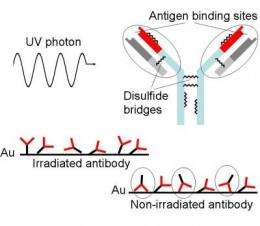
One UV photon is absorbed by the antibody and the disulfide bridge is opened, thereby forming thiol groups. Their interaction with the gold surface leads to an oriented Fab region so that the upside down position (circled in the right side of the picture) is hampered and the antigen binding is more effective. Credit: Biomedical Optics Express
From detecting pathogens in blood samples to the study of protein synthesis, Quartz Crystal Microbalance (QCM) sensors have many uses in modern biology. In this technique, antibodies anchored to gold electrodes on a piece of quartz crystal act like the "hooks" on the sticky side of a Velcro strap, grabbing molecules of interest as they pass by. The more molecule-sensing antibodies on the surface of the sensor, the more sensitive the QCM device's detection capabilities.
Unfortunately, some of the antibodies typically anchor themselves to the gold plate "hook"-side-down, rendering them useless as bio-receptors and dampening the sensor's sensitivity. Now researchers from the University of Naples "Federico II" and the Second University of Naples in Italy have found a way to increase the number of right-side-up antibodies in this well-established molecule detection process using light.
In a paper recently published in the Optical Society's open-access journal Biomedical Optics Express, the team of scientists irradiated antibodies with ultra-short pulses of ultraviolet (UV) light. The UV light is absorbed by the amino acid tryptophan, which breaks the disulfide bridges holding parts of the antibody together and causes a particular part of the amino acid cysteine, called a thiol group, to become exposed at the tail end of the antibody.
Because thiol groups are more strongly attracted to the gold electrodes than other parts of the antibody, the bottom sides of these irradiated antibodies become much more likely to adhere to the gold electrodes than the "hook" ends. Using this method, the researchers were able to more than double the sensitivity of the QCM device, opening up new possibilities for research using this type of sensor, the researchers say.
More information: "Light assisted antibody immobilization for bio-sensing," Biomedical Optics Express, Della Ventura et al., Vol. 2, Issue 11, pp. 3223-3231 (2011).
Provided by
Optical Society of America
-
From lemons to lemonade: Reaction uses carbon dioxide to make carbon-based semiconductor,
32 comments
-
Thioridazine kills cancer stem cells in human while avoiding toxic side-effects of conventional cancer treatments,
3 comments
-
SpaceX private rocket blasts off for space station (Update),
42 comments
-
Climate scientists say they have solved riddle of rising sea,
31 comments
-
SpaceX capsule has 'new car' smell, astronauts say (Update),
4 comments
-
Water flow question
4 hours ago
-
[Drift velocity] Factors affecting velocity
6 hours ago
-
does cold gasoline have less energy
7 hours ago
-
distribution of molecules throughout the atmosphere
9 hours ago
-
The Global Positioning System !
10 hours ago
-
A Question relating Power
11 hours ago
- More from Physics Forums - General Physics
More news stories
Is a classical electrodynamics law incompatible with special relativity?
(Phys.org) -- The laws of classical electromagnetism that were developed in the 19th century are the same laws that scientists use today. They include Maxwell’s four equations along with the Lorentz la ...
Landmark calculation clears the way to answering how matter is formed
(Phys.org) -- An international collaboration of scientists, including Thomas Blum, associate professor of physics, is reporting in landmark detail the decay process of a subatomic particle called a kaon ...
May 25, 2012 |
4.3 / 5 (22) |
51
|
Lying in wait for WIMPs: Researchers seek to dramatically increase sensitivity of Large Underground Xenon detector
Although it's invisible, dark matter accounts for at least 80 percent of the matter in the universe. No one knows what it is, but most scientists would bet on weakly interacting massive particles, or WIMPs.
May 23, 2012 |
4 / 5 (7) |
15
|
Hawaii lab turns laser-powered bubbles into microrobots
(Phys.org) -- A team of scientists from the University of Hawaii are working on microrobots created from bubbles of air in a saline solution. The bubbles take on their title of robots as a laser ...
Sound increases the efficiency of boiling
Scientists at the Georgia Institute of Technology achieved a 17-percent increase in boiling efficiency by using an acoustic field to enhance heat transfer. The acoustic field does this by efficiently removing vapor bubbles ...
May 24, 2012 |
5 / 5 (2) |
2
'Unzipped' carbon nanotubes could help energize fuel cells, batteries
Multi-walled carbon nanotubes riddled with defects and impurities on the outside could replace some of the expensive platinum catalysts used in fuel cells and metal-air batteries, according to scientists at ...
T cells 'hunt' parasites like animal predators seek prey, study shows
By pairing an intimate knowledge of immune-system function with a deep understanding of statistical physics, a cross-disciplinary team at the University of Pennsylvania has arrived at a surprising finding: T cells use a movement ...
Computer model used to pinpoint prime materials for efficient carbon capture
When power plants begin capturing their carbon emissions to reduce greenhouse gases and to most in the electric power industry, it's a question of when, not if it will be an expensive undertaking.
Change in developmental timing was crucial in the evolutionary shift from dinosaurs to birds: study
At first glance, it's hard to see how a common house sparrow and a Tyrannosaurus Rex might have anything in common. After all, one is a bird that weighs less than an ounce, and the other is a dinosaur that ...
Yale study concludes public apathy over climate change unrelated to science literacy
Are members of the public divided about climate change because they don't understand the science behind it? If Americans knew more basic science and were more proficient in technical reasoning, would public consensus match ...
Same gene that stunts infants' growth also makes them grow too big: research
UCLA geneticists have identified the mutation responsible for IMAGe* syndrome, a rare disorder that stunts infants' growth. The twist? The mutation occurs on the same gene that causes Beckwith-Wiedemann syndrome, which makes ...