Unknown species and larval stages of extremely long-legged beetles discovered by DNA test
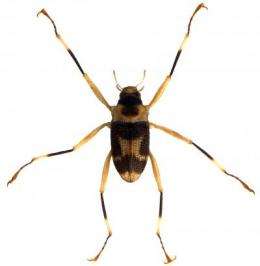
The extremely long legs and cross-like elytral color patterns of Ancyronyx beetles remind of spiders. Credit: H. Freitag (2007)
The unknown larval stages and a new species of the curious Spider Water Beetles were described after their assignment by DNA sequences. These taxonomic works are groundwork for the development of water quality bioindicator systems in the tropics. This study of the AQUA Palawana biodiversity program in the Philippines was published in the journal ZooKeys.
The research program AQUA Palawana has been exploring the unique freshwater biodiversity of the Philippine Island and biosphere reserve of Palawan for more than a decade. Scientists from the Senckenberg Museum of Zoology Dresden and the Bavarian State Collections of Zoology in Munich have now described larvae and a new species of the curious Spider Water Beetles (Ancyronyx) from this biodiversity hotspot. Their study was realized in cooperation with the Palawan Council for Sustainable Development and the De La Salle University Manila.
The scientists conducting this study, Hendrik Freitag and Michael Balke, used mitochondrial DNA, which should be identical in all developmental stages in a species, to assign the previously unknown larval stages to adult imagines. This method was very useful because the outside appearance of immature and mature stages of holometabolous insects look completely different and would not allow an easy assignment to each other.
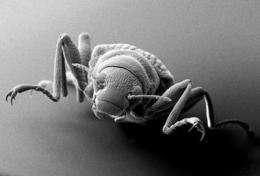
This is a Philippine Spider Water Beetle in frontal view. Credit: H. Freitag (2009)
The studied insects of the genus Ancyronyx have extremely long legs, often accompanied by an eye-catching cross-like elytral colour pattern, so that they remind of spiders. In point of fact they are "Riffle Beetles" (Elmidae) that are able to breathe through a plastron, a microfilm of air around their body surface that is microscopically enlarged by setose structures. This enables them to remain permanently under water. Such beetles are often highly sensitive to water pollution and are therefore greatly valued as bioindicators. The researchers aim at providing basic knowledge and identification tools for tropical species that are potentially useful as freshwater bioindicators.One of newly described Philippine species, Ancyronyx punkti named after the German environmental NGO punkt e.V. was recently chosen by BIOnet International for a campaign highlighting the relevance of taxonomy to society which was presented at the tenth COP meeting of the Convention on Biological Diversity in Nagoya, Japan 2010.

A typical habitat of spider water beetles in undisturbed mountain rivers of Palawan Island. Credit: H. Freitag (2008)
The new discoveries from the Philippines lead to the assumption that the region is the actual diversity centre of the genus. By now, ten of the 18 described species are known solely from the Philippines, of which most are endemic to the country or even to single islands.More information: Freitag H, Balke M (2011) Larvae and a new species of Ancyronyx Erichson, 1847 (Insecta, Coleoptera, Elmidae) from Palawan, Philippines, using DNA sequences for the assignment of the developmental stages. ZooKeys 136: 47-82. doi: 10.3897/zookeys.136.1914
Provided by Pensoft Publishers
-
From lemons to lemonade: Reaction uses carbon dioxide to make carbon-based semiconductor,
32 comments
-
Thioridazine kills cancer stem cells in human while avoiding toxic side-effects of conventional cancer treatments,
3 comments
-
SpaceX private rocket blasts off for space station (Update),
42 comments
-
Climate scientists say they have solved riddle of rising sea,
31 comments
-
SpaceX capsule has 'new car' smell, astronauts say (Update),
4 comments
-
What would stain as translucent on light-coloured fabric?
21 hours ago
-
How do I identify different bacteria on culture plates?
May 26, 2012
-
Why Do Dogs do Strange things...
May 25, 2012
-
What does exophillic and endophillic mean in terms of mosquito and their control?
May 24, 2012
-
Semen stains glows under black lights (uv light)?
May 23, 2012
-
Question on Human Chromosome 2
May 23, 2012
- More from Physics Forums - Biology
More news stories
Manufacturing genes to attack flu virus
An international research team has manufactured a new protein that can combat deadly flu epidemics.
1 hour ago |
not rated yet |
0
|
Scientist: Evolution debate will soon be history
(AP) -- Richard Leakey predicts skepticism over evolution will soon be history. Not that the avowed atheist has any doubts himself.
20 hours ago |
3.4 / 5 (19) |
73
More plant species responding to global warming than previously thought
(Phys.org) -- Far more wild plant species may be responding to global warming than previous large-scale estimates have suggested.
May 22, 2012 |
4.6 / 5 (14) |
18
|
Thousands of shellfish found dead in Peru
Thousands of crustaceans were found dead off the coast of Lima following the mystery mass death of dolphins and pelicans, the Peruvian Navy said Friday.
May 26, 2012 |
4.8 / 5 (5) |
7
For monogamous sparrows, it doesn't pay to stray (but they do it anyway)
It's quite common for a female song sparrow to stray from her breeding partner and mate with the male next door, but a new study shows that sleeping around can be costly.
May 22, 2012 |
5 / 5 (2) |
8
|
'Unzipped' carbon nanotubes could help energize fuel cells, batteries
Multi-walled carbon nanotubes riddled with defects and impurities on the outside could replace some of the expensive platinum catalysts used in fuel cells and metal-air batteries, according to scientists at ...
T cells 'hunt' parasites like animal predators seek prey, study shows
By pairing an intimate knowledge of immune-system function with a deep understanding of statistical physics, a cross-disciplinary team at the University of Pennsylvania has arrived at a surprising finding: T cells use a movement ...
Computer model used to pinpoint prime materials for efficient carbon capture
When power plants begin capturing their carbon emissions to reduce greenhouse gases and to most in the electric power industry, it's a question of when, not if it will be an expensive undertaking.
Change in developmental timing was crucial in the evolutionary shift from dinosaurs to birds: study
At first glance, it's hard to see how a common house sparrow and a Tyrannosaurus Rex might have anything in common. After all, one is a bird that weighs less than an ounce, and the other is a dinosaur that ...
Yale study concludes public apathy over climate change unrelated to science literacy
Are members of the public divided about climate change because they don't understand the science behind it? If Americans knew more basic science and were more proficient in technical reasoning, would public consensus match ...
Same gene that stunts infants' growth also makes them grow too big: research
UCLA geneticists have identified the mutation responsible for IMAGe* syndrome, a rare disorder that stunts infants' growth. The twist? The mutation occurs on the same gene that causes Beckwith-Wiedemann syndrome, which makes ...

